
Minerva
Goddess of wisdom and the crafts — third of the Capitoline Triad, and Rome's patron of every skilled trade from weaving and teaching to medicine.
Minerva, Roman marble statue, 1st-2nd c. AD (Musee du Louvre, Ma 332), CC BY 4.0 · CC BY 4.0 · source
An Etruscan Arrival
Minerva did not come to Rome from Greece. She came from Etruria and the Italic towns to the north, where she was Menrva, and her name is generally connected with the root behind Latin mens, "mind" — the thinking faculty rather than the battlefield 3,7. Faliscan and Etruscan sanctuaries knew her long before Roman literature did, and her sanctuary at Falerii and her role in Etruscan temple groupings show a goddess already established in central Italy 7.
Her equation with the Greek Athena followed, and it was thorough: helmet, aegis, owl, olive, the birth from Jupiter's head, the contest with Arachne 2,4. What survives underneath the Greek costume is the Italic emphasis on skill. In Roman usage Minerva is what you invoke when work has to be done correctly 7,8.
The Capitoline Triad
Her position in the Roman state was fixed by architecture. The great temple on the Capitoline Hill housed three cult chambers: Jupiter Optimus Maximus in the centre, Juno Regina on one side, Minerva on the other 1,7. Livy attributes the building to the Tarquin kings and its dedication to the first year of the Republic, and the same three-cella arrangement appears in Etruscan practice, which is further evidence of where the grouping came from 1,7.
Pliny records that the terracotta cult images for that temple were commissioned from an Etruscan craftsman of Veii, which is a fitting origin for a goddess of skilled making 5. Provincial cities across the empire later built "Capitolia" reproducing the triad in miniature, so Minerva travelled with Roman administration wherever it went 7.
The Quinquatrus
Her festival, the Quinquatrus, ran from 19 to 23 March. Varro is emphatic that the name means "the fifth day after the Ides," in the manner of the neighbouring Italic towns, and that the popular reading of it as a five-day festival was a mistake which nonetheless won — by the late Republic it was five days long 3.
Ovid describes who turned out for it, and the list is a directory of Roman working life: weavers and wool-workers, fullers and dyers, cobblers, carpenters, sculptors, painters, physicians, and above all schoolteachers and their pupils 2. Schools closed for the holiday, and students brought their master the minerval, the fee owed for teaching — a payment named directly after the goddess 2. The first day was bloodless, in keeping with a craft festival; gladiatorial displays filled the later days, and the sequence ended on 23 March with the Tubilustrium, the purification of the trumpets 2,3.
A second, smaller festival, the Quinquatrus minusculae of 13 June, belonged to the guild of flute-players. Ovid tells the story behind it with obvious enjoyment: the tibicines, aggrieved at losing their traditional privileges, went on strike and decamped to Tibur, and Rome — unable to hold a sacrifice without them — had to get them drunk and cart them home 2.
Goddess of the Guilds
That connection with organised trades was institutional, not merely sentimental. Rome's associations of writers and actors had their headquarters in a temple of Minerva on the Aventine, and craft collegia across Italy used her as their patron, meeting on her festival and putting her image on their monuments 1,7.
She also had a healing aspect. Dedications to Minerva Medica and votive deposits at her shrines show her invoked for recovery from illness, which sits comfortably with a goddess of physicians' skill rather than of divine miracle 7. In Roman terms medicine was a craft like any other, and its patron was the patron of crafts 7,8.
War, the Palladium, and the State
Minerva's martial side is real but narrow. She is not a war-goddess in the way Mars is; she is the strategic and defensive intelligence behind arms, and her cult titles in that register run to Victrix and Pacifera 4,7.
The most consequential military object in Rome was nonetheless hers. The Palladium, an ancient wooden image of armed Pallas said to have fallen from the sky at Troy and to have been carried to Italy by Aeneas, was kept out of sight in the temple of Vesta, and Rome's survival was believed to depend on it 2,7. Ovid tells the story of the pontifex maximus Metellus, blinded, according to the tradition, rescuing it from a fire in 241 BCE 2.
Domitian and the Provinces
No emperor took her more seriously than Domitian, who treated Minerva as his personal protector: she dominates his coinage, he built her shrines, he founded a college of her worship, and Suetonius reports that shortly before his assassination he dreamed she had abandoned him 6. Her prominence in the Forum Transitorium, completed just after his death, is a leftover of that programme 7.
Outside Italy she fused with local goddesses in the usual Roman way. At Bath in Britain she was worshipped as Sulis Minerva at a hot spring, where excavation has recovered the temple, the gilded bronze head of her cult statue, and lead tablets on which visitors cursed the people who had stolen their clothes at the baths 7. It is a very ordinary use for a goddess of wisdom, and a good indication of what Roman worshippers actually wanted from her: not philosophy, but competence applied to a problem 7,8.
Continue Exploring
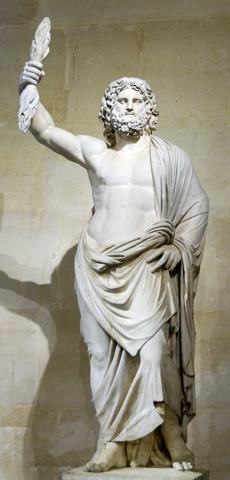
King of the gods and of the Roman state — lord of the bright sky, hurler of the lightning bolt, and the guarantor behind every oath and treaty.
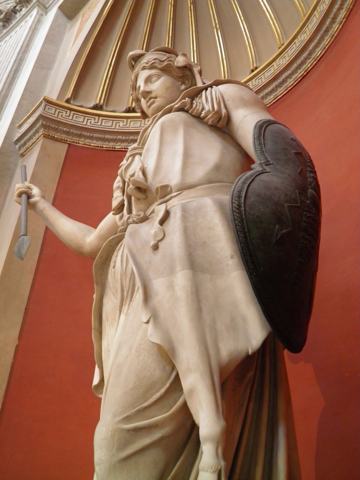
Queen of the gods — Rome's guardian of women, childbirth and the state, whose sacred geese warned the Capitol and whose temple gave us the word money.
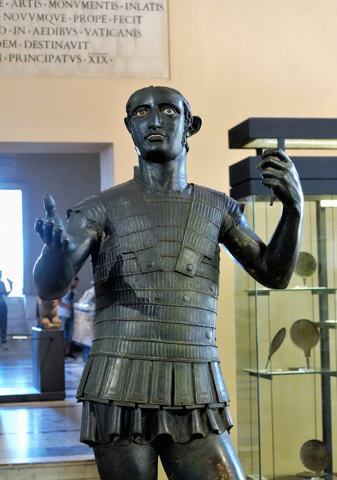
God of war and father of Rome — honoured above almost every other deity, with his own month, his own dancing priests, and the twins he fathered on a Vestal.
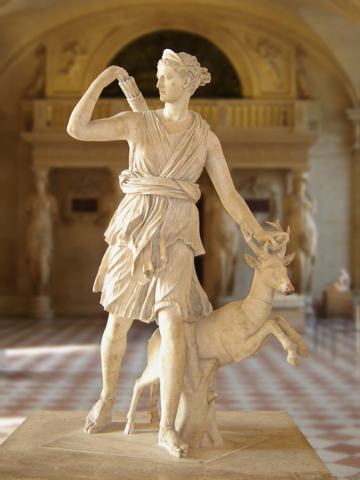
Roman goddess of the hunt, wild places and the moon, whose oldest sanctuary at Lake Nemi was guarded by a priest who held office by killing his predecessor.
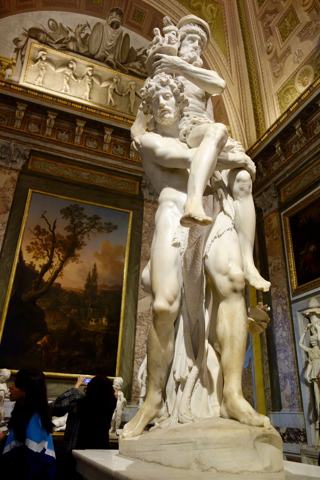
The Trojan prince who escaped burning Troy carrying his father and household gods, wandered the Mediterranean, and became Rome's mythical ancestor.
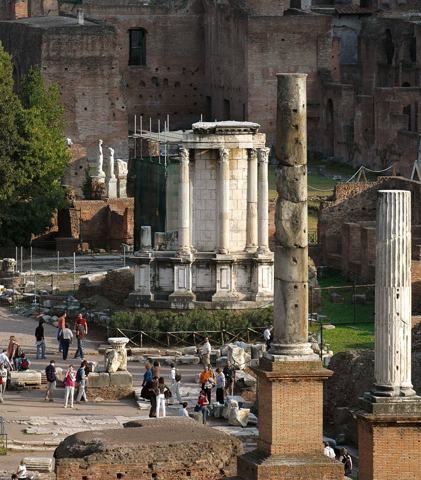
Rome's hearth goddess, worshipped as a living fire rather than a statue, tended in the Forum by six priestesses for over a thousand years.
Also mentioned inApollo in Roman ReligionThe Palladium
Sources & Further Reading
- 1.Livy, Ab Urbe Condita (c. 27 BCE) — esp. Books 1 and 7.
- 2.Ovid, Fasti (c. 8 CE) — esp. Books 3 and 6.
- 3.Varro, De Lingua Latina (1st century BCE), Books 5–6.
- 4.Cicero, De Natura Deorum (45 BCE).
- 5.Pliny the Elder, Natural History (77 CE).
- 6.Suetonius, Lives of the Caesars — Domitian (c. 121 CE).
- 7.Beard, Mary, John North & Simon Price. Religions of Rome, Volume 1: A History. Cambridge University Press, 1998.
- 8.Scheid, John. An Introduction to Roman Religion. Edinburgh University Press, 2003.
Spot an error or have a source to suggest? Write to info@viseterna.com. We cite primary sources and modern scholarship, and we correct fast.