
Vesta and the Vestal Virgins
Rome's hearth goddess, worshipped as a living fire rather than a statue, tended in the Forum by six priestesses for over a thousand years.
Temple of Vesta, Roman Forum, Rome; photograph by Sergey Sosnovskiy, 2006 · CC BY-SA 2.0 · source
The Fire, Not the Statue
Vesta was the goddess of the hearth — the household fire first, and by extension the single communal hearth of the Roman state. What makes her cult unusual is that it had no cult image at its centre. The round aedes Vestae in the Forum held a fire, tended without interruption, and Roman writers were explicit that the flame itself was what worshippers faced 1,2.
Ovid says he had assumed there was a statue there and was corrected: nothing stood in the shrine but the living fire 1. The building was round, which ancient writers linked variously to the shape of the earth or to the primitive round huts of early Latium, and technically it was an aedes rather than a templum — it had not been inaugurated in the augural sense, a distinction Roman priestly law took seriously 6.
Behind the shrine lay the penus Vestae, an inner storeroom whose contents were secret and which only the priestesses and the pontifex maximus could enter. Roman tradition held that the Palladium, the image of Minerva brought from Troy by Aeneas, was among the objects kept there, along with other pignora imperii, tokens on which Rome's survival was thought to depend 2,6. Whether any Roman could have said what was actually inside is another question; secrecy was the point.
Along with Janus, who opened Roman prayer sequences, Vesta commonly closed them — the two of them bracketing the gods between the threshold and the hearth 6.
Numa's Priesthood
Roman tradition credited the priesthood, like most religious institutions, to Numa Pompilius, the second king, though earlier Alban origins were also claimed and the historical origin is unrecoverable 3,4. There were six Vestals in the classical period, and they were the only full-time, salaried, publicly maintained priestesses in the Roman state.
A candidate was taken between the ages of six and ten, free-born, without physical defect, with both parents living. The pontifex maximus selected her and performed the captio — literally "the seizing" — leading her by the hand from her father's house with the words recorded by Aulus Gellius. The ceremony removed her from patria potestas, her father's legal power, without placing her under anyone else's 5,6.
Service ran thirty years, understood in three blocks of ten: learning the rites, performing them, and teaching the next generation. After that a Vestal could leave and marry, though sources suggest few did 2,3,5.
Privilege and Penalty
The legal position of a Vestal has no parallel in Roman life. She could make a will and hold property in her own right at a period when most women could not act without a guardian. She was preceded by a lictor in public, had reserved seating at the games, could give evidence without swearing an oath, and a condemned man who chanced to meet her on his way to execution was spared 2,5,6. Robin Lorsch Wildfang and Ariadne Staples have both argued that this anomalous status is precisely the point: the Vestals sat outside the ordinary Roman categories of daughter, wife and matron, and that categorical strangeness is what made them fit to hold the state's hearth 5,7.
The penalties matched. A Vestal who let the fire go out was scourged by the pontifex maximus, and the flame had to be rekindled by ritual means, by friction of wood rather than from another fire 2,3. The graver offence, incestum — breach of the vow of chastity — carried a punishment designed to avoid shedding a Vestal's blood or burying her in ordinary ground: she was carried in a closed litter to the Campus Sceleratus by the Colline Gate and shut into an underground chamber with a little food and a lamp. Her partner was flogged to death in the Forum 4,5.
Livy records that this happened at moments of political crisis. The best known case followed the disaster at Cannae in 216 BC, when two Vestals were found guilty amid a general panic about broken relations with the gods 4. Modern historians generally read such episodes less as sexual scandals than as public reckonings: when Rome's fortunes collapsed, the state's ritual purity was audited, and the Vestals were where that purity was stored 5,6.
The Vestalia and the Ritual Year
The Vestals' work was daily and unglamorous. They kept the fire, drew water from a sacred spring (never from the aqueducts), swept the shrine and carried out the sweepings on a fixed date, and prepared the mola salsa — salted flour ground from the first ears of far, a hulled wheat, which was sprinkled on every public sacrificial victim in Rome 1,6. That last duty quietly places them inside every state sacrifice performed in the city.
Their festival, the Vestalia, ran from 7 to 15 June. For those days the penus was opened and Roman matrons could enter the shrine barefoot to make offerings; on 9 June the mill-donkeys were garlanded with violets and loaves and given the day off, a detail Ovid preserves with obvious affection 1. The period closed when the temple was cleaned and the refuse removed, after which normal business resumed.
The cult outlasted almost everything else in Roman religion. The emperor Gratian withdrew state funding from the traditional priesthoods in 382, and the fire that had been the Roman hearth for a thousand years went out in the last decade of the fourth century, under Theodosius 6.
Continue Exploring
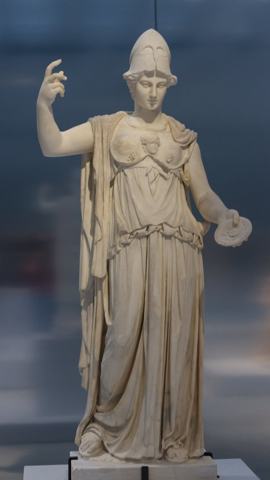
Goddess of wisdom and the crafts — third of the Capitoline Triad, and Rome's patron of every skilled trade from weaving and teaching to medicine.

The two-faced Roman god of doors, beginnings and endings, named first in every prayer, whose gates in the Forum stood open only while Rome was at war.
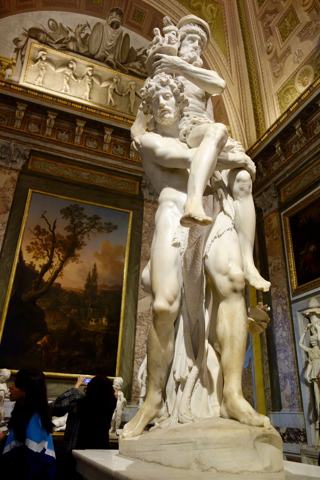
The Trojan prince who escaped burning Troy carrying his father and household gods, wandered the Mediterranean, and became Rome's mythical ancestor.
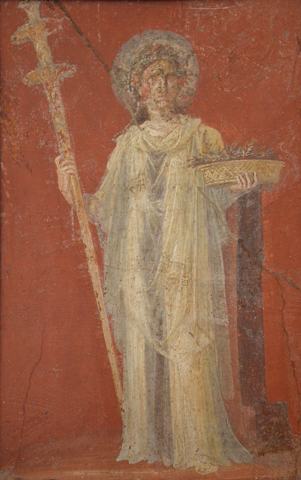
Rome's grain goddess, patron of the plebeian order, whose search for her stolen daughter gave the city its most solemn public festival.
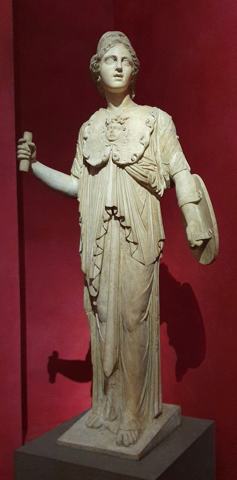
The wooden image of Pallas Athena said to guard Troy, stolen by the Greeks and, by Roman legend, carried to Italy by Aeneas to protect Rome instead.
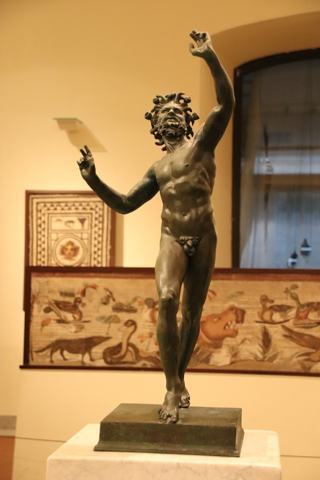
Rome's rustic god of forest and flock, an oracle who spoke through dreams and whose name the Romans linked to the Lupercalia and to Greek Pan and the satyrs.
Also mentioned inLupercalia
Sources & Further Reading
- 1.Ovid, Fasti — Book VI, lines 249-460 (the Vestalia, c. AD 8).
- 2.Dionysius of Halicarnassus, Roman Antiquities — Book II.64-69 (late 1st century BC).
- 3.Plutarch, Life of Numa — chapters 9-11 (c. AD 100).
- 4.Livy, Ab Urbe Condita — Books I.20, IV.44, XXII.57 (the Vestals and their punishment).
- 5.Wildfang, Robin Lorsch. Rome's Vestal Virgins — A Study of Rome's Vestal Priestesses in the Late Republic and Early Empire. Routledge, 2006.
- 6.Beard, Mary, John North and Simon Price. Religions of Rome. 2 vols. Cambridge University Press, 1998.
- 7.Staples, Ariadne. From Good Goddess to Vestal Virgins — Sex and Category in Roman Religion. Routledge, 1998.
Spot an error or have a source to suggest? Write to info@viseterna.com. We cite primary sources and modern scholarship, and we correct fast.