
Apollo in Roman Religion
The one great Greek god Rome adopted without renaming him — plague-healer, oracle-giver, and the personal patron Augustus built into the imperial order.
Apollo Citharoedus (Apollo Musagetes), Roman marble, 2nd century AD (Museo Pio-Clementino, Vatican Museums) · Public domain · source
The God Who Kept His Name
Rome's usual practice with Greek gods was translation. Zeus became Jupiter, Poseidon became Neptune, Athena became Minerva — Italian deities with their own histories were matched to Greek ones and absorbed the Greek mythology wholesale. Apollo is the conspicuous exception. He had no Italian counterpart to be identified with, and the Romans took him over under his own name 7,8.
That makes him unusually easy to trace. Because Apollo arrives as an import rather than an inheritance, his Roman career has dates, decrees and building records attached to it, and it can be watched developing across five centuries of the Republic and Empire. It also means that for most of the Republic he was a specialist rather than a great god: important, but not one of the Capitoline three.
Apollo Medicus and the Plague
Apollo's first foothold at Rome was medical. Livy records that in 433 BC, during an epidemic, a temple was vowed to Apollo for the health of the people, and dedicated two years later by the consul Gnaeus Julius in the Flaminian meadows outside the pomerium, the city's sacred boundary 1. This was Rome's first temple to Apollo, and for nearly four hundred years it was the only one.
The cult title was Apollo Medicus, the healer. The location outside the sacred boundary is standard for gods received from abroad, and the circumstances — plague, consultation, vow — are the standard Roman procedure for importing a deity when the traditional gods appeared not to be answering 1,8. Eric Orlin's work on Republican temple foundation stresses how routinely such vows were made by magistrates and ratified by the Senate: religious innovation at Rome was a political process with paperwork 8.
Oracles, Sibyls and the Second Punic War
The other half of Apollo's Republican identity was prophetic. Rome kept a collection of oracular verses, the Sibylline Books, consulted by a priestly college at the Senate's direction whenever prodigies suggested the gods were displeased. The Books were traditionally connected with the Sibyl of Cumae, Apollo's prophetess on the Bay of Naples, whose cave and frenzy Virgil describes at the opening of Aeneid VI 2,7.
In 212 BC, at the low point of the war with Hannibal, prophetic verses attributed to a seer named Marcius were examined and produced instructions for games in Apollo's honour. The Ludi Apollinares were held that year, repeated, and made a fixed annual festival in 208 during a further epidemic, running from 6 to 13 July 1,7. They are the clearest surviving case of Roman religious institutions being created under wartime pressure and then simply staying.
Through the Republic, then, Apollo at Rome is the god you turn to when things have gone wrong — disease, defeat, unreadable omens. He is not yet the god of the state's self-image.
Augustus and Actium
That changed decisively with Octavian. The future Augustus cultivated a personal association with Apollo well before Actium; Suetonius preserves the gossip, including the story that his mother conceived him in Apollo's temple and a scandal about a costume party at which he appeared as the god 4. Historians read these anecdotes as evidence of a deliberately built public identity, hostile and friendly versions alike 6,7.
The decisive event was the naval battle of Actium in 31 BC, fought off a promontory in western Greece crowned by an ancient temple of Apollo. Octavian's victory over Antony and Cleopatra was presented as Apollo's, and Roman poets took the cue enthusiastically. Virgil puts Apollo drawing his bow above the battle on the shield of Aeneas; Propertius has the god descend and speak to Octavian before the fighting starts 2,5.
Already in 36 BC Octavian had vowed a temple to Apollo on the Palatine, next to his own house; it was dedicated in 28 BC 4,6. The building was famous for its Greek and Latin libraries, its portico of the Danaids, and for housing the Sibylline Books after Augustus had them edited and moved there from the temple of Jupiter on the Capitol 4,7. The transfer is worth pausing on: Rome's oracular archive moved from the state's chief god to the princeps' neighbour.
The Secular Games
The culmination was the Secular Games of 17 BC, a festival marking the turn of an age. Horace was commissioned to write a hymn for a choir of twenty-seven boys and twenty-seven girls, and the Carmen Saeculare they sang is addressed to Apollo and Diana jointly — sun and moon, the divine twins, presiding over a Rome restored 3.
John F. Miller's study of Augustan poetry argues that Apollo's elevation was neither purely imperial propaganda nor purely a poets' invention, but a sustained negotiation between the two: the poets shaped the god they were supposedly celebrating 6. The result was a Roman Apollo who carried lyre and bow, patronised poetry, medicine, prophecy and moral order, and stood for civilised light against eastern excess — a construction whose politics are not subtle.
After Augustus
Apollo remained a major god of the Empire without ever recovering that central position. In the provinces, Roman administrators applied interpretatio Romana and identified him with local healing and light deities — Grannus in Gaul and the Danube lands, Belenus in the Alpine regions, Maponus in Britain — usually at thermal springs 7. In late antiquity his solar aspect fed into the imperial cult of Sol Invictus, though scholars are careful to distinguish the two rather than merge them 7.
The temple on the Palatine burned in AD 363. What has lasted longer is the Augustan idea: that the god of the lyre, the bow and the oracle could also be the god of a regime.
Continue Exploring
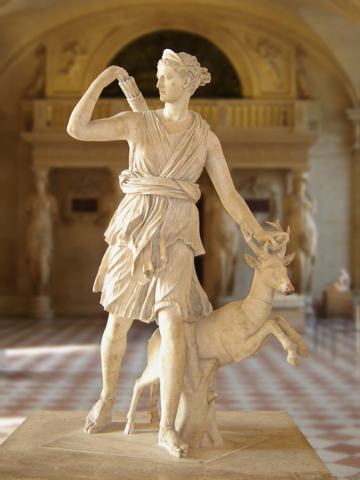
Roman goddess of the hunt, wild places and the moon, whose oldest sanctuary at Lake Nemi was guarded by a priest who held office by killing his predecessor.
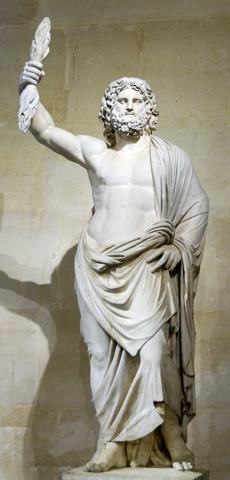
King of the gods and of the Roman state — lord of the bright sky, hurler of the lightning bolt, and the guarantor behind every oath and treaty.
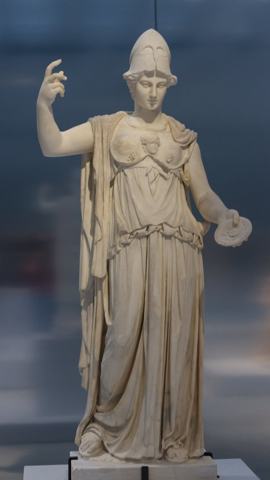
Goddess of wisdom and the crafts — third of the Capitoline Triad, and Rome's patron of every skilled trade from weaving and teaching to medicine.
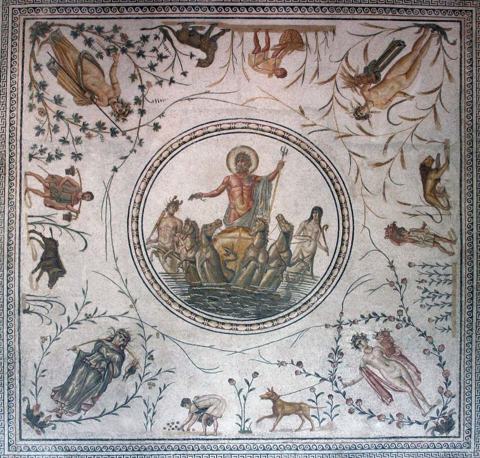
Lord of the sea — though the Romans knew him first as a god of springs and running water, honoured at midsummer when the rivers ran lowest.
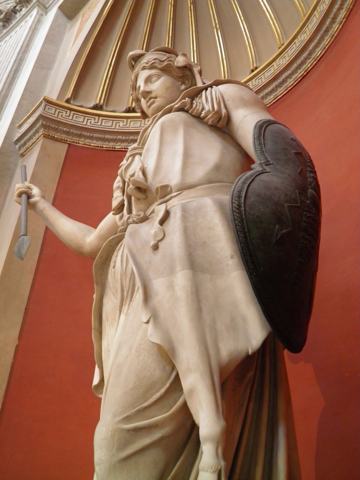
Queen of the gods — Rome's guardian of women, childbirth and the state, whose sacred geese warned the Capitol and whose temple gave us the word money.
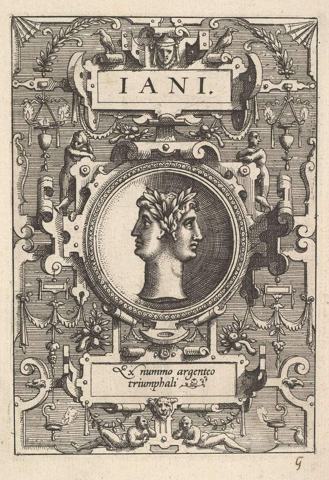
The two-faced Roman god of doors, beginnings and endings, named first in every prayer, whose gates in the Forum stood open only while Rome was at war.
Sources & Further Reading
- 1.Livy, Ab Urbe Condita — Books IV.25 and XXV.12 (the temple of Apollo Medicus and the Ludi Apollinares).
- 2.Virgil, Aeneid — Books VI (the Cumaean Sibyl) and VIII.704-713 (Apollo at Actium), c. 19 BC.
- 3.Horace, Carmen Saeculare (17 BC) and Odes I.31.
- 4.Suetonius, Life of Augustus — chapters 29, 31, 52, 94 (c. AD 121).
- 5.Propertius, Elegies — Book IV.6 (the Palatine temple and Actium).
- 6.Miller, John F. Apollo, Augustus, and the Poets. Cambridge University Press, 2009.
- 7.Beard, Mary, John North and Simon Price. Religions of Rome. 2 vols. Cambridge University Press, 1998.
- 8.Orlin, Eric. Temples, Religion and Politics in the Roman Republic. Brill, 1997.
Spot an error or have a source to suggest? Write to info@viseterna.com. We cite primary sources and modern scholarship, and we correct fast.