
The Palladium
The wooden image of Pallas Athena said to guard Troy, stolen by the Greeks and, by Roman legend, carried to Italy by Aeneas to protect Rome instead.
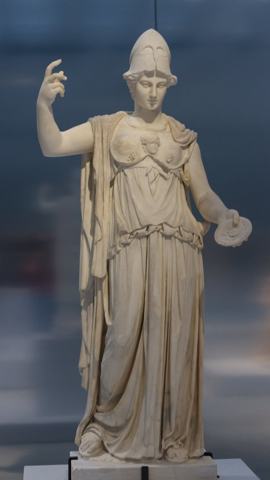
Statue of Minerva ("Palladium"), Roman marble, Uffizi Gallery, Florence; photograph by Yair Haklai · CC BY-SA 4.0 · source
An Image That Guaranteed a City
The Palladium was a small wooden cult image, a xoanon in the Greek term, of Pallas Athena — identified by the Romans with their own Minerva — said in the earliest versions of the story to have fallen from the sky and landed at Troy, where it was housed in a temple and credited with the city's continued safety for as long as it remained inside the walls 5,6. The Greeks themselves disagreed about exactly how it came to be there: one strand of myth makes it a gift, or an accident, from Zeus, another ties its fall to the death of the mortal Pallas after whom Pallas Athena was supposedly named, and Timothy Gantz's survey of the sources treats the inconsistency as typical of how far back, and how loosely, the story was already fixed by the time any surviving text tells it in full 6.
Stolen From Troy
The best-known version of the myth holds that Troy could not fall while the Palladium remained inside its walls, so the Greek heroes Odysseus and Diomedes slipped into the city by night, killed its guards, and carried the image out before the final assault — a story summarized concisely in the mythographic handbook attributed to Apollodorus and alluded to across Greek and Roman literature without ever being told in full by any single surviving epic 5. Virgil uses the theft as background rather than main plot: in the Aeneid, the treacherous Greek Sinon cites the stolen Palladium, and the anger it caused in Athena, as part of the false story he tells the Trojans to explain the wooden horse 1.
A Second, Contradictory Story
Roman tradition then adds a claim that sits awkwardly against the Greek one: that Aeneas rescued the true Palladium from burning Troy and carried it to Italy, where it eventually reached Rome 3. Ancient writers were aware of the contradiction — if Diomedes and Odysseus had already taken the Palladium to the Greek camp, Aeneas could not also have saved the original from the flames — and offered various patches for it: that the Greeks had stolen a copy while the true image stayed hidden in Troy, or that several Palladia were in circulation by the historical period, one claimed by Argos, one by Athens, one by Rome 3,6. Dionysius of Halicarnassus, writing to give a Roman audience a suitably ancient Trojan pedigree, presents the Roman version as settled fact while still acknowledging that Greek writers told the story differently 3.
Guarded in Vesta's Shrine
By the historical period, Roman tradition placed the Palladium inside the penus Vestae, the sealed inner storeroom of the Vesta temple in the Forum, among a small group of sacred objects the Romans called the pignora imperii — pledges of the kind that stood alongside less tangible guarantees, like the augury taken before nearly every act of state, on which the city's survival was thought to depend 3,7. Only the Vestals and the pontifex maximus could enter that space, and no outside account claims to describe the object directly; what Romans "knew" about the Palladium's appearance and precise location was transmitted secondhand, through the authority of the priesthood, rather than through anyone's actual sight of it 7,8.
Rescued From the Flames
That secrecy was interrupted at least once, memorably. In 241 BC a fire damaged the temple of Vesta, and Roman tradition credits Lucius Caecilius Metellus, then pontifex maximus, with going into the burning storeroom to save its contents, including the Palladium, and being blinded for having looked on an object no man was supposed to see 2,4. Ovid gives a compressed version of the story in the Fasti as part of his account of the cult of Vesta, treating Metellus's blindness as the price of an act that was simultaneously heroic and transgressive 2.
An Object Rome Could Never Produce
The Palladium's real historical value was rhetorical rather than material: it let Rome claim direct, physical continuity with Troy, the most prestigious ruin in the ancient Mediterranean imagination, at exactly the moment the city was building an origin story to match its growing power 6,7. That the object could never actually be produced or examined only reinforced its authority — an artifact permanently withheld from scrutiny is much harder to disprove than one on public display, and Roman writers seem to have treated this as a feature of the cult rather than an embarrassment 7,8. The word outlived the belief: "palladium," in English and other European languages, still means a safeguard or protection, a sense directly descended from the Roman conviction that the city's fate hung on an object nobody had ever actually seen 6.
Continue Exploring
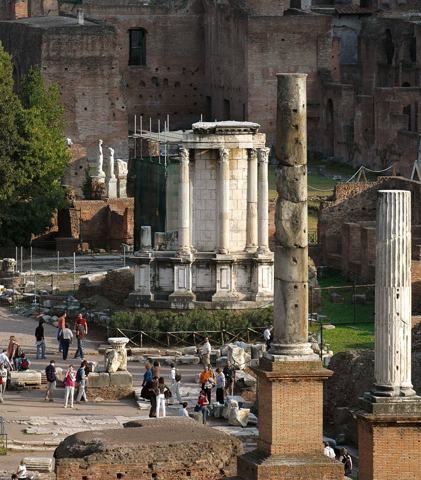
Rome's hearth goddess, worshipped as a living fire rather than a statue, tended in the Forum by six priestesses for over a thousand years.
Goddess of wisdom and the crafts — third of the Capitoline Triad, and Rome's patron of every skilled trade from weaving and teaching to medicine.
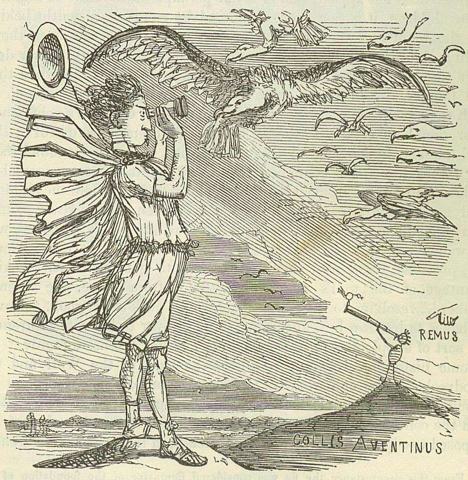
How Roman magistrates read the will of the gods from bird-flight and lightning before every public act — the state's oldest form of applied religion.
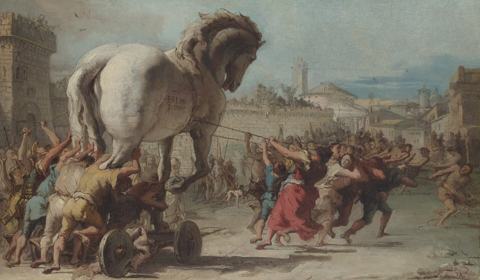
The hollow wooden horse that let the Greeks inside Troy's walls — absent from the Iliad, first told in the lost Epic Cycle, and made famous by Virgil.
Ovid's 15-book Latin epic of transformation myths — the single work that shaped how the post-classical West came to know Greek and Roman mythology.
The pelt of a winged golden ram, hung in a grove sacred to Ares and guarded by a sleepless dragon, that Jason sailed to the edge of the world to steal.
Sources & Further Reading
- 1.Virgil, Aeneid — Book II, lines 162-170 (c. 19 BC).
- 2.Ovid, Fasti — Book VI, lines 419-454 (c. AD 8).
- 3.Dionysius of Halicarnassus, Roman Antiquities — Book I.68-69, II.66 (late 1st century BC).
- 4.Pliny the Elder, Natural History — Book VII.45 (c. AD 77).
- 5.Apollodorus, Bibliotheca — Epitome 5.13.
- 6.Gantz, Timothy. Early Greek Myth — A Guide to Literary and Artistic Sources. Johns Hopkins University Press, 1993.
- 7.Beard, Mary, John North and Simon Price. Religions of Rome. 2 vols. Cambridge University Press, 1998.
- 8.Wildfang, Robin Lorsch. Rome's Vestal Virgins — A Study of Rome's Vestal Priestesses in the Late Republic and Early Empire. Routledge, 2006.
Spot an error or have a source to suggest? Write to info@viseterna.com. We cite primary sources and modern scholarship, and we correct fast.