
Leshy (Slavic Forest Spirit)
The Slavic forest lord who leads travellers in circles, owns the wolves and the game, and can stand taller than the pines or shorter than the grass.
Girl and Leshy, panel after a design by Maria Yakunchikova, 1899 · Public domain · source
The Owner of the Woods
The leshy (Russian леший, from les, "forest") is the presiding spirit of the woodland in East Slavic belief, with counterparts across the Slavic world — the Polish leszy or borowy, the Czech lesní muž, the Belarusian lyasun, the Ukrainian lisovyk. Regional names run to dozens: lesovik, borovik, lesnoi khoziain ("forest master"), and euphemisms used precisely because saying the real name was thought to summon him 1,2,7.
He is not a god and was never worshipped in any organised sense. He is an owner. The forest, its trees, its mushrooms and berries, and above all its animals are his property, and every interaction recorded by nineteenth-century ethnographers turns on that relationship: permission, trespass, theft, and payment 1,2,5.
Appearance and Shape
Descriptions are contradictory in a way that is itself a characteristic. The leshy is most often a tall old man, pale-faced with green or glowing eyes, wearing his coat or bast shoes on the wrong side, with the left flap crossed over the right — the reversal marking him as belonging to the other order of things. Some accounts give him no shadow, no eyebrows or eyelashes, blue blood, or a beard of living moss and vines 1,2,4.
His defining trait is variable size. He can stand higher than the tallest pine while walking in the deep forest and shrink below the grass at the woodland edge, matching himself to the height of whatever grows around him. He also changes shape freely — into a wolf, bear, owl, whirlwind, a familiar neighbour, or a tree that was not there a moment ago 1,2,5. Where several leshiye share a large forest, folklore assigns them boundaries and has them fight over them, which is one traditional explanation for storm-flattened swathes of woodland 1,2.
Getting Lost
The leshy's signature act is not violence but disorientation. A traveller who offends him, or simply crosses his path at the wrong moment, walks in circles for hours on ground he knows perfectly well, hearing laughter, whistling, clapping, weeping, or a voice calling his name from the wrong direction. Some accounts have him leading people to a swamp or over a cliff; most have him releasing them at dawn, exhausted and frightened 1,2,5.
The counter-measures collected from Russian villages are remarkably practical and remarkably consistent. Turn every piece of clothing inside out; swap left and right shoes; walk backwards out of the wood; sit down and say a prayer, or alternatively a suitably crude oath, since the leshy was thought to respond to both. In several districts the lost traveller was advised to declare his own name aloud, breaking the spirit's hold 1,2,6. The underlying logic is symmetry: the leshy inverts the world, so the traveller inverts himself back.
Herds, Hunters, and Bargains
The leshy drives the game. Migrations of squirrels, hares, wolves and mice were routinely explained as one forest master transferring his herds to another, sometimes as payment for a lost card game 1,2,3. Hunters and herdsmen therefore treated him as a party to a contract rather than a monster. Offerings recorded include the first shot of the season, an egg, bread and salt left on a stump, tobacco, or a cow's head; a shepherd driving cattle to summer pasture in the northern forests might strike an explicit agreement with the leshy for the safety of the herd, sealed with a promise not to pick berries or break branches for the season 1,2,5.
Breaking that etiquette had consequences — cattle vanishing, a hunter's aim failing, a woodcutter's axe turning. Conversely, the leshy is often benign and even generous: he guides lost children home, fills a respectful gatherer's basket, and in some tales rewards a passing kindness with a purse that never empties 1,2,5. Elizabeth Warner and Linda Ivanits both stress that the East Slavic nature spirits are best read as amoral rather than evil — dangerous in the way weather and wild ground are dangerous, and negotiable in the way a landlord is negotiable 1,5.
Calendar and Christianisation
The leshy has a season. He is abroad from spring until roughly the feast of the Exaltation of the Cross in late September, after which, in widespread Russian belief, he crashes through the forest in a final destructive rage, then falls through the earth and sleeps until the thaw. Woodsmen avoided the forest on that day entirely 1,2,6.
Under Christianity he was reclassified rather than removed. Village explanations make him one of the angels cast out of heaven who fell into the woods, or a soul that died unbaptised — the same category, the "unclean dead", that produces the rusalka 1,6. He fears the cross, the church bell and holy water, yet the same peasants who crossed themselves against him still left him bread on a stump. Some folk traditions also give him a family — a wife, the lesovikha, and children — while others insist he is always alone 1,2,4.
Attempts to make him a demoted pagan god are speculative. Alexander Afanasyev, working in the Romantic comparative tradition, tried to link the forest spirits to a solar-and-storm mythology; later scholarship treats that framework as largely superseded, and reads the leshy instead as a spirit of place, formed where a settled agricultural society meets an enormous forest it depends on and cannot control 3,4,6.
Kin and Afterlife
Within the Slavic system he sits alongside the other territorial masters: the domovoi in the house, the bannik in the bathhouse, the vodyanoy in the water, the polevik in the field. Baba Yaga, whose hut stands deep in the same woods, occupies a related but distinct role as a threshold guardian of the other world 1,5,7.
He has proved unusually durable in modern culture. Symbolist painters including Léon Bakst and Maria Yakunchikova took him up around 1900, and today the leshy is a fixture of Slavic folk horror, fantasy fiction and video games — usually rendered as an antlered giant of bark and moss, which is a modern visual invention layered on a genuinely old idea: that the forest is not empty, and it notices you 1,5,7.
Continue Exploring
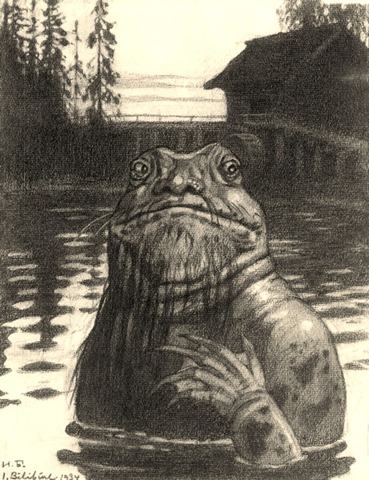
The bearded, shapeshifting master of Slavic rivers and millponds, placated by millers and fishermen and blamed for every drowning in his water.
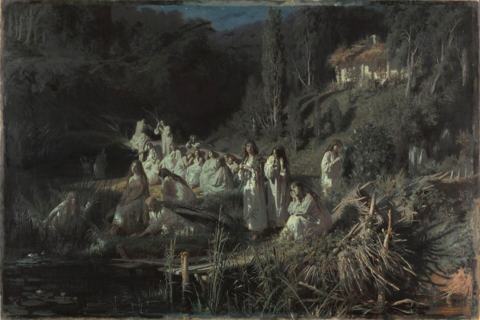
Slavic water spirit of the restless dead: a drowned or unbaptised girl who leaves the river for one week each summer to walk the fields and the woods.
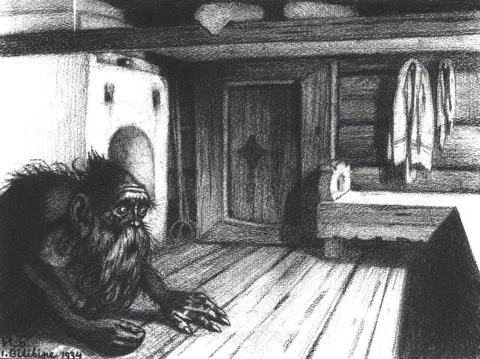
The Slavic house spirit who lives behind the stove, guards the family and its livestock, and turns hostile if the household forgets to feed him.
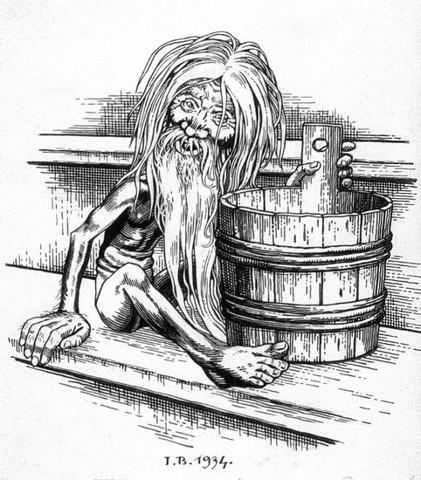
The irritable spirit who owns the Russian bathhouse after dark — a fortune-teller at Yuletide, a danger to anyone who bathes in his hour uninvited.
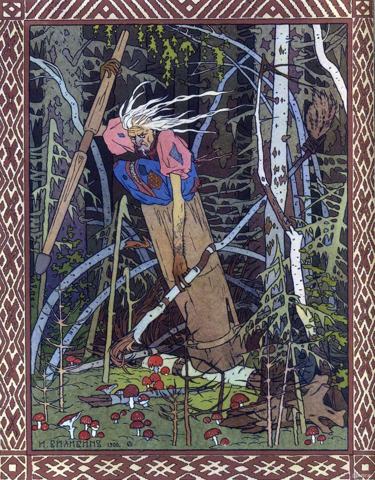
The witch of the wood — the iron-toothed old woman in a hut on chicken legs, who eats some visitors and hands the others exactly what they need.
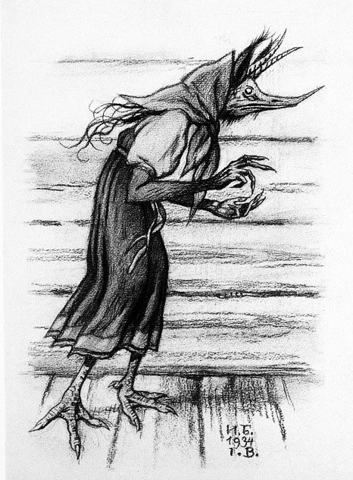
The domovoi's uneasy female counterpart in Russian folk belief — blamed for tangled yarn, bad omens, and trouble in the house or the swamp beyond it.
Also mentioned inLikho (One-Eyed Misfortune)Poludnitsa (Lady Midday)Vila (Slavic Fairy)
Sources & Further Reading
- 1.Ivanits, Linda J. Russian Folk Belief. M.E. Sharpe, 1989.
- 2.Maksimov, S.V. Nechistaia, nevedomaia i krestnaia sila (Unclean, Unknown and Holy Powers). St Petersburg, 1903.
- 3.Afanasyev, Alexander. Poeticheskie vozzreniia slavian na prirodu (The Poetic Views of the Slavs on Nature), 3 vols. Moscow, 1865-1869.
- 4.Machal, Jan. Slavic Mythology, in The Mythology of All Races, vol. III. Marshall Jones, 1918.
- 5.Warner, Elizabeth. Russian Myths. British Museum Press, 2002.
- 6.Zelenin, Dmitrij. Russische (Ostslavische) Volkskunde. Walter de Gruyter, 1927.
- 7.Dixon-Kennedy, Mike. Encyclopedia of Russian and Slavic Myth and Legend. ABC-CLIO, 1998.
Spot an error or have a source to suggest? Write to info@viseterna.com. We cite primary sources and modern scholarship, and we correct fast.