
Domovoi (Slavic House Spirit)
The Slavic house spirit who lives behind the stove, guards the family and its livestock, and turns hostile if the household forgets to feed him.
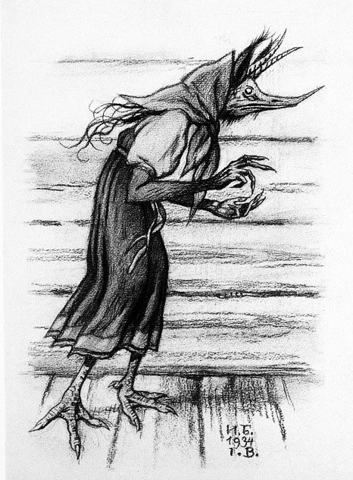
Domovoi, Ivan Bilibin, 1934 · Public domain · source
The Spirit Behind the Stove
The domovoi (Russian домовой, from dom, "house") is the household spirit of East Slavic folk belief, with close relatives across the Slavic world: the Polish domownik, Czech hospodáříček, Ukrainian domovyk, and the Serbian and Croatian house snake. He is by far the best documented supernatural being in the Russian peasant record, because unlike the forest and water spirits he was not a story told about elsewhere — he was believed to be in the room 1,4,7.
His home is the stove: behind it, under it, or on the ledge above it, the warmest and most sacred point of the cottage. Some regions place him instead under the threshold, in the cellar, or in the yard, and the yard-dwelling variant is sometimes given its own name, dvorovoi 1,6. Peasants avoided saying his name aloud, preferring respectful circumlocutions — khoziain ("master"), ded ("grandfather"), dobrokhot ("well-wisher"), or simply sam, "himself" 1,3.
What He Looks Like
Descriptions collected in the nineteenth century are consistent in outline and vague in detail, which is what one expects of a being usually met in the dark. He is small, old, and covered in hair — sometimes entirely, palms included — with a long grey beard and glowing eyes. Often he simply appears as the current or a former head of the household, which fits the widespread idea that the domovoi is an ancestor: the founding father of the family line, still keeping an eye on the property 1,2,4.
He may also take the form of a cat, dog, snake or rat, and in some districts his presence is inferred rather than seen, from the sound of footsteps, weeping, or a warm furry hand laid on a sleeper. That last belief supplies a folk method of divination: if the hand is warm and soft the coming year is good, if cold and rough, hard times are approaching 1,2,5.
Duties and Offerings
The domovoi's business is the prosperity of the household. He guards the family from harm, keeps the property intact, and above all tends the livestock — brushing and plaiting the manes of horses he likes and tormenting the ones he does not. A horse the domovoi disapproves of will be found sweating and exhausted in the morning, its mane tangled beyond combing, and the usual remedy was to sell that animal and buy one of a colour he preferred 1,2,3.
In exchange he expected acknowledgement. Households left him bread and salt, a bowl of porridge or milk behind the stove, the first of a new dish, or a share of the holiday meal, especially at the turning points of the year 1,4,5. Neglect made him a poltergeist: banging in the night, upsetting crockery, pinching sleepers, stripping the covers off the bed, and pressing on the chest of a sleeper in the classic nightmare pattern. Serious offence — building on a bad site, swearing near the stove, whistling indoors — could push him to abandon the house entirely, which was understood as a sentence of ruin 1,2,6.
Moving House
Because the domovoi belonged to the family rather than the building, moving was a ritual problem. Ethnographers recorded a standard sequence: the household formally invited him to come along, often addressing him as grandfather, and carried him to the new place in a physical vessel — most commonly embers or ash from the old stove, sometimes a shoe, a broom, or a loaf of bread carried on a cloth. The fire from the old hearth was kindled into the new one, and the first bread baked there was his 1,2,5,6.
A related belief holds that a house with no domovoi is not really a house. In some districts a new dwelling had to be "warmed" by a ritual first night, and folklore across the East Slavic area preserves darker traditions in which the first living thing to enter a new house — usually a chicken or a cat — becomes the price paid for the spirit's presence 1,6.
Omens, Quarrels, and the Wider Household
The domovoi was consulted as much as he was feared. His weeping foretold a death in the family; laughter or the sound of a hand-loom meant good fortune; sudden noise in the yard warned of fire or theft 1,2,3. When two families shared a farmstead, quarrels between their domovye were blamed for broken tools and sick animals, and when a household prospered unusually, neighbours might mutter that its spirit had been stealing from theirs 1,2.
Christianity did not so much displace him as file him. In the peasant synthesis often called dvoeverie — "double faith" — the domovoi is sometimes explained as a fallen angel who landed on a roof rather than in hell, and icons hung in the "beautiful corner" of the hut coexisted quite comfortably with the porridge bowl behind the stove 1,4,5. Scholars generally read him not as a demoted god but as the domestic end of the Slavic cult of ancestors, the same complex that produced ritual meals for the dead and the belief that the family line and the family land are a single continuous thing 1,4,6.
Domovoi and His Neighbours
Slavic folk belief distributes spirits by territory, and the domovoi holds the smallest and safest of them. Beyond the fence begins the yard-spirit's ground, then the bathhouse, the barn, the field, and finally the forest of the leshy and the water of the rusalka, both of which are dangerous in ways the domovoi is not 1,5,7. That geography is the point: the house spirit is the one supernatural power in the system who is on your side by default, and the folklore is largely a manual for keeping him that way.
He remains alive in the culture. Ivan Bilibin drew him in the 1930s, Russian and Ukrainian children's books keep him in print, and the small bearded figure behind the stove is now a stock character in Slavic-flavoured fantasy — usually, and not unreasonably, played as the grumpiest well-meaning creature in the story 1,5,7.
Continue Exploring
The Slavic forest lord who leads travellers in circles, owns the wolves and the game, and can stand taller than the pines or shorter than the grass.
Slavic water spirit of the restless dead: a drowned or unbaptised girl who leaves the river for one week each summer to walk the fields and the woods.
The bearded, shapeshifting master of Slavic rivers and millponds, placated by millers and fishermen and blamed for every drowning in his water.
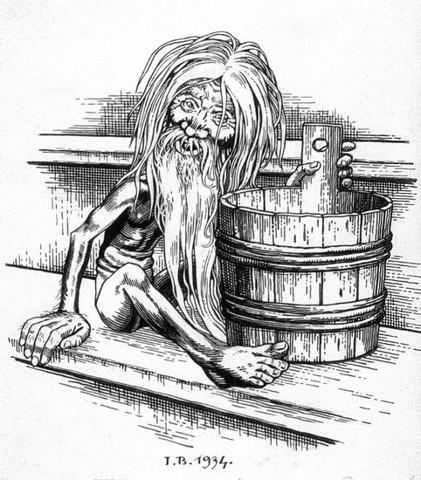
The irritable spirit who owns the Russian bathhouse after dark — a fortune-teller at Yuletide, a danger to anyone who bathes in his hour uninvited.
The domovoi's uneasy female counterpart in Russian folk belief — blamed for tangled yarn, bad omens, and trouble in the house or the swamp beyond it.
A white-clad woman who appears in Slavic fields at noon to strike down harvesters with sunstroke, madness, or sudden death for working through her hour.
Sources & Further Reading
- 1.Ivanits, Linda J. Russian Folk Belief. M.E. Sharpe, 1989.
- 2.Maksimov, S.V. Nechistaia, nevedomaia i krestnaia sila (Unclean, Unknown and Holy Powers). St Petersburg, 1903.
- 3.Ralston, W.R.S. The Songs of the Russian People, as Illustrative of Slavonic Mythology and Russian Social Life. Ellis & Green, 1872.
- 4.Machal, Jan. Slavic Mythology, in The Mythology of All Races, vol. III. Marshall Jones, 1918.
- 5.Warner, Elizabeth. Russian Myths. British Museum Press, 2002.
- 6.Zelenin, Dmitrij. Russische (Ostslavische) Volkskunde. Walter de Gruyter, 1927.
- 7.Dixon-Kennedy, Mike. Encyclopedia of Russian and Slavic Myth and Legend. ABC-CLIO, 1998.
Spot an error or have a source to suggest? Write to info@viseterna.com. We cite primary sources and modern scholarship, and we correct fast.