
Baba Yaga
The witch of the wood — the iron-toothed old woman in a hut on chicken legs, who eats some visitors and hands the others exactly what they need.
Baba Yaga, Ivan Bilibin, illustration for Vasilisa the Beautiful, 1900 · Public domain · source
Who She Is
Baba Yaga is the great ambiguous figure of the East Slavic wondertale, known across Russian, Ukrainian, and Belarusian tradition 4. Baba is an old woman or grandmother, often with a rude edge; Yaga has no agreed derivation, with proposals ranging across Slavic roots for horror, sickness, and snake, none of them settled 4.
She is an old woman with an iron nose or iron teeth, a bony leg, and a body so large it fills her hut, with her nose pressed against the ceiling 1,4. She lives deep in the forest, keeps company with geese, ravens, and cats, and is surrounded by the bones of people she has eaten 1. She is also, in a large proportion of the recorded tales, the person who gives the hero what the story needs — food, a horse, a magic object, or the piece of information without which the plot cannot continue 4.
The earliest known printed mention of the name is not in a folktale at all. Giles Fletcher, an English envoy, mentions "Yaga-Baba" in his 1591 account of Russia while describing the peoples of the far northeast, in a passage that has been read as pointing to Finno-Ugric contact 2,4.
The Hut on Chicken Legs
Her house is the most recognisable object in Slavic folklore: a small hut standing on chicken legs, which turns as it pleases, its door facing away from the visitor and towards the forest 1,4. It is often fenced with human bones and skulls whose eye sockets light up at night 1.
Getting in requires a formula, not a key. The hero says: "Hut, hut, turn your back to the forest and your front to me," and the hut obeys 1,4. What that formula implies has been picked over for a century, because the door being turned away from the human world is a spatial statement — the visitor is arriving from the wrong side 3,4.
Mortar, Pestle, and Broom
Baba Yaga does not ride a broomstick. She travels in a mortar, driving it with the pestle and sweeping away her tracks behind her with a broom, and her passage is announced by the noise of trees cracking and the wind rising 1,4. The mortar is a grain-grinding vessel, an object of women's daily labour turned into a vehicle, and the image is unlike anything in Western European witch iconography 4.
She has a set of stock behaviours as fixed as the hut's formula. She smells a visitor before seeing them and announces that she smells the Russian scent; she feeds them, gives them a bath in the bathhouse, and lets them sleep before asking any questions; and only then does she ask their business, or set them a task with death as the forfeit 1,4.
Devourer, Donor, or Both
Johns's study is the standard scholarly treatment, and its central argument is in the subtitle: Baba Yaga's defining quality is her ambiguity 4. She is not a villain who is sometimes helpful or a helper who is sometimes cruel; the tradition sustains both roles simultaneously and shows no interest in reconciling them 4.
Vasilisa the Beautiful is the clearest case. Vasilisa, sent by her stepmother to fetch fire, arrives at the hut, is set impossible sorting tasks, and completes them with the help of a doll her dying mother gave her 1. Baba Yaga questions her, is unsettled by the answer that her mother's blessing helps her, and drives her out — but gives her the fire she came for, in a skull on a stick, and that fire burns the stepmother and stepsisters to ash 1. She is the source of both the ordeal and the reward, and she is never thanked 1,4.
Johns catalogues the range across hundreds of variants: she is cannibal, mother of daughters, mistress of animals, keeper of the water of life, aunt or grandmother of the hero, and occasionally a straightforward antagonist to be killed 4.
Propp and the Initiation Reading
Vladimir Propp, in Historical Roots of the Wondertale, read the whole complex as a memory of initiation ritual 3. The forest is the place of seclusion, the hut is the initiation lodge, Baba Yaga is the guardian of the boundary between the living and the dead, and the hero's feeding and washing are the rites that transform a living visitor into someone who may pass through 3. Her bony leg becomes the leg of a corpse, and the whole encounter becomes a controlled visit to the land of the dead 3.
It is an influential and elegant reading, and it is a hypothesis about origins built on comparative ethnography rather than on evidence from the storytellers themselves 3,4. Johns treats it as one interpretive tradition among several, alongside psychoanalytic readings and readings grounded in the social realities of Russian peasant women's lives — where an old woman living alone outside the village, with knowledge of herbs and childbirth, was a real and ambivalent presence 4,5.
Not a Demoted Goddess
A persistent claim holds that Baba Yaga is a pre-Christian Slavic goddess — of death, of the earth, of winter — reduced to a witch by Christianisation. There is no evidence for it 4,6. She appears in no medieval source, no chronicle list, no anti-pagan sermon, and no oath formula; her documentary life begins in the early modern period and her rich attestation is in nineteenth-century folktale collections 2,4.
That does not make her shallow. Kalik and Uchitel's broader point about invented Slavic pantheons is worth applying here in both directions: refusing to promote her to a goddess is not the same as dismissing her 6. She is one of the most fully developed supernatural characters in European oral tradition, recorded in hundreds of variants from named tellers, and she does not need an imaginary pedigree 4.
In Print and Beyond
Afanasyev's collections of the 1850s and 1860s put her into print for a national readership, and from there she moved into art, music, and eventually film — Viktor Vasnetsov's paintings, Mussorgsky's Pictures at an Exhibition with its "Hut on Fowl's Legs," Ivan Bilibin's illustrations, and a long line of Soviet and post-Soviet screen versions 1,4. Modern fantasy has adopted her wholesale, usually keeping the hut and losing the ambiguity 4.
The tellers themselves were less tidy. In the recorded corpus she eats children and she also lends horses, and the same narrator can do both within an evening 4.
Continue Exploring
The Slavic forest lord who leads travellers in circles, owns the wolves and the game, and can stand taller than the pines or shorter than the grass.
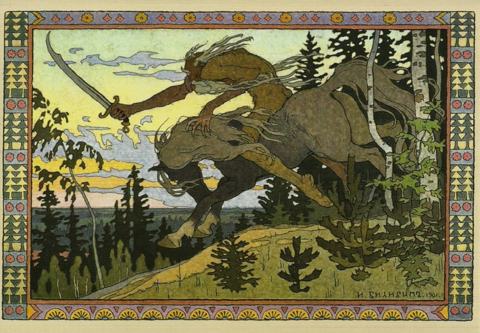
The undying sorcerer of Russian folktale who hid his death in a needle, inside an egg, inside a duck, inside a hare, inside a chest, beneath an oak.
Slavic water spirit of the restless dead: a drowned or unbaptised girl who leaves the river for one week each summer to walk the fields and the woods.
The many-headed dragon — the fire-breathing serpent of Russian epic song, met at a river crossing, and beaten only by a hero who refuses to stop swinging.
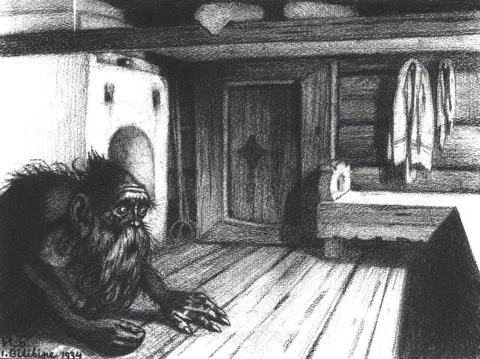
The Slavic house spirit who lives behind the stove, guards the family and its livestock, and turns hostile if the household forgets to feed him.
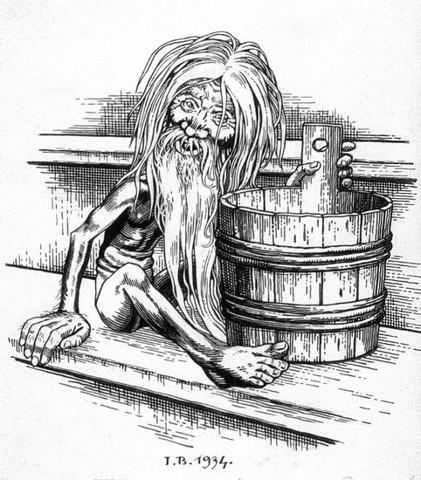
The irritable spirit who owns the Russian bathhouse after dark — a fortune-teller at Yuletide, a danger to anyone who bathes in his hour uninvited.
Sources & Further Reading
- 1.Afanasyev, Alexander. Narodnye russkie skazki (Russian Folk Tales), 1855–1863 — including 'Vasilisa the Beautiful', 'Baba Yaga', and 'The Maiden Tsar'.
- 2.Giles Fletcher the Elder, Of the Russe Common Wealth (London, 1591).
- 3.Propp, Vladimir. Istoricheskie korni volshebnoi skazki (Historical Roots of the Wondertale). Leningrad, 1946.
- 4.Johns, Andreas. Baba Yaga: The Ambiguous Mother and Witch of the Russian Folktale. International Folkloristics vol. 3. Peter Lang, 2004.
- 5.Ivanits, Linda J. Russian Folk Belief. M.E. Sharpe, 1989.
- 6.Kalik, Judith & Alexander Uchitel. Slavic Gods and Heroes. Routledge, 2019.
Spot an error or have a source to suggest? Write to info@viseterna.com. We cite primary sources and modern scholarship, and we correct fast.