
Bannik (Bathhouse Spirit)
The irritable spirit who owns the Russian bathhouse after dark — a fortune-teller at Yuletide, a danger to anyone who bathes in his hour uninvited.
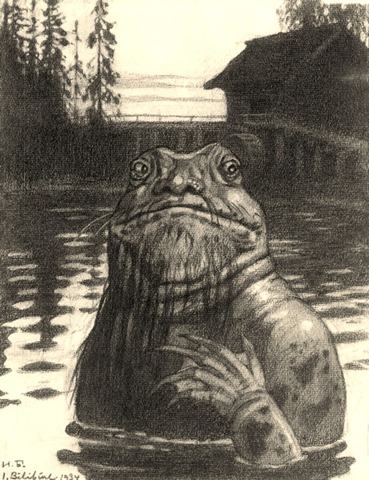
Bannik, Ivan Bilibin, 1934 · Public domain · source
Master of an Unclean Room
The Russian bathhouse, the banya, stood apart from the rest of the farmstead both physically and spiritually. Peasants built it away from the house, heated it with a stove that had no chimney, and treated it as the one building on the property where icons were not hung and the sign of the cross was not made — a deliberately "unclean" space set aside from the Christian order of the home 1,3. Its resident spirit, the bannik, inherited that ambiguous status: not evil exactly, but never trusted the way the domovoi could be, and never invited to feel at home in the rest of the house 1,4.
Appearance and Temper
Collected descriptions give the bannik a small, wiry, unclothed body, a long tangled beard, and skin sometimes said to be blotched or scabbed like an old bath-broom's worn birch leaves 1,3. He was credited with the power to change shape — into a family member, a black cat, or even a lump of coal on the stove — and with the strength, when roused, to scald with the bathhouse's own stones and steam, to hold a door shut, or to suffocate a bather in fumes 2,3,5. Maksimov's collected material treats him as one of the more genuinely feared members of the household pantheon precisely because the bathhouse gave him so many ordinary-looking weapons: heat, steam, water, and a door that locked from the inside 2.
The Shifts of the Bath
A family's bath night ran in an understood order — the men first, then the women, then, in some districts, guests or the elderly — with a final, unclaimed round left open 1,3. That last shift belonged to the bannik and to whatever other unclean spirits he chose to entertain there; popular belief held that the leshy and even the household's own domovoi might join him once the humans had cleared out 1. Anyone who lost track of the shifts and wandered in during the spirits' round risked real harm, and villages told cautionary stories of bathers found scalded, senseless, or simply gone the next morning, their absence blamed squarely on the bannik rather than on carbon monoxide or a collapsed stove, though the physical dangers of an unventilated bathhouse were of course real enough on their own terms 2,3.
Birth and the Bathhouse
Because the peasant house was kept ritually clean, childbirth — considered unclean in the same practical, non-moral sense as the bathhouse itself — commonly took place there rather than indoors, attended by the village midwife 1,4. The midwife's role went beyond delivery: she was expected to know the prayers and small courtesies that kept the bannik from harming mother or newborn, and a woman recovering from labor was never left alone in the bathhouse overnight, since she was held to be especially vulnerable to him during that period 1,3. Entering at all, at any hour, called for a token request for permission, addressed to him as "master" before stepping over the threshold 4.
Fortune-Telling at Yuletide
The bannik's one clearly beneficial role was divination, and it was almost always exercised during Svyatki, the twelve days between Christmas and Epiphany when Russian folk belief held the boundary between the human and spirit worlds to be thinnest 1,3. Unmarried girls went to the bathhouse after dark, often in groups for courage, and offered their bare backs or hands to the darkness inside, waiting to learn whether the touch that came was a gentle stroke — promising a good marriage and a fortunate year — or a scratch, which promised the opposite 1,3,5. Other Yuletide bathhouse rites used a mirror and candle to summon a glimpse of a future husband's face, a custom recorded alongside the touch-divination as part of the same midwinter license to consult beings normally left alone 3.
Bannik Among the Household Spirits
Set against the domovoi, who guarded the family from behind the stove, and the kikimora, whose harassment stayed confined to spinning and sleep, the bannik marks the point at which Slavic household religion handed a whole building over to a power that was never fully domesticated 1,4,5. He was fed, addressed politely, and asked for permission like any other resident spirit, but no offering fully purchased safety in his room, and the peasant solution was less to win him over than to know his hours and stay out of them 2,3.
Continue Exploring
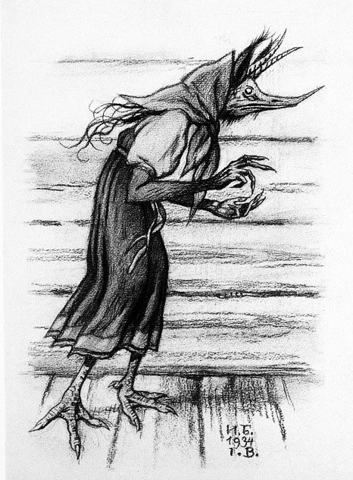
The domovoi's uneasy female counterpart in Russian folk belief — blamed for tangled yarn, bad omens, and trouble in the house or the swamp beyond it.
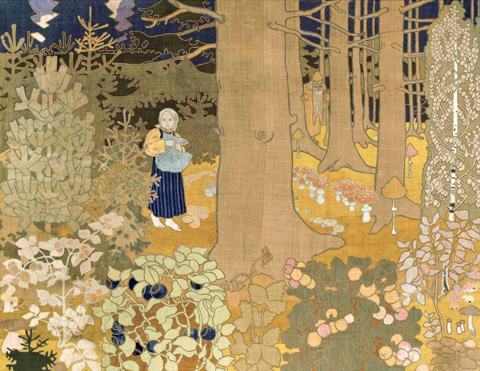
The Slavic forest lord who leads travellers in circles, owns the wolves and the game, and can stand taller than the pines or shorter than the grass.
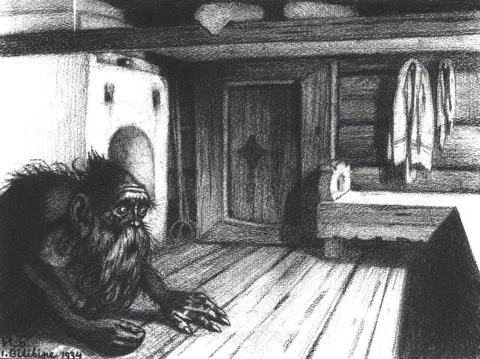
The Slavic house spirit who lives behind the stove, guards the family and its livestock, and turns hostile if the household forgets to feed him.
A white-clad woman who appears in Slavic fields at noon to strike down harvesters with sunstroke, madness, or sudden death for working through her hour.
The bearded, shapeshifting master of Slavic rivers and millponds, placated by millers and fishermen and blamed for every drowning in his water.
Slavic water spirit of the restless dead: a drowned or unbaptised girl who leaves the river for one week each summer to walk the fields and the woods.
Sources & Further Reading
- 1.Ivanits, Linda J. Russian Folk Belief. M.E. Sharpe, 1989.
- 2.Maksimov, S.V. Nechistaia, nevedomaia i krestnaia sila (Unclean, Unknown and Holy Powers). St Petersburg, 1903.
- 3.Warner, Elizabeth. Russian Myths. British Museum Press, 2002.
- 4.Zelenin, Dmitrij. Russische (Ostslavische) Volkskunde. Walter de Gruyter, 1927.
- 5.Dixon-Kennedy, Mike. Encyclopedia of Russian and Slavic Myth and Legend. ABC-CLIO, 1998.
Spot an error or have a source to suggest? Write to info@viseterna.com. We cite primary sources and modern scholarship, and we correct fast.