
Rusalka (Slavic Water Spirit)
Slavic water spirit of the restless dead: a drowned or unbaptised girl who leaves the river for one week each summer to walk the fields and the woods.
Mermaids (Rusalki), Ivan Kramskoy, 1871 (State Tretyakov Gallery, Moscow) · Public domain · source
Not a Mermaid
English translations have made rusalka into "mermaid", and the word does the story a disservice. The rusalka of Slavic folk belief has legs, walks on land, climbs trees, and spends much of her season nowhere near water. She has no fish tail in the older ethnographic record; the tail arrives late, through Western literary and operatic influence, and through the southern Russian and Ukrainian coastal traditions that met it halfway 1,2,5.
What she is, in the belief system that produced her, is a dead woman who did not finish dying properly. Dmitry Zelenin's classic 1916 study placed the rusalki squarely in the category he named zalozhnye pokoiniki — the "unclean" or "pledged" dead, those who died before their allotted span: suicides, the drowned, the murdered, women who died unmarried or in childbirth, and infants who died unbaptised. Such souls could not enter the ordinary land of the dead and remained on earth until their natural lifetime expired 1,2,6.
Who Becomes One
The commonest account has a girl drown herself over a betrayal or a forced marriage, or be drowned by another, and rise as a rusalka bound to that stretch of water. Stillborn and unbaptised children form a second stream of the tradition, sometimes given their own name — in Ukrainian belief the mavka or navka, connected linguistically to Nav, the realm of the dead 1,2,3,7.
Regional portraits diverge sharply, and the divergence is a genuine finding rather than confusion in the sources. In the northern Russian belief-region the rusalka is pale, cold, naked or shrouded in white, dishevelled, and frightening — closer to a ghost than to a nymph. In Ukrainian and southern Russian tradition she is beautiful, green-eyed, garlanded with flowers, laughing, and dangerous in a seductive rather than a spectral register 1,2,5,6. Her long unbound hair is constant across both, and always wet: in many accounts she must keep it damp, and combing it out floods the meadows.
Rusalka Week
The rusalki are not a permanent presence but a seasonal one. They emerge from the water around Semik and the Whitsun period — the seventh Thursday after Easter and the week that follows, known as rusalnaia nedelia, Rusalka Week or Green Week — and spend it in the birch groves, the rye fields and the crossroads 1,2,5,6.
During that week the ordinary rules of village life were suspended for safety. People avoided swimming, working in the fields, and going out alone after dark; women did not wash linen or sew; livestock were kept in. Protective charms recorded include wormwood, which the rusalki were said to hate, garlic, a cross, or a pin. A traditional test is preserved in the folk sources: a rusalka asks a passer-by "wormwood or parsley?" — parsley is the wrong answer 1,2,5.
The week closed with a rite of expulsion. Villagers made a straw rusalka or used a decorated birch, carried it out of the settlement with singing, and destroyed it in the fields or the river, sending the spirits back to the water until the following year 1,2,5. The structure is the same one that governs the drowning of Morana: a personified danger is embodied, escorted across the boundary, and disposed of on the far side.
What They Do
Rusalki are best known for luring men — with singing, laughter, or the sight of a familiar face — into the water and drowning them, or tickling them to death, a detail that appears in the Russian material with striking regularity and is far grimmer in context than it sounds 1,2,4,7. They call to children, ride on water-wheels, tangle fishing nets, steal thread and linen left out at night, and swing from birch branches.
But they also fertilise. A substantial strand of belief holds that where the rusalki dance and where their wet hair drags, the rye grows tall, and that their season coincides exactly with the point in the agricultural year when the young grain most needs rain 1,2,3,5. Scholars have read this as the key to the whole figure: the untimely dead retain the vitality they never spent, and that unspent life is both a threat to the living and a resource the fields require. The rusalka is dangerous because she is full, not because she is empty 1,2,6.
Some traditions hold that a rusalka can be released. Naming her, baptising her posthumously, or completing an unfinished obligation lets her go on to the proper land of the dead; a few tale-types allow her to return to human life if a man keeps a promise, which in folklore he almost never does 2,5,7.
Origins and Debate
The name's derivation is contested. The most widely held explanation connects it to the Latin rosalia, the Roman festival of roses for the dead, which entered the Balkans through the Byzantine world and gave South Slavic languages the rusalii rites; others have argued for an older Slavic root connected with light-coloured hair or with river names 1,3,6. What is not seriously disputed is the association with commemoration of the dead: even the etymological argument points at a funerary festival.
Nineteenth-century Romantic scholarship treated the rusalki as faded water-goddesses or nature nymphs. Zelenin's demonstration that they belong to the cult of the unquiet dead has largely displaced that reading, though some scholars still argue for an older water-spirit layer beneath the funerary one 1,3,6. Their male counterpart in the water, the vodyanoy, is a separate figure with a different logic — an owner of the river, like the leshy in the forest, rather than a returning corpse 2,5.
In Literature and Music
The rusalka is the most artistically productive figure in Slavic folk belief. Pushkin left an unfinished verse drama Rusalka; Gogol built "May Night" around them; Dargomyzhsky and Dvořák each wrote a Rusalka opera, and Dvořák's 1901 version — with its "Song to the Moon" — is the form in which most of the world now meets her, filtered through Andersen and Fouqué into something closer to a tragic mermaid 5,7. Ivan Kramskoy's 1871 painting of pale figures on a moonlit bank, made after Gogol, remains the defining image 5.
The folk rusalka is stranger and colder than any of them: not a lovelorn spirit of the deep, but a girl from the next village who died at the wrong time and is now out in the rye, in daylight, asking a question with only one safe answer 1,2,6.
Continue Exploring
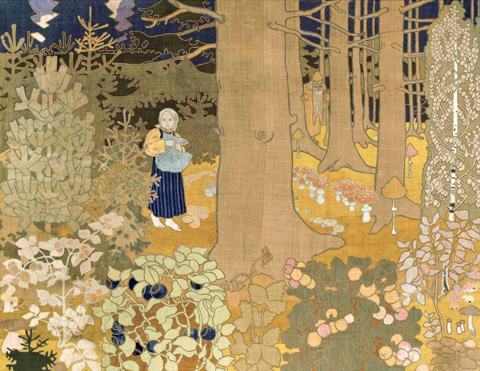
The Slavic forest lord who leads travellers in circles, owns the wolves and the game, and can stand taller than the pines or shorter than the grass.
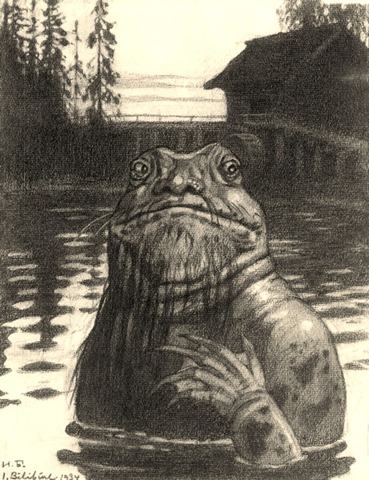
The bearded, shapeshifting master of Slavic rivers and millponds, placated by millers and fishermen and blamed for every drowning in his water.
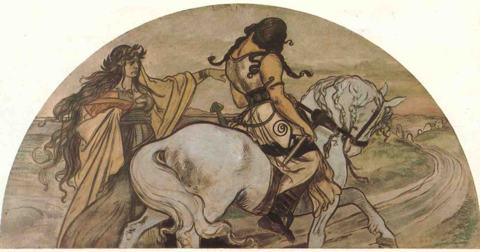
Slavic winter-and-death figure, drowned in effigy every spring. The rite is documented from 1420; whether a real goddess stood behind it is debated.
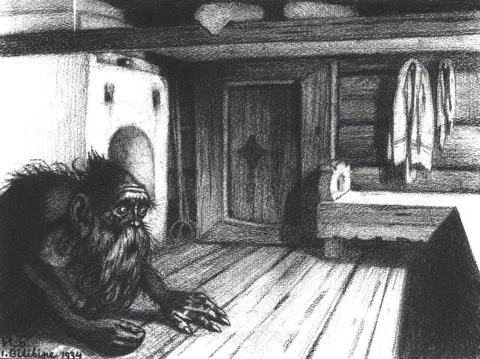
The Slavic house spirit who lives behind the stove, guards the family and its livestock, and turns hostile if the household forgets to feed him.
The land of the dead — an old Slavic word for a corpse and for the dead who come back, and the least documented otherworld in European mythology.
A white-clad woman who appears in Slavic fields at noon to strike down harvesters with sunstroke, madness, or sudden death for working through her hour.
Also mentioned inVila (Slavic Fairy)
Sources & Further Reading
- 1.Zelenin, Dmitry. Ocherki russkoi mifologii - Umershie neestestvennoiu smertiu i rusalki (Essays on Russian Mythology - Those Dead by Unnatural Death, and the Rusalki). Petrograd, 1916.
- 2.Ivanits, Linda J. Russian Folk Belief. M.E. Sharpe, 1989.
- 3.Machal, Jan. Slavic Mythology, in The Mythology of All Races, vol. III. Marshall Jones, 1918.
- 4.Ralston, W.R.S. The Songs of the Russian People, as Illustrative of Slavonic Mythology and Russian Social Life. Ellis & Green, 1872.
- 5.Warner, Elizabeth. Russian Myths. British Museum Press, 2002.
- 6.Zelenin, Dmitrij. Russische (Ostslavische) Volkskunde. Walter de Gruyter, 1927.
- 7.Dixon-Kennedy, Mike. Encyclopedia of Russian and Slavic Myth and Legend. ABC-CLIO, 1998.
Spot an error or have a source to suggest? Write to info@viseterna.com. We cite primary sources and modern scholarship, and we correct fast.