
Vodyanoy (Slavic Water Spirit)
The bearded, shapeshifting master of Slavic rivers and millponds, placated by millers and fishermen and blamed for every drowning in his water.
Vodyanoy, Ivan Bilibin, 1934 · Public domain · source
Grandfather of the Deep
The vodyanoy (Russian vodianoi, "of the water") is the master spirit of Slavic still and moving water — millponds above all, but also lakes, river-pools, and the deep stretches under a bridge or a bathing place 1,2. Regional cousins carry the idea across the Slavic world under different names: the Czech vodník, the Polish topielec, and in some Russian dialects simply dedushka, "grandfather," a respectful evasion of the kind peasants also used for the domovoi 2,6. Unlike the domovoi, whose presence was wanted, the vodyanoy was tolerated at best, and villages built their relationship to him around avoidance and payment rather than affection 3,4.
A Shapeshifter's Body
Machal's collected descriptions give him a bald head, a swollen belly, puffed cheeks, a cap woven from reeds, and a belt of rushes, an image consistent enough across the East Slavic record to count as a type rather than one witness's invention 2. Other accounts make him hairier and more explicitly animal: a green or grey beard, webbed hands, and — especially in later, more literary retellings — a fish's tail in place of legs 3,5,6. He was also credited with shapeshifting into a large fish, a drowned man, or an ordinary traveler asking to be ferried across a river, and his strength was said to be tied entirely to his element: formidable in the water, markedly weak once dragged onto dry land 2,6.
The Miller's Bargain
No one negotiated with the vodyanoy as directly as the miller, whose wheel and dam sat squarely in his territory. Machal records that a miller who wanted his mill to run safely was expected to sink a living offering into the foundations or the millpond — traditionally a black, well-fed sow, and in the grimmer end of the tradition a sheep or even a human life 2. Millers who kept up this arrangement were popularly believed to enjoy a kind of understanding with the vodyanoy, which is part of why village opinion so often cast millers themselves as half-sorcerous figures, men who dealt with powers ordinary peasants preferred to avoid 3,4. Fishermen paid smaller, gentler tribute — butter, tobacco, the first catch of the season — hoping only to fish undisturbed 2,6.
What Happens to the Drowned
The vodyanoy's central danger was drowning, and Russian folk belief drew a hard line between an ordinary death and one that ended in his water. Those who drowned, particularly suicides and others who died before their allotted time, were widely held not to enter the ordinary land of the dead but to pass into the vodyanoy's service, becoming his underwater household 1,3. Ralston's collected material describes him keeping court over the souls of the drowned much as a landowner keeps serfs, and later accounts add that his daughters — sometimes identified with drowned girls in their own right — tormented these unwilling servants further 1,2. Bathing alone at midday or at midnight was considered particularly reckless, since those were the hours he was thought likeliest to reach for a swimmer's legs 2.
Waking with the Spring Ice
Like a good deal of Slavic nature-spirit belief, the vodyanoy's danger was seasonal rather than constant. He was said to sleep through the winter beneath the ice and to wake, hungry and bad-tempered, with the spring thaw — the period folklore blamed for ice breaking unpredictably, currents whipping up without warning, and fish scattering out of nets 2. Some districts marked his waking with a spring offering, most notably a horse smeared with honey and released into the water, a sacrifice grand enough to suggest how seriously the danger of spring flooding was taken in communities built around water-powered mills 2,3.
Vodyanoy and His Neighbors
The vodyanoy shares his territory, uneasily, with the rusalka, the drowned or restless dead who leave the water only in high summer; where she walks the fields and groves during Rusalka Week, he never really leaves his pool, and the two were not generally treated as the same kind of being despite sharing an address 1,3. On dry land his opposite number is the leshy, lord of the forest, with whom he was sometimes said to gamble or quarrel over livestock that strayed between wood and water 2,6. Both stand outside the safer, smaller jurisdiction of the domovoi, whose stove-side rule was the one corner of the Slavic supernatural landscape peasants could count on being on their side 6.
Continue Exploring
The Slavic forest lord who leads travellers in circles, owns the wolves and the game, and can stand taller than the pines or shorter than the grass.
Slavic water spirit of the restless dead: a drowned or unbaptised girl who leaves the river for one week each summer to walk the fields and the woods.
The Slavic house spirit who lives behind the stove, guards the family and its livestock, and turns hostile if the household forgets to feed him.
The poor gusli-player of Novgorod who wagered with the Sea Tsar, grew rich, and nearly stayed in the Tsar's underwater hall forever.
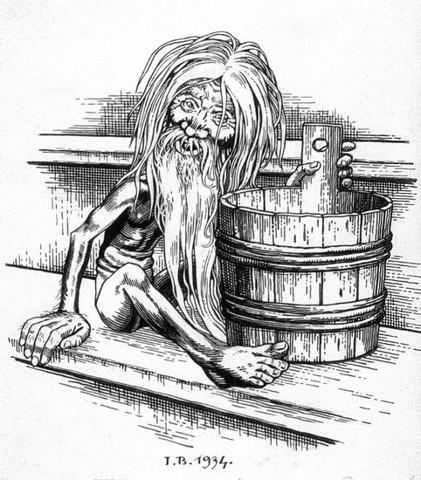
The irritable spirit who owns the Russian bathhouse after dark — a fortune-teller at Yuletide, a danger to anyone who bathes in his hour uninvited.
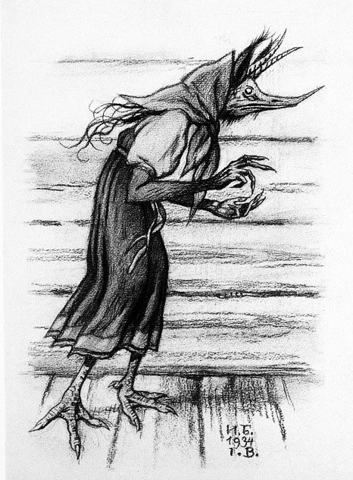
The domovoi's uneasy female counterpart in Russian folk belief — blamed for tangled yarn, bad omens, and trouble in the house or the swamp beyond it.
Sources & Further Reading
- 1.Ralston, W.R.S. The Songs of the Russian People, as Illustrative of Slavonic Mythology and Russian Social Life. Ellis & Green, 1872.
- 2.Machal, Jan. Slavic Mythology, in The Mythology of All Races, vol. III. Marshall Jones, 1918.
- 3.Ivanits, Linda J. Russian Folk Belief. M.E. Sharpe, 1989.
- 4.Maksimov, S.V. Nechistaia, nevedomaia i krestnaia sila (Unclean, Unknown and Holy Powers). St Petersburg, 1903.
- 5.Warner, Elizabeth. Russian Myths. British Museum Press, 2002.
- 6.Dixon-Kennedy, Mike. Encyclopedia of Russian and Slavic Myth and Legend. ABC-CLIO, 1998.
Spot an error or have a source to suggest? Write to info@viseterna.com. We cite primary sources and modern scholarship, and we correct fast.