
Kikimora (Slavic House Spirit)
The domovoi's uneasy female counterpart in Russian folk belief — blamed for tangled yarn, bad omens, and trouble in the house or the swamp beyond it.
Kikimora, Ivan Bilibin, 1934 · Public domain · source
A Second Spirit of the House
Russian peasant cosmology rarely gave the domovoi a family, but where it did, the wife most often named was the kikimora — and the marriage was not a happy one 1,4. She is far less consistently described than her male counterpart: collectors recorded her under different origins, different addresses within the same house, and different tempers, and the nineteenth- and early twentieth-century record makes no attempt to reconcile them 1,3,6. What is constant is that she is small, female, unpleasant to have around, and closely tied to the work of women — spinning, weaving, and the watching of small children 1,2.
Two Kinds of Kikimora
Ivanits and Dixon-Kennedy both preserve what amounts to two overlapping traditions rather than one settled figure 1,6. The domestic kikimora lives behind or under the stove, in the cellar, or in the corner opposite the domovoi's usual post, and is sometimes explained as his wife, other times as an independent and unrelated tenant who arrived with a curse rather than a blessing 1,4,6. A second, wilder kikimora belongs to the swamp — Maksimov and later collectors record her as kikimora bolotnaia, a filthy, emaciated old woman with tangled hair who lives in marshland and is occasionally paired with the leshy rather than the domovoi 2,6. Folklorists have never fully sorted out whether these are one being described two ways or two beings sharing a name, and the honest answer, on the evidence, is that peasant testimony did not sort it out either, a regional patchiness Zelenin's countrywide survey of East Slavic custom illustrates well 1,3,5.
How She Got There
Ethnographers recorded several rival explanations for a kikimora's presence, and none of them is flattering. The commonest holds that she is the soul of an unbaptized, stillborn, or cursed infant, unable to rest and drawn back to a household 1,2,6. A second, darker strand blames the builders: a carpenter with a grudge against the family that hired him could curse a new house by working a small cursed object — a knotted rag, a sliver of wood, a crude doll — into the timbers or under the threshold, and the kikimora born of that act would torment the household indefinitely 1,6. Warner notes that this second explanation belongs to the same body of belief that made peasants anxious about the ritual state of a house at the moment of building, the same anxiety visible in the domovoi's own foundation customs 4.
Nightwork
A kikimora's harassment is domestic and nocturnal rather than violent. She tangles yarn on the distaff, snaps thread, unravels a day's weaving overnight, and is blamed above all for interference with spinning — a task so bound up with her that the sound of a spinning wheel running by itself after dark was itself taken as a sign of her presence 1,2,4. Her weeping foretold misfortune, and a peasant commonplace held that if she was heard clicking bobbins as though making lace, a death in the family should be expected soon after 2,6. She also plucked at sleepers' hair, frightened children, and — like the wilder spirits of the yard — took a dislike to particular livestock or particular people without any offense the household could identify 1,2.
Driving Her Out
Because she was rarely welcomed the way the domovoi could be, remedies against a kikimora ran toward expulsion rather than propitiation. Ivanits records prayer, the sign of the cross, and blessed items such as consecrated willow branches from Palm Sunday as standard defenses, alongside more specific charms against builders' curses, such as burying a coin or incense under the threshold of a new house before moving in 1. Where a family concluded their kikimora could not be dislodged, they simply lived alongside her the way they lived alongside damp walls or a leaking roof — a permanent, resented inconvenience rather than a crisis 1,4.
Kikimora in the Wider Household
Set beside the domovoi, the kikimora marks the limit of how far the "master of the house" idea could be stretched to cover every domestic irritation peasants needed to explain. Where he is an ancestor kept sweet with porridge, she is closer to an intruder who happens to share the address, and the two figures were sometimes said to quarrel audibly behind the stove 1,4. The swamp variant, by contrast, belongs to the same loose confederation of wilderness spirits as the leshy and, further into the yard, the bannik who claims the household's bathhouse after dark — a reminder that Slavic folk religion parcelled out even a single farmstead among several jealous small powers 2,3,6.
Continue Exploring
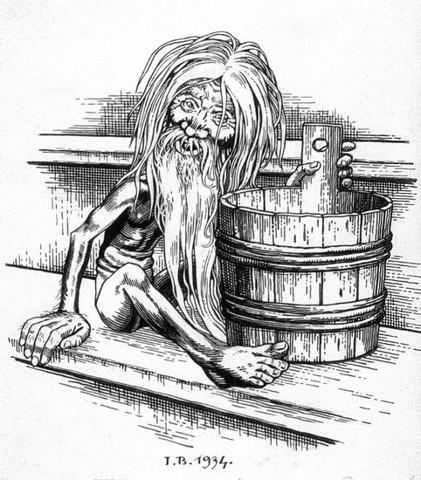
The irritable spirit who owns the Russian bathhouse after dark — a fortune-teller at Yuletide, a danger to anyone who bathes in his hour uninvited.
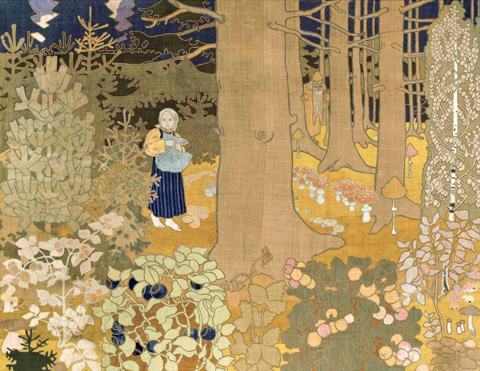
The Slavic forest lord who leads travellers in circles, owns the wolves and the game, and can stand taller than the pines or shorter than the grass.
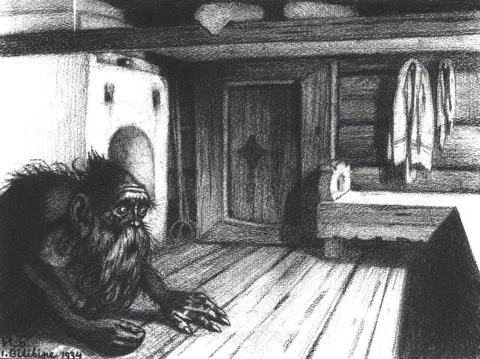
The Slavic house spirit who lives behind the stove, guards the family and its livestock, and turns hostile if the household forgets to feed him.
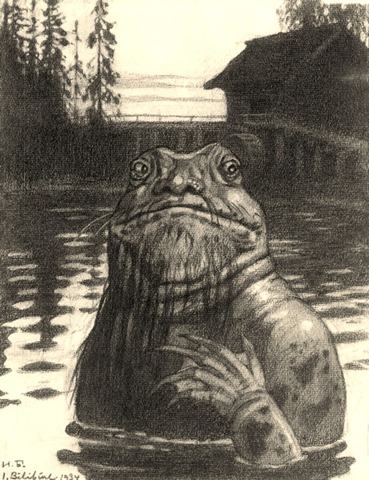
The bearded, shapeshifting master of Slavic rivers and millponds, placated by millers and fishermen and blamed for every drowning in his water.
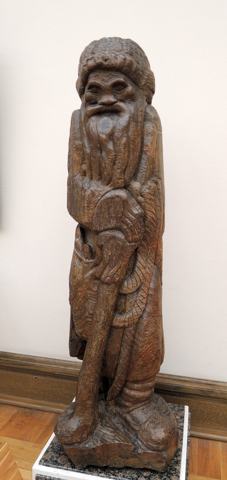
A white-clad woman who appears in Slavic fields at noon to strike down harvesters with sunstroke, madness, or sudden death for working through her hour.
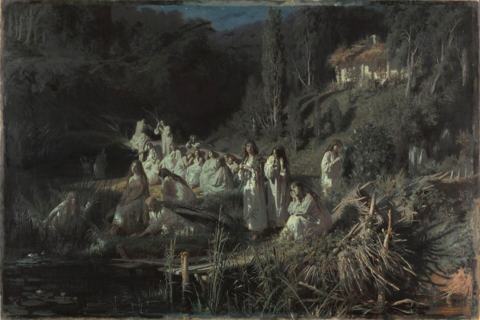
Slavic water spirit of the restless dead: a drowned or unbaptised girl who leaves the river for one week each summer to walk the fields and the woods.
Sources & Further Reading
- 1.Ivanits, Linda J. Russian Folk Belief. M.E. Sharpe, 1989.
- 2.Maksimov, S.V. Nechistaia, nevedomaia i krestnaia sila (Unclean, Unknown and Holy Powers). St Petersburg, 1903.
- 3.Machal, Jan. Slavic Mythology, in The Mythology of All Races, vol. III. Marshall Jones, 1918.
- 4.Warner, Elizabeth. Russian Myths. British Museum Press, 2002.
- 5.Zelenin, Dmitrij. Russische (Ostslavische) Volkskunde. Walter de Gruyter, 1927.
- 6.Dixon-Kennedy, Mike. Encyclopedia of Russian and Slavic Myth and Legend. ABC-CLIO, 1998.
Spot an error or have a source to suggest? Write to info@viseterna.com. We cite primary sources and modern scholarship, and we correct fast.