
Poludnitsa (Lady Midday)
A white-clad woman who appears in Slavic fields at noon to strike down harvesters with sunstroke, madness, or sudden death for working through her hour.
Starichok-polevichok (Little Old Field Spirit), Sergey Konenkov, 1910 (Tretyakov Gallery) · Public domain · source
The Hour She Owns
Poludnitsa — from polden', "midday" — is the noon spirit of Slavic field-belief, a demon who claims the hour when the sun stands highest and the heat is worst for anyone still working the rye or flax 1,2. Peasant custom across the Slavic lands treated noon as a mandatory rest period for exactly this reason: to keep working through it, or to let a child nap unwatched at the field's edge, was to invite her attention 1,3. She belongs to the same broad family of danger-by-clock beings as the bathhouse's bannik, who claims his own unlucky hour, though the two figures were never confused with one another in the sources 3.
A Figure That Changes by Region
Machal's survey of the East and West Slavic material shows a genuinely unstable figure rather than one description copied from village to village. Bohemian tradition gave her as "an airy, white lady, or ... an old woman" who travels on violent gusts of wind, sometimes appearing "slight and slim like a girl twelve years old" and carrying a whip 1. Moravian accounts instead made her an old woman with horses' hooves, a hideous face, slanting eyes, and matted hair, while Polish tradition preferred a tall woman in a white robe to the feet, carrying a sharp sickle and interrogating anyone she met 1. The Russian version common in Ivanits's and Maksimov's material is younger and more conventionally beautiful — a tall girl in white — while Siberian accounts fall back to an old woman living among reeds and nettle-thickets, closer to the Moravian type than the Russian one 1,2,3.
What Happens to Those She Meets
Whatever she looks like locally, poludnitsa's business with trespassers is consistent: sudden and serious harm. The Polish poludnitsa "propounds hard questions" to harvesters, and failure to answer brings on "grievous maladies" 1. Russian accounts have her seize reapers and twist their necks, a folk description that maps fairly directly onto the sunstroke, heat cramps, and neck strain that came with real midday field labor 1,2. Warner records the belief, widespread enough to function as an everyday threat used on children, that a mother who left an infant unattended at the field's edge during the noon hour risked having it stolen by the poludnitsa outright, which functioned in practice as a piece of very practical child-minding advice dressed as folklore 4.
Her Male Counterpart, and His Opposite
Russian tradition paired her, loosely, with the polevik, a male field-spirit who was small in spring and grew "to the size of the stubble" as the crop was cut, turning genuinely dangerous once the harvest was in 1. Machal records that the polevik, "roaming about on horseback," would ride down anyone careless enough to nap unprotected in a stubble field, or send disease on them for the offense 1. Against both figures stood the belun of Belarusian belief, a positive counter-image described as "an old man with a long white beard and gown" who helped exhausted reapers and rewarded them rather than harming them — proof that the field, in this system, was not imagined as uniformly hostile, only unevenly so, and hedged with as much comfort as threat 1,5.
Real Danger Behind the Belief
It is worth being plain about how much of this figure is best read as folk medicine rather than theology. Warner and Dixon-Kennedy both treat the poludnitsa tradition as a working explanation for heatstroke, epilepsy-like collapse, and sudden fever among people who spent unbroken summer days bent over in open fields with no real protection from the sun 4,5. Read that way, the enforced noon rest she polices, and the sunstroke or madness she inflicts on those who ignore it, describe an entirely real occupational hazard of pre-industrial farm labor in terms a peasant community could act on: stop working, get out of the sun, and keep the children close 2,3.
Poludnitsa and the Rest of the Field
She belongs to the daylight, open-country end of a Slavic supernatural landscape that also includes the rusalka, who claims the groves and rye fields only during her own fixed season, and the leshy, who rules the forest edge the fields border 1,2. All three enforce a version of the same lesson — that the working landscape outside the farmstead answers to owners who are not the people who plant and harvest it — but poludnitsa is the only one of the three whose danger is tied to a single hour of a single day, which is what makes her, among Slavic field-spirits, the most purely a piece of practical timekeeping dressed as a demon 1,4.
Continue Exploring
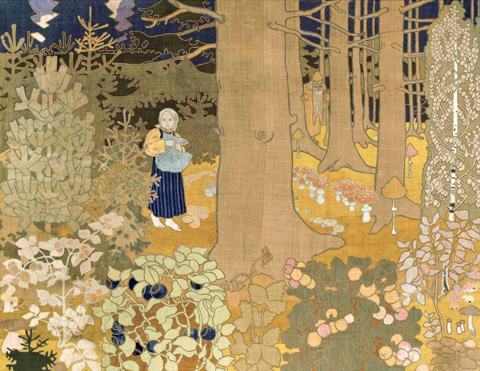
The Slavic forest lord who leads travellers in circles, owns the wolves and the game, and can stand taller than the pines or shorter than the grass.
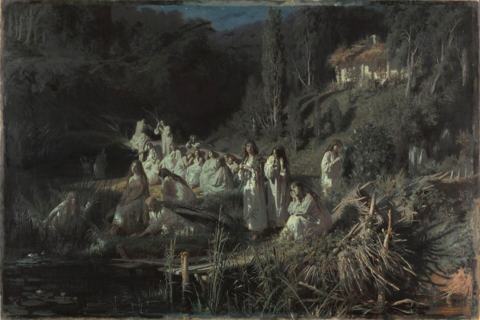
Slavic water spirit of the restless dead: a drowned or unbaptised girl who leaves the river for one week each summer to walk the fields and the woods.
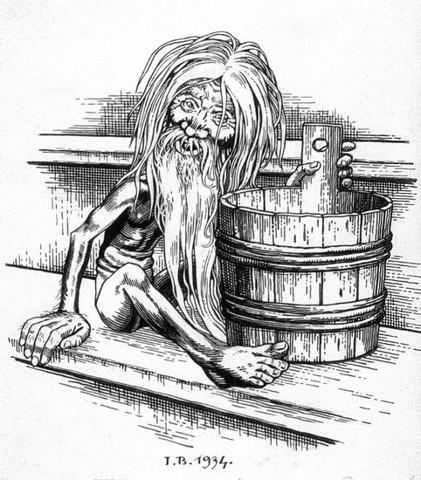
The irritable spirit who owns the Russian bathhouse after dark — a fortune-teller at Yuletide, a danger to anyone who bathes in his hour uninvited.
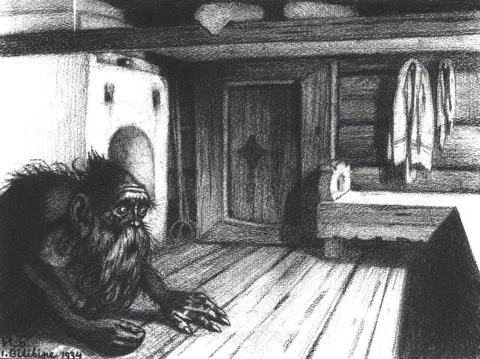
The Slavic house spirit who lives behind the stove, guards the family and its livestock, and turns hostile if the household forgets to feed him.
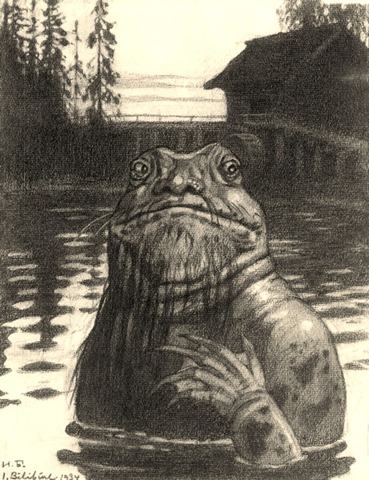
The bearded, shapeshifting master of Slavic rivers and millponds, placated by millers and fishermen and blamed for every drowning in his water.
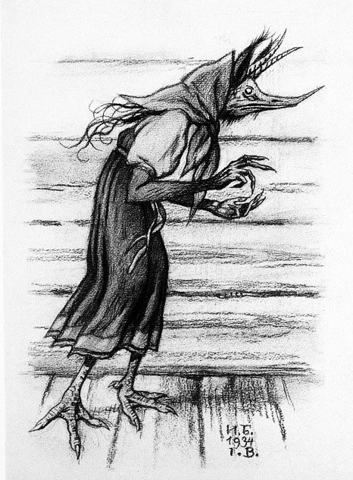
The domovoi's uneasy female counterpart in Russian folk belief — blamed for tangled yarn, bad omens, and trouble in the house or the swamp beyond it.
Sources & Further Reading
- 1.Machal, Jan. Slavic Mythology, in The Mythology of All Races, vol. III. Marshall Jones, 1918.
- 2.Ivanits, Linda J. Russian Folk Belief. M.E. Sharpe, 1989.
- 3.Maksimov, S.V. Nechistaia, nevedomaia i krestnaia sila (Unclean, Unknown and Holy Powers). St Petersburg, 1903.
- 4.Warner, Elizabeth. Russian Myths. British Museum Press, 2002.
- 5.Dixon-Kennedy, Mike. Encyclopedia of Russian and Slavic Myth and Legend. ABC-CLIO, 1998.
Spot an error or have a source to suggest? Write to info@viseterna.com. We cite primary sources and modern scholarship, and we correct fast.