
Vila (Slavic Fairy)
The beautiful, dangerous fairy-women of South Slavic mountains and epic song — healers, archers and shapeshifters, distinct from the East Slavic rusalka.
Vila, illustration to the poem Forest Longing, Vera Khlebnikova, 1920s · Public domain · source
Sisters of the Mountain
The vila (plural vile; Bulgarian samovila or samodiva) is the fairy-woman of South Slavic tradition — Serbian, Croatian, Bosnian, Montenegrin, Slovene, Macedonian, and Bulgarian folklore all know her, though under enough local variation that Machal treats her as a family of related beings rather than one figure with one biography 1. She is best documented not in peasant testimony collected door to door, the way the household spirits of the Russian north were, but in oral epic poetry — the guslar songs about medieval heroes that Vuk Karadžić began collecting and publishing in the early nineteenth century, and which remained the primary vehicle for vila belief into the twentieth 1,2.
Bodies Made of Wind and Cloud
Machal's synthesis of the ethnographic record describes the vila as "eternally young," pale, dressed in white, with long fair or golden hair on which her strength was said to depend — cut it, and she loses her power, a detail that echoes similar hair-taboos attached to other Slavic female spirits 1. Her body was imagined as unnaturally light, "as slender as the stem of a pine, and as light as those of birds," and some traditions gave her wings outright 1. She was credited with shapeshifting into a horse, wolf, snake, falcon, or swan, with unerring archery, with healing by mountain herbs, and with the power to ride the whirlwind — a cluster of abilities that made her equally useful as an ally and dangerous as an enemy, depending entirely on how she was treated 1,4.
Where They Live, and What Explains Them
Krauss's fieldwork among South Slavic communities and Machal's later synthesis both locate the vile across three zones rather than one: among the clouds, where they sleep, sing, and dance; in the mountains, caves, and forests — territory that in the East Slavic system belongs to the leshy — and in rivers, springs, and wells 1,3. Origin stories varied as much as habitat. Some traditions held that vile were the souls of the dead — Bulgarian belief specifically named them as girls who died unbaptized, Slovak tradition as brides who died after betrothal but before marriage, Polish tradition as beautiful young women serving out a period of atonement 1. Other strands of belief treated them simply as nature spirits with no human origin at all, and Machal is candid that the sources do not resolve the contradiction 1.
Vila and the Hero: Marko Kraljevic
The vila's fullest life is in the epic cycle built around Marko Kraljević, the historical fourteenth-century Balkan lord who became the central hero of Serbian oral poetry, songs collected by Karadžić and translated into English by D. H. Low in 1922 2. In the ballad "Marko and the Vila," a mountain vila who has forbidden singing on her territory kills a companion of Marko's for defying her, and Marko hunts her down in turn; the standard shape of these songs has him overpower her by force and then accept her surrender as a posestrima — a sworn sister bound to him by oath rather than blood, obliged afterward to use her powers, including her herb-lore, in his service 2. The pattern recurs across the cycle: the vila is dangerous to cross, formidable enough that only a hero of Marko's stature can master her, and, once bound by oath, a genuinely loyal ally rather than a defeated enemy kept on sufferance 1,2.
Offerings and Everyday Belief
Outside epic song, ordinary villagers treated the vila's ground with real caution. Krauss records offerings of fruit, flowers, and silk ribbons left on stones at the mouths of caves believed to be vila dwellings, and a Bulgarian custom of hanging ribbons on trees or leaving small cakes near wells associated with samovili 1,3. Machal notes a belief, evidently older than the epic material's habit of treating vile chiefly as obstacles for heroes, that they had once lived in close and helpful contact with human beings — teaching them to harvest, mow, and build — before that friendship soured into the more distant, easily offended relationship recorded by the nineteenth-century collectors 1.
Not the Rusalka: A Necessary Distinction
English-language summaries sometimes flatten the vila into a Balkan rusalka, and the two do share real ground: both are beautiful, dangerous young women tied to wild places, and both plausibly descend from an older common Slavic idea of the restless or unquiet female dead 1,4. But they belong to separate regional traditions that developed largely independently — rusalka belief is an East Slavic, specifically water-and-season-bound phenomenon tied to a fixed midsummer week, while the vila is a South Slavic mountain-and-forest figure with no comparable calendar restriction and a much heavier presence in heroic epic than in domestic peasant testimony 1,2,4. The vila's closest working relationship in South Slavic story is arguably not with any water-spirit but with the zmey, the dragon-hero of Balkan legend, with whom she appears paired or in rivalry across a number of songs 1,4. Treating vila and rusalka as interchangeable, however tempting the surface resemblance, erases exactly the regional texture that makes each tradition worth taking on its own terms.
Continue Exploring
The Slavic forest lord who leads travellers in circles, owns the wolves and the game, and can stand taller than the pines or shorter than the grass.
Slavic water spirit of the restless dead: a drowned or unbaptised girl who leaves the river for one week each summer to walk the fields and the woods.
The many-headed dragon — the fire-breathing serpent of Russian epic song, met at a river crossing, and beaten only by a hero who refuses to stop swinging.
The Slavic house spirit who lives behind the stove, guards the family and its livestock, and turns hostile if the household forgets to feed him.
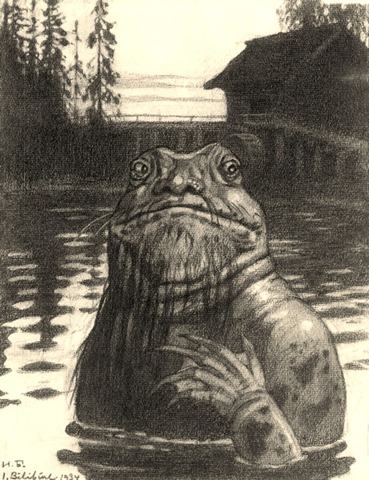
The bearded, shapeshifting master of Slavic rivers and millponds, placated by millers and fishermen and blamed for every drowning in his water.
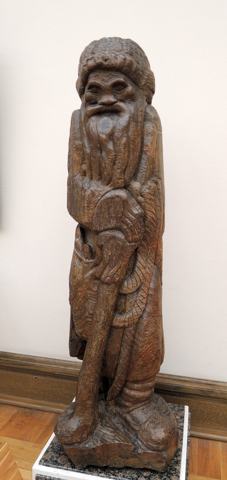
A white-clad woman who appears in Slavic fields at noon to strike down harvesters with sunstroke, madness, or sudden death for working through her hour.
Sources & Further Reading
- 1.Machal, Jan. Slavic Mythology, in The Mythology of All Races, vol. III. Marshall Jones, 1918.
- 2.Low, D.H., trans. The Ballads of Marko Kraljevic. Cambridge University Press, 1922.
- 3.Krauss, Friedrich S. Volksglaube und religioeser Brauch der Suedslaven. Aschendorff, 1890.
- 4.Dixon-Kennedy, Mike. Encyclopedia of Russian and Slavic Myth and Legend. ABC-CLIO, 1998.
Spot an error or have a source to suggest? Write to info@viseterna.com. We cite primary sources and modern scholarship, and we correct fast.