
Buyan (the Enchanted Island)
The magical island of Russian folk charm and fairy tale, home to the sacred stone Alatyr and, in wonder-tales, the hidden death of Koschei.
Illustration to The Tale of Tsar Saltan, Ivan Bilibin, 1905 · Public domain · source
An Island Only a Charm Can Reach
Buyan is the standard setting-formula of the East Slavic magical charm and the Russian wonder-tale alike: "na more-okiane, na ostrove Buyane" - "on the sea-ocean, on the island of Buyan" - opens an enormous number of recorded zagovory and skazki, placing whatever follows in a location deliberately impossible to plot on a map 1,5,7. Ethnographers who collected these formulas in the nineteenth century found no consistent geography attached to it at all: Buyan is sometimes said to appear and vanish with the tide, sometimes simply to lie "beyond thrice-nine lands," the standard fairy-tale measure of an unreachable distance, and no informant ever claimed to have sailed there 1,3. What is consistent is its function - a charged, otherworldly place that the words of a charm or story can reach even though a boat cannot 5,7.
What Lies Offshore
The island's best-known feature is the stone Alatyr, the "father of all stones," which folk charms and the spiritual verse called the Golubinaya kniga place at Buyan's center beneath a great oak or cosmic tree 4,7. Wonder-tales put the same island to a darker use: in the cycle of tales about Koschei the Deathless, the sorcerer's death is hidden in a needle, in an egg, in a duck, in a hare, in a chest, buried under an oak - and the oak, in the fullest versions of the formula, stands specifically on Buyan 1,2. The island functions, in other words, as the one place in East Slavic folk cosmology where the world's most concentrated and dangerous things are kept, whether that is an immortal sorcerer's life or an illness a healer wants gone for good 3,4.
Guardians and a Golden City
The Dove Book names two guardians standing watch at the stone: a serpent called Garafena and a bird called Gagana, figures who appear nowhere else in Slavic tradition with any independent story of their own, and read by scholars as decorative elaborations of the charm-formula's central image rather than as gods with a cult 4,7. A separate literary tradition gives the island a city instead of guardians. Alexander Pushkin's 1831 verse fairy tale The Tale of Tsar Saltan sends its exiled prince Gvidon to wash ashore on Buyan, where a swan-maiden raises a golden-domed city out of nothing for him in a single night - Pushkin's own invention, built on the folk island's name and reputation rather than on any specific older tale about a city there 2,3. Ivan Bilibin's 1905 illustrations for the poem fixed the now-standard image of Buyan as a walled town of onion domes rising from a green hill, an image many people now picture before they picture the bare charm-formula it grew from 3.
The Rugen Question
Nineteenth-century mythologists, working in an era eager to find real Slavic geography behind every folkloric name, proposed that Buyan preserved a folk memory of Rugen, the Baltic island where the West Slavic Rani maintained their great temple to Svetovid at Arkona until its destruction in 1168 - the theory leans on a resemblance between "Buyan" and Ruyan, an old Slavic name for the island, and on Rugen's genuine historical status as a famous pre-Christian holy site 1,6. The identification has never had more than circumstantial support: no medieval source calls Rugen "Buyan," the charm-island's features (the stone, the oak, the guardians) have no counterpart in what is actually recorded of Arkona's cult, and modern scholarship treats the connection as a plausible-sounding but unproven piece of Romantic-era comparative mythology rather than an established fact 6,7.
An Otherworld of Its Own
Buyan is worth setting beside Vyraj, the other major otherworld of East Slavic folklore, because the two are shaped so differently. Vyraj is warm, walled, and reached by migrating birds in a seasonal cycle tied to spring and winter; Buyan is oceanic, fixed at the world's center rather than its edge, and reached only through the specific grammar of the charm or the wonder-tale rather than through any natural cycle 5,7. Neither is attested before the modern ethnographic record, and neither should be read as a surviving fragment of an organized pre-Christian cosmology - what the sources actually preserve is a formula that worked, repeated by healers and storytellers for a very long time without ever needing to say exactly where it was 3,5.
Continue Exploring
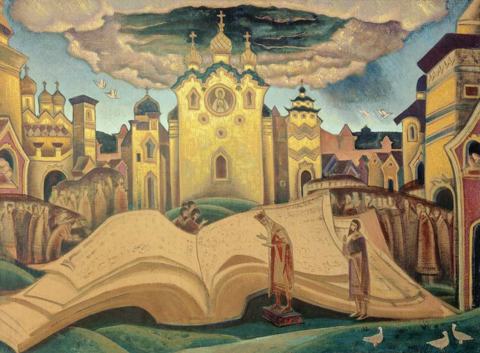
The "father of all stones" at the center of the world in Russian folk charms and the apocryphal Book of the Dove - a formula more than a place.
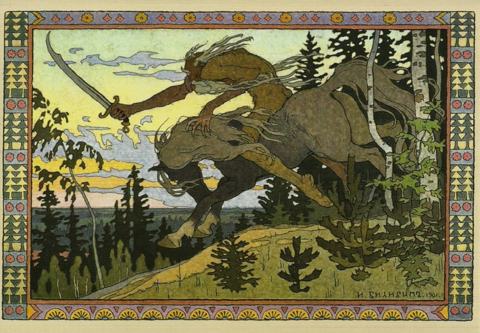
The undying sorcerer of Russian folktale who hid his death in a needle, inside an egg, inside a duck, inside a hare, inside a chest, beneath an oak.
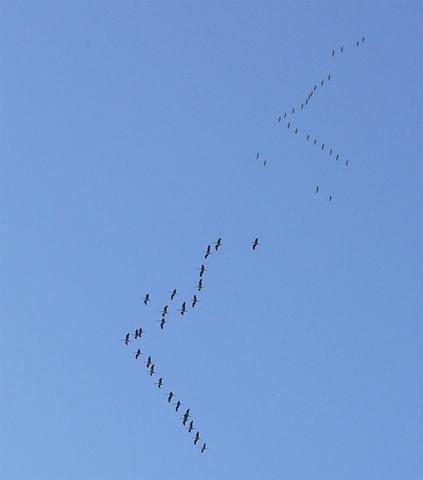
A warm otherworld at the earth's edge where migratory birds winter and, per some folklore, the dead go too - modern ethnography only, no medieval attestation.
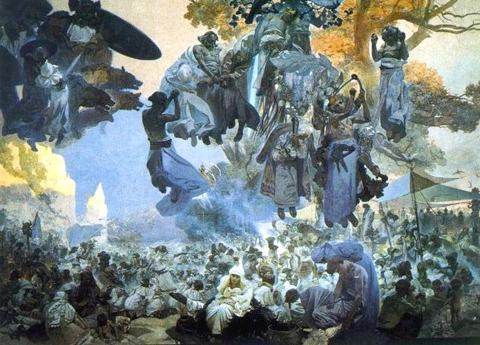
Four-headed war-oracle god of the Rugian Slavs at Arkona, described in unmatched detail by Saxo Grammaticus before Danes destroyed his temple in 1168.
Sun god of the Kyivan pantheon and, in the Tale of Igor's Campaign, the mythical ancestor of the Rus' people themselves.
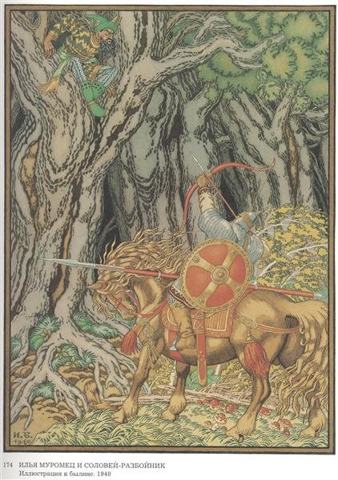
The paralysed peasant's son of Murom who rose from the stove to become Russia's greatest epic hero, and shot down the monstrous Nightingale the Robber.
Sources & Further Reading
- 1.Afanasyev, Alexander. Poeticheskie vozzreniia slavian na prirodu (The Poetic Views of the Slavs on Nature), 3 vols. Moscow, 1865-1869.
- 2.Haney, Jack V., trans. and ed. An Anthology of Russian Folktales. Routledge, 2014.
- 3.Dixon-Kennedy, Mike. Encyclopedia of Russian and Slavic Myth and Legend. ABC-CLIO, 1998.
- 4.Meletinsky, E. M., ed. Mifologicheskii slovar (Mythological Dictionary). Sovetskaya Entsiklopediya, 1990.
- 5.Ivanits, Linda J. Russian Folk Belief. M.E. Sharpe, 1989.
- 6.Kalik, Judith & Alexander Uchitel. Slavic Gods and Heroes. Routledge, 2018.
- 7.Ryan, W. F. "The Bathhouse at Midnight: An Historical Survey of Magic and Divination in Russia." Sutton, 1999.
Spot an error or have a source to suggest? Write to info@viseterna.com. We cite primary sources and modern scholarship, and we correct fast.