
Firebird (Zhar-Ptitsa)
The glowing bird of Russian wonder tale whose single stolen feather starts a fatal quest — first collected by Afanasyev, later Stravinsky's ballet subject.
Ivan Tsarevich and the Firebird, illustration for the Russian folk tale of Ivan Tsarevich, the Firebird and the Grey Wolf, Ivan Bilibin, 1899 · Public domain · source
A Bird of Light, Not Flame
The firebird (Russian zhar-ptitsa, from zhar, the glowing heat of embers rather than an open blaze) is the great treasure-animal of the Russian wonder tale: a bird with feathers of gold and silver that light up the night like a fire without burning anything, eyes like crystal, and a habit of stealing golden apples from a royal orchard 1,2,6. It has no cult, no shrine, and no place in any chronicle. Everything known about it comes from folktales collected in the nineteenth century, chiefly by Alexander Afanasyev, and from the international tale-types those stories belong to 1,3,6,7.
The Golden Apple Orchard
The commonest opening is domestic and small in scale before it becomes enormous. A tsar owns a garden with a tree of golden apples, and something is stealing them by night. A son, or a huntsman in the tsar's service, is set to watch, catches the thief in the act, and comes away holding not the bird but a single glowing feather 1,6,7. That feather is the engine of the whole plot: brought before the tsar, it provokes a command to bring the bird itself alive, which starts an escalating chain of impossible tasks that Vladimir Propp identified as one of the wonder tale's standard shapes, the small transgression that snowballs into a life-or-death quest 4,6.
Ivan, the Grey Wolf, and the Firebird
The best-known version is Afanasyev's "Tsarevich Ivan, the Firebird and the Gray Wolf," classified in the international index as ATU 550, "Bird, Horse and Princess" 1,3. Tsarevich Ivan, youngest of three sons, is sent after the bird that has been stripping his father's orchard. He loses his horse to a wolf in the forest — who, in the pattern typical of the genre, then adopts the hero's cause and becomes his helper and mount for the rest of the story 1,6. The wolf warns Ivan to take the firebird from its golden cage without touching the cage itself; Ivan disobeys, is caught, and is set a further task to make amends: fetch the Horse with the Golden Mane. He disobeys again over that horse's golden bridle, and is set a third task, to win Princess Yelena the Fair. Each failure escalates rather than ends the story, until the wolf's cunning secures all three prizes and Ivan is murdered by his jealous brothers on the road home, then revived with the waters of death and life 1,6.
Two Tales, Two Quests
Afanasyev recorded more than one story built around the same bird, and they are not variants of a single master plot so much as different quests that happen to start with the same feather. In "The Firebird and Princess Vasilisa," classified separately as ATU 531, it is a royal archer, not a prince, who finds the feather; a talking horse he already owns — rather than one gained on the road — walks him through the escalating demands of a jealous tsar: bring the bird, then bring Princess Vasilisa, then dive to the sea floor for her wedding dress 1,3. The throughline is not a fixed cast of characters but a narrative engine: a glowing feather that should have been left on the ground, and never is 1,6,7.
A Motif, Not a Myth
It is worth being plain about what the firebird is not. Unlike the villains of the same story-world — the many-headed Zmey, the deathless sorcerer Koschei — the firebird is neither predator nor antagonist; it does nothing except exist somewhere it should not, and be wanted 6,7. It is also not a nature deity or a solar symbol in any documented pre-Christian sense: no medieval Slavic source mentions it, and the nineteenth-century Romantic habit of reading Russian folk animals as faded gods has, as with so much else in this material, little textual support here 4,5,6. What the record actually shows is a spectacularly effective piece of story machinery, distinct in kind from the sung epics of Ilya Muromets and confined entirely to the prose wonder tale 6,7.
Stravinsky's Firebird
The bird's afterlife outside the tale collections is almost entirely the work of one piece of music. Sergei Diaghilev commissioned the young Igor Stravinsky to score a firebird ballet for the Ballets Russes in Paris, and the 1910 premiere, choreographed by Michel Fokine, made Stravinsky's reputation overnight 8. The libretto is not a translation of any single Afanasyev tale but a compression assembled by the production's collaborators, splicing the feather-and-quest plot onto Koschei as the villain and folding in motifs from several stories at once 8. Richard Taruskin's study of Stravinsky's early work traces the score's debts to specific Russian folk and liturgical material in detail, and treats the ballet as a landmark of reception and reinvention rather than as evidence for what nineteenth-century peasants actually believed about the bird 8.
Continue Exploring
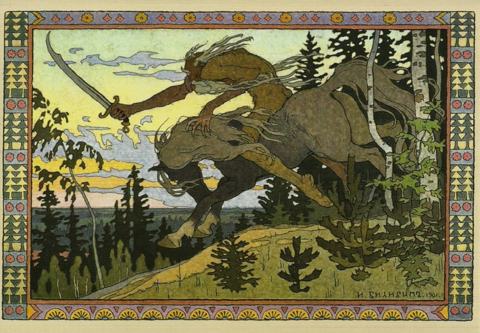
The undying sorcerer of Russian folktale who hid his death in a needle, inside an egg, inside a duck, inside a hare, inside a chest, beneath an oak.
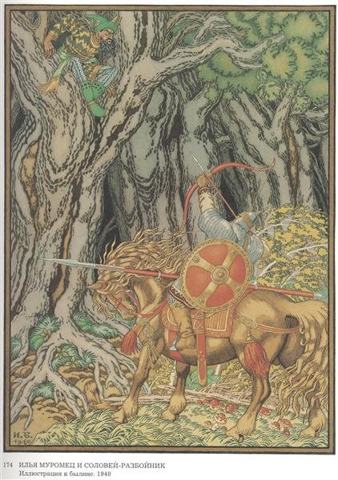
The paralysed peasant's son of Murom who rose from the stove to become Russia's greatest epic hero, and shot down the monstrous Nightingale the Robber.
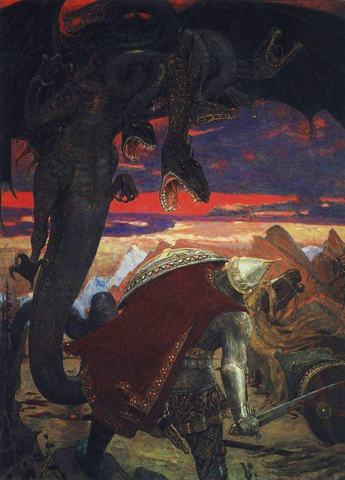
The many-headed dragon — the fire-breathing serpent of Russian epic song, met at a river crossing, and beaten only by a hero who refuses to stop swinging.
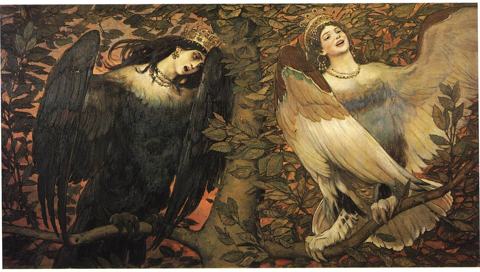
Human-headed bird-women of Russian legend, descended from the Greek siren and halcyon by way of Byzantium, and spread for centuries on cheap lubok prints.
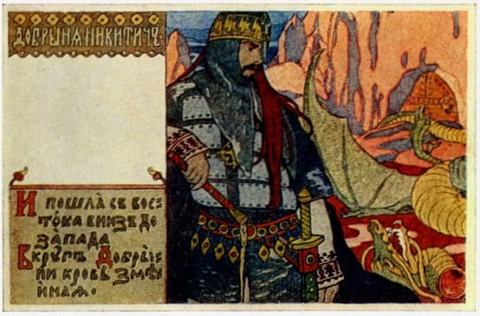
The courtly bogatyr of Kyivan byliny who slew the dragon Zmey Gorynych, outwitted a sorceress, and returned home from a false report of his death.
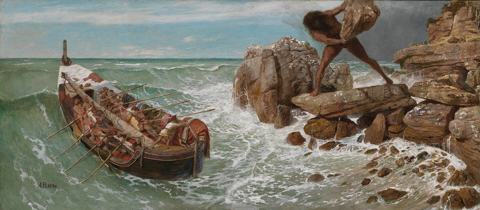
The one-eyed embodiment of misfortune in Slavic folk tale, blinded and evaded in a story that runs remarkably close to Homer's Polyphemus.
Sources & Further Reading
- 1.Afanasyev, Alexander. Russian Fairy Tales. Translated by Norbert Guterman. Pantheon Books, 1945 - including "The Firebird and Princess Vasilisa" and "Tsarevich Ivan, the Firebird and the Gray Wolf".
- 2.Afanasyev, Alexander. Narodnye russkie skazki (Russian Folk Tales), 1855-1863.
- 3.Uther, Hans-Jorg. The Types of International Folktales, ATU 550 "Bird, Horse and Princess" and ATU 531 "The Clever Horse". Academia Scientiarum Fennica, 2004.
- 4.Propp, Vladimir. Morphology of the Folktale. Leningrad, 1928; English trans. Univ. of Texas Press, 2nd ed. 1968.
- 5.Haney, Jack V. An Introduction to the Russian Folktale. M.E. Sharpe, 1999.
- 6.Warner, Elizabeth. Russian Myths. British Museum Press, 2002.
- 7.Dixon-Kennedy, Mike. Encyclopedia of Russian and Slavic Myth and Legend. ABC-CLIO, 1998.
- 8.Taruskin, Richard. Stravinsky and the Russian Traditions - A Biography of the Works through Mavra. University of California Press, 1996.
Spot an error or have a source to suggest? Write to info@viseterna.com. We cite primary sources and modern scholarship, and we correct fast.