
Ilya Muromets (Bogatyr Hero)
The paralysed peasant's son of Murom who rose from the stove to become Russia's greatest epic hero, and shot down the monstrous Nightingale the Robber.
Ilya Muromets and Nightingale the Robber, illustration to a bylina, Ivan Bilibin, 1940 · Public domain · source
The Eldest of the Bogatyrs
Ilya Muromets is the central figure of the byliny, the sung heroic epics of Kyivan Rus preserved not in any medieval manuscript but in the living memory of peasant singers, chiefly in the far north around Lake Onega, and taken down by folklorists only in the nineteenth century 1,2,3. He belongs to the "Kyivan cycle," a grouping Vladimir Propp used to organise the byliny by the court and period a song is set in rather than by when it was actually composed or first sung, since oral epic keeps changing in performance long after its ostensible setting 1,2,4,6. Within that cycle he is consistently treated as senior to Dobrynya Nikitich and Alyosha Popovich: the strongest, the most pious, and the one other bogatyrs defer to 1,2,6. His epithet in the songs is usually simply staryi kazak, "the old Cossack," a title that has more to do with seniority and a wandering, semi-independent way of life than with the later historical Cossack hosts 1,2.
Thirty-Three Years on the Stove
The songs give him an origin unlike any other bogatyr's. He is the son of peasants, Ivan Timofeevich and Efrosinia Yakovlevna, in the village of Karacharovo near Murom, and he cannot walk: for thirty-three years he sits helpless on the stove, the warmest spot in a peasant hut, while his parents work the land without him 1,2,6. Wandering pilgrims — kaliki perekhozhie, a recurring class of holy travelers in the byliny — come to the house and ask him for water. He tells them he cannot rise; they insist; he finds that he can, and the drink they give him afterward grants him a strength so enormous that the songs have him warned to spend only part of it, since the earth itself could not bear the whole measure of a man built that way 1,2,3. He asks his parents' blessing, is given a horse he chooses himself by testing which one can bear his weight without sinking, and sets out for Kyiv to serve Prince Vladimir 1,2.
The Nightingale Robber
The single most famous bylina is Ilya's first journey to Kyiv, when he takes the direct road through the forest of Bryn against every local warning, because it has been blocked for years by Nightingale the Robber (Solovei Razboinik), a brigand with a bird's whistle that fells the forest and kills every rider in range 1,2,3. Descriptions vary between manuscripts as to how monstrous the figure is — sometimes a bandit chief with an inhuman gift, sometimes something closer to a bird-man nesting in an oak with his whole family — but the effect of the whistle is constant: trees bow to the ground, flowers shed their petals, and ordinary men and horses drop dead where they stand 1,2,3. Ilya, protected by his pilgrim-given strength, rides through it, locates Nightingale in his tree, and shoots him down with a single arrow through the eye. He ties the wounded robber to his stirrup and brings him to Vladimir's court as proof of the cleared road; when the prince, disbelieving, demands to hear the famous whistle, Ilya has Nightingale blow it at only a fraction of its force, and the reduced blast still flattens roofs and drops men senseless across the hall 1,2,3.
Svyatogor and the Quarrel with Vladimir
Other songs round out the cycle. Ilya meets Svyatogor, an older and even more colossal bogatyr so heavy that the earth itself barely carries him; in some tellings Svyatogor tries to lift a mysterious pouch left on the ground by a passing plowman and is swallowed into the earth by its unmovable weight, dying and passing some of his strength on to Ilya as his chosen successor 1,2. Ilya's relationship with Prince Vladimir is not always smooth: one well-known song has the prince insult or imprison him, only for Ilya, once the city is under real attack, to be the one Vladimir must beg to take the field again — a recurring theme of the peasant hero's uneasy, conditional loyalty to a court he does not entirely trust 1,2,6.
Ilya of the Caves
Popular tradition identifies the epic hero with a real medieval monk. Ilya Pechersky, buried in the Near Caves of the Kyiv Pechersk Monastery, is first recorded there by name in the travel diary of a secretary to a Holy Roman Imperial embassy in 1594, and the Orthodox Church canonized him in 1643 5,6. Whether this Ilya of Murom, who apparently died in the late twelfth century, is the same figure the singers meant by their bogatyr, or simply a monk whose name and hometown attracted the epic material onto his relics after the fact, cannot be settled from the sources available; the identification is a matter of popular veneration and later tradition rather than documented fact; the two traditions run in parallel for centuries before being treated as one and the same 5,6.
Afterlife
Ilya outlasted the oral tradition that made him. Viktor Vasnetsov's 1898 painting The Bogatyrs, showing Ilya flanked by Dobrynya and Alyosha on the steppe frontier, became one of the most reproduced images in Russian art, and Ivan Bilibin illustrated the Nightingale bylina repeatedly into the 1940s 5,6. He belongs to a different genre than the wonder-tale figures of Slavic legend — there is no bylina in which Ilya meets the sorcerer Koschei or the Firebird's golden cage — but the world he moves through overlaps with theirs: it is the same storytelling culture that gave Dobrynya Nikitich his own bylina duel with the dragon Zmey, sung by the same singers who kept Ilya's road to Kyiv alive for a thousand years 1,2.
Continue Exploring
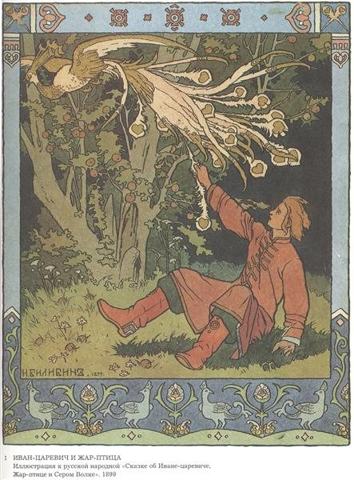
The glowing bird of Russian wonder tale whose single stolen feather starts a fatal quest — first collected by Afanasyev, later Stravinsky's ballet subject.
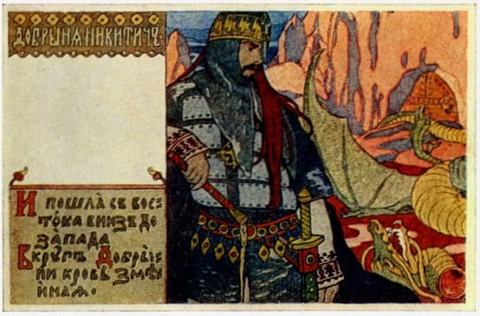
The courtly bogatyr of Kyivan byliny who slew the dragon Zmey Gorynych, outwitted a sorceress, and returned home from a false report of his death.
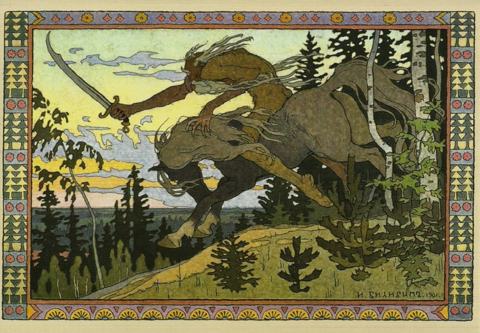
The undying sorcerer of Russian folktale who hid his death in a needle, inside an egg, inside a duck, inside a hare, inside a chest, beneath an oak.
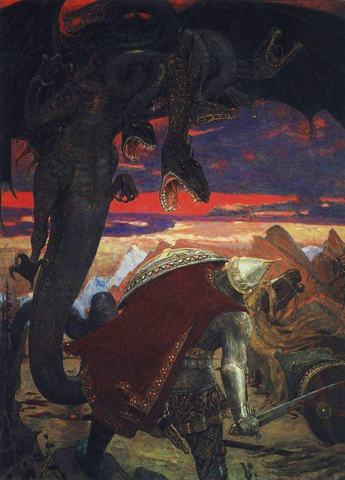
The many-headed dragon — the fire-breathing serpent of Russian epic song, met at a river crossing, and beaten only by a hero who refuses to stop swinging.
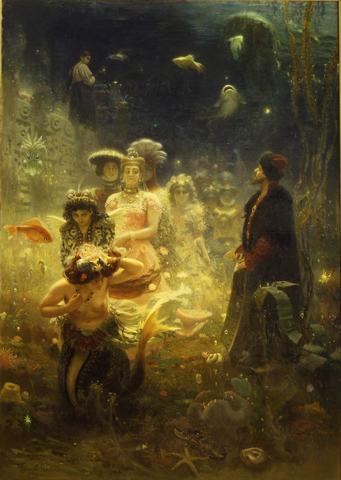
The poor gusli-player of Novgorod who wagered with the Sea Tsar, grew rich, and nearly stayed in the Tsar's underwater hall forever.
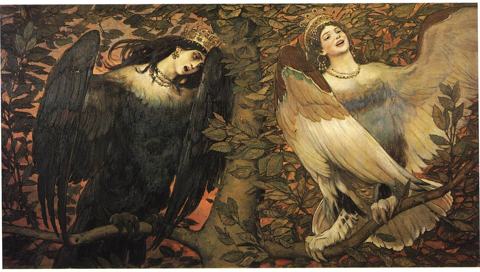
Human-headed bird-women of Russian legend, descended from the Greek siren and halcyon by way of Byzantium, and spread for centuries on cheap lubok prints.
Sources & Further Reading
- 1.Chadwick, N. Kershaw, trans. and ed. Russian Heroic Poetry. Cambridge University Press, 1932.
- 2.Bailey, James & Tatyana Ivanova, trans. An Anthology of Russian Folk Epics. M.E. Sharpe, 1998.
- 3.Hapgood, Isabel Florence. The Epic Songs of Russia. Charles Scribner's Sons, 1886.
- 4.Propp, Vladimir. Russkii geroicheskii epos (The Russian Heroic Epic). Leningrad, 1955.
- 5.Dixon-Kennedy, Mike. Encyclopedia of Russian and Slavic Myth and Legend. ABC-CLIO, 1998.
- 6.Warner, Elizabeth. Russian Myths. British Museum Press, 2002.
Spot an error or have a source to suggest? Write to info@viseterna.com. We cite primary sources and modern scholarship, and we correct fast.