
The Seven Lucky Gods (Shichifukujin)
Seven mismatched deities of luck, drawn from native, Buddhist, Hindu and Taoist sources, who ride together on a treasure ship and visit New Year's dreams.
Seven Gods of Good Fortune on the Treasure Ship, Utagawa Hiroshige, c. 1847-1850 · CC0 · source
Seven Gods, No Common Origin
The Shichifukujin are not a pantheon in the usual sense — they are a committee, assembled in Japan out of deities from at least four different religious traditions with no shared myth of origin and, in most tellings, no myth at all beyond the fact of traveling together. One is a native kami, one arrived from Hindu and Buddhist India by way of China, two more are Chinese Taoist star-gods, one is a legendary Chinese monk, and one is claimed by both a native and a Buddhist identity depending on who is asked 3,5. What unites them is function rather than genealogy: each grants a specific worldly benefit — a good catch, a full harvest, victory, eloquence, long life, contentment — and together they cover most of what an early modern household might reasonably wish for, in much the same practical spirit that keeps a single agricultural kami like Inari among Japan's most visited deities 3,4.
Ebisu and Daikokuten: The Native and the Adapted
Ebisu, shown with a sea bream under one arm and a fishing rod over his shoulder, is the only member of the seven with no foreign pedigree at all, worshipped as a god of fishing and, later, of trade and the marketplace. Popular tradition came to identify him with Hiruko, the boneless first child of Izanagi and Izanami who is set adrift in a reed boat in the Kojiki's creation narrative, with a parallel account in the Nihon Shoki — a reabsorption of the discarded god that scholars read as a medieval development layered onto the ancient texts rather than something either chronicle itself intends 1,2,5. Daikokuten stands beside him as his usual partner, a stout, sack-carrying figure of wealth whose name and iconography descend from Mahakala, a wrathful form of the Hindu god Shiva absorbed into Buddhism as a temple guardian. In Japan a near-homophony between "Daikoku" and the kami Okuninushi's name allowed the imported god and the native one to merge into a single figure, a fusion Faure treats as a representative case of how medieval Japanese religion habitually built new deities out of old ones rather than replacing them outright, the same combinatory logic Breen and Teeuwen describe as normal practice across pre-Meiji shrine life generally 3,6.
Bishamonten and Benzaiten: Imports by Way of Buddhism
Bishamonten, armored and carrying a spear and a miniature pagoda, is the Japanese form of Vaishravana, one of Buddhism's Four Heavenly Kings and guardian of the north, worshipped in Japan chiefly as a protector of warriors and, by extension, of the wealth that martial success could bring 3. Benzaiten, the only woman among the seven, descends from the Hindu river goddess Sarasvati and kept the association with water that name implies — her major shrines sit on islands and lakeshores, at Enoshima and Chikubushima among others — while gaining a Japanese emphasis on music, eloquence, and the arts, usually shown with a biwa lute in hand 3,5.
Fukurokuju, Jurojin, and Hotei: The Chinese Contribution
Fukurokuju and Jurojin are both Japanese adaptations of Chinese Taoist longevity gods, and the overlap between them is close enough that scholars and popular tradition alike have never fully settled their boundary: both are elderly, both carry a staff, and both are linked to the same southern pole-star iconography of long life, which is why a few older lists substitute another deity, most often the fortune-goddess Kichijoten, for one of the pair 3,5. Fukurokuju is recognizable by his distended, elongated bald head, accompanied by a crane or a tortoise; Jurojin carries a scroll said to record the lifespan of every living person. Hotei, by contrast, has a plausible human original: Budai, an eccentric, itinerant Chinese Chan monk of the tenth century, remembered as fat, cheerful, and always carrying a cloth sack of belongings, and reinterpreted in East Asian Buddhism as a folk manifestation of the future Buddha Maitreya 3.
The Treasure Ship and the New Year's Dream
The seven were not fixed into a single traveling group until relatively late, generally placed in the commercial culture of Muromachi-period cities, where merchant patrons had practical reasons to want a compact set of prosperity gods rather than seven separate cults to maintain 3,4. Their standard vehicle is the takarabune, a treasure ship crewed by all seven and loaded with rice bales, coral, and sacks of gold, exactly the cargo depicted in the Hiroshige print above 3. An Edo-period custom had people slide a printed image of the treasure ship under their pillow on the second night of the new year, hoping to secure a lucky hatsuyume, or first dream, of the year; a bad dream could be sent off downstream the next morning by setting the same print afloat on a river 4.
Pilgrimage Circuits Today
The Shichifukujin remain a living devotional circuit rather than a museum piece. Cities across Japan run shichifukujin meguri, pilgrimage routes linking seven shrines or temples, each keeping one god, that people walk during the New Year holidays to collect a stamp or a small charm at every stop. Reader and Tanabe treat these circuits as a textbook case of what they call Japan's "common religion" of worldly benefit, genze riyaku: practical, cheerfully unsystematic, and far more concerned with a good year ahead than with doctrinal consistency among the seven very different gods being petitioned 4. The same pragmatism that assembled the group in the first place, borrowing whatever useful deity was on hand regardless of its origin, keeps it popular now 3,4.
Continue Exploring
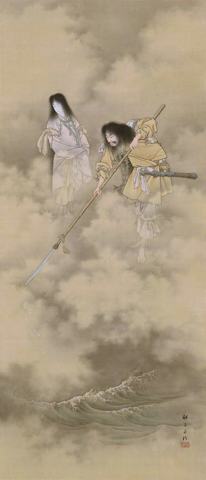
The creator pair of Japanese myth: they stirred the first island out of the sea, bore the land itself, and were parted forever by death.
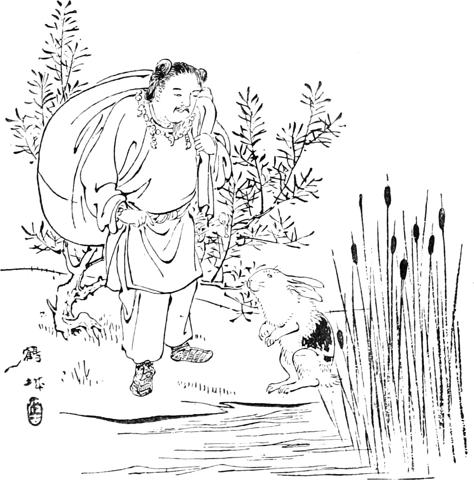
The Izumo kami who healed a skinned hare, survived his own brothers twice, built the land with a tiny god, and ceded it all to Amaterasu's line.
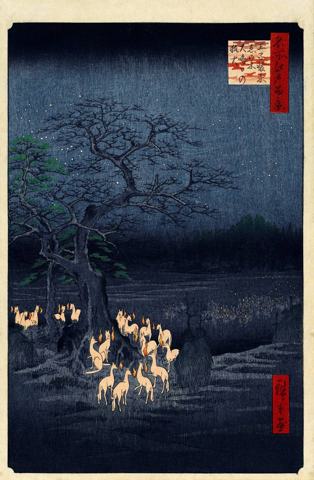
Kami of rice, sake and worldly prosperity, served by white foxes and worshipped at roughly a third of all Japanese shrines.
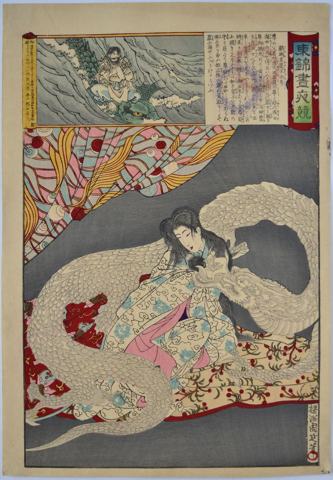
Japan's dragon king of the sea, ruling the palace Ryugu-jo with tide-jewels that command the ocean and a daughter who nearly kept the imperial line undersea.
The land of the dead in Japan's oldest myths: a polluted country reached by a slope in Izumo, sealed with a boulder, with no judgment and no return.
Kami of war, archery and the bow, patron of the samurai and the first kami titled a bodhisattva, worshipped at tens of thousands of shrines.
Sources & Further Reading
- 1.Kojiki (Records of Ancient Matters, 712), trans. Donald L. Philippi. University of Tokyo Press, 1968.
- 2.Nihon Shoki (Chronicles of Japan, 720), in W.G. Aston, trans., Nihongi. Kegan Paul, 1896.
- 3.Faure, Bernard. The Fluid Pantheon: Gods of Medieval Japan, vol. 1. University of Hawai'i Press, 2015.
- 4.Reader, Ian & Tanabe, George J. Practically Religious: Worldly Benefits and the Common Religion of Japan. University of Hawai'i Press, 1998.
- 5.Hardacre, Helen. Shinto: A History. Oxford University Press, 2017.
- 6.Breen, John & Mark Teeuwen. A New History of Shinto. Wiley-Blackwell, 2010.
Spot an error or have a source to suggest? Write to info@viseterna.com. We cite primary sources and modern scholarship, and we correct fast.