
Urashima Taro
A fisherman rewarded with a journey to a timeless undersea land, who returns home to find centuries have passed and opens the one box he was told to leave shut.
Urashima Taro Returning on the Turtle, Tsukioka Yoshitoshi, 1882 · Public domain · source
A Fisherman and a Turtle
Japan's oldest surviving reference to Urashima Taro is a single terse court-chronicle entry. The Nihon Shoki, under the twenty-second year of the legendary Emperor Yuryaku, records that a man of Mizunoe named Urashimako went fishing, caught a large turtle, and watched it turn into a woman; the two of them went into the sea together and reached Horai, glossed in the text as Tokoyo, the eternal land, where they saw immortals 1. The chronicle offers no further plot — no box, no warning, no return — because the compilers were noting a wonder for the record, not telling a story 1.
The fuller story survives elsewhere. A chōka in the eighth-century poetry anthology Man'yoshu dwells on Urashima at length, and Cranston's translation captures its mood: not adventure but loss, the fisherman entering a jewelled hall of the sea god's daughter, forgetting his home for what feels like days, and returning to find everything he knew gone 2. The Tango no Kuni Fudoki, a provincial gazetteer whose Urashima section survives only in quotation inside the later Shaku Nihongi, is the most detailed of the three: it names the fisherman Ura-no-Shimako, describes the sea-maiden explicitly as one of the immortals, and gives the fullest account of his years in her undersea country 3.
Horai, Not Yet a Dragon Palace
It is worth being precise about what the earliest versions actually say, because later retellings changed it. In the Nihon Shoki, the Man'yoshu, and the Tango Fudoki, the fisherman's destination is Horai (the Japanese reading of Penglai, the Daoist isle of immortals) or Tokoyo, the timeless land — a paradise defined by the absence of death and change, not identified with any named ruler of the sea 1,2,3. The now-standard idea that the maiden is Otohime, daughter of the dragon king Ryujin, and that the palace is Ryugu-jo, is a later accretion, layered on as Chinese dragon-king lore and Buddhist naga imagery folded into Japanese folk cosmology over the medieval centuries — the same syncretic process that gave the native sea god Ryujin his familiar dragon body in the first place 4,5. By the time the tale reached the form most people know today, the timeless island of the old texts had been absorbed into that dragon-king's undersea court 4.
The Box He Was Told Not to Open
That later, fuller version is also where the story's most famous object appears: the tamatebako, a jewelled box the sea-maiden gives Urashima as he leaves, with the instruction never to open it 4. Homesick, he insists on returning to shore, only to find his village unrecognisable, his family and friends generations dead, and centuries gone by in what felt to him like a handful of years 3,4. In despair, he opens the forbidden box despite the warning, and a cloud of white smoke escapes it, carrying away the youth the sea country had preserved in him; he ages instantly, in some versions dying on the spot, in others transforming into a white crane 4.
The taboo itself belongs to a pattern this mythology returns to often — a warning not to look, or not to open, that the hero cannot help but break, with the same structural shape as Izanagi's forbidden look at Izanami in Yomi. In both cases the broken instruction is what seals the separation between the human world and the timeless or dead one, permanently 4.
Urashima Taro Since
The tale's medieval and early modern retellings, particularly the illustrated otogizoshi booklets of the Muromachi period, are where the Ryugu-jo framing, the crane transformation, and the box's smoke all become fixed conventions rather than one storyteller's choice 4. From there the story moved easily into children's literature and, like Momotaro, into standardised illustrated versions that shaped how generations of Japanese schoolchildren first met it 4,6.
Modern folklorists read Urashima Taro as one of Japan's clearest examples of the "otherworldly bride" and "time slip" story types found worldwide, but Foster's caution about Japanese folk categories applies here as much as anywhere: the tale was never fixed, and every era that retold it changed what the box, the turtle, and the undersea country were understood to mean 6. What has not changed across two and a half millennia of retelling is the shape of the ending — a reward accepted, a warning ignored, and a homecoming that turns out to be no homecoming at all 1,2,3.
Continue Exploring
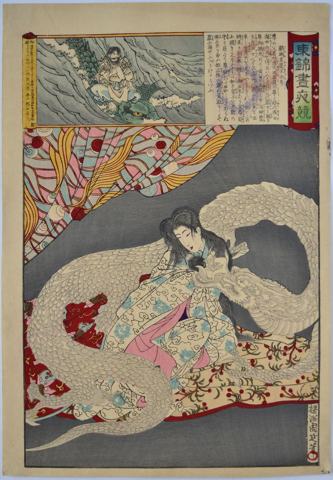
Japan's dragon king of the sea, ruling the palace Ryugu-jo with tide-jewels that command the ocean and a daughter who nearly kept the imperial line undersea.
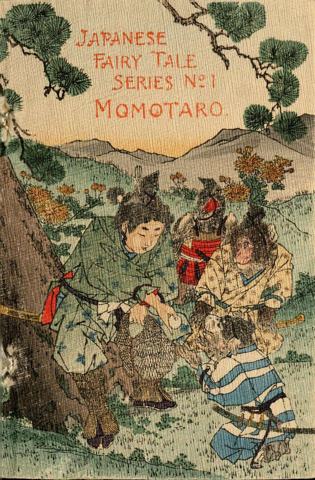
Japan's best-known folk hero — born from a peach and famous for recruiting a dog, a monkey, and a pheasant to raid an island of oni.
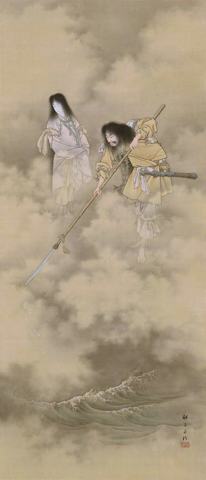
The creator pair of Japanese myth: they stirred the first island out of the sea, bore the land itself, and were parted forever by death.
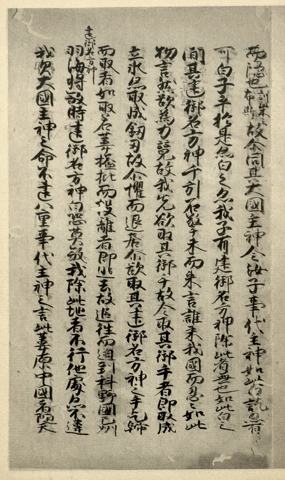
Japan's oldest surviving chronicle, presented to the throne in 712 from one court reciter's memory — the deepest source for the Codex's kami and early emperors.
The land of the dead in Japan's oldest myths: a polluted country reached by a slope in Izumo, sealed with a boulder, with no judgment and no return.
The cherry-blossom princess who married the heavenly grandson, proved her sons' birth by fire, and became the kami worshipped on Mount Fuji.
Sources & Further Reading
- 1.Nihon Shoki (Chronicles of Japan, 720) — Book Fourteen, Yuryaku 22, in W.G. Aston (trans.), Nihongi. Kegan Paul, 1896.
- 2.Cranston, Edwin A., trans. A Waka Anthology, Volume One — The Gem-Glistening Cup. Stanford University Press, 1993.
- 3.Tango no Kuni Fudoki — Gazetteer of Tango Province (8th c.), preserved in fragments within the Shaku Nihongi (13th c.).
- 4.de Visser, Marinus Willem. The Dragon in China and Japan. Johannes Müller, 1913.
- 5.Hardacre, Helen. Shinto: A History. Oxford University Press, 2017.
- 6.Foster, Michael Dylan. The Book of Yokai: Mysterious Creatures of Japanese Folklore. University of California Press, 2015.
Spot an error or have a source to suggest? Write to info@viseterna.com. We cite primary sources and modern scholarship, and we correct fast.