
Ix Chel (Ixchel)
"Rainbow Lady" — the Maya goddess of childbirth, weaving, medicine and divination, and the two distinct goddesses tangled together behind her name.
Ix Chel (Goddess O), Dresden Codex, Maya, c. 11th-12th century · Public domain · source
A Name Before a Goddess
Ix Chel is Yucatec Maya: the feminine prefix ix- with chel, most often translated "rainbow," giving "Rainbow Lady," though "Lady of the Colours" or "Lady Rainbow" render it about as well 4,5. The name is genuinely attested in colonial Yucatec sources. What is far less secure is the single, unified moon-and-fertility goddess that name now conjures 6.
The figure familiar today — moon goddess, weaver, midwife, protector of women, patroness of Cozumel — is a composite assembled over the last century from several distinct pieces of evidence 6. Sorting the pieces is not pedantry; it is the difference between what the Maya recorded and what the twentieth century made 4,6.
What Landa Wrote
Diego de Landa, whose Relacion is both the richest colonial description of Yucatec religion and the work of the man who burned Maya books, names Ixchel in specific contexts 1. He associates her with childbirth, listing her among the deities invoked by women, and connects her to medicine: in the festival of the physicians and diviners in the month Zip, held for Ixchel and other patrons, practitioners brought out their bundles of curing stones and idols 1.
Landa also reports that Maya women made pilgrimages by sea to the island of Cozumel to petition a goddess there, a shrine that drew travellers from far along the coast 1,7. Later tradition attached the shrines of Cozumel and Isla Mujeres to Ix Chel specifically, and archaeology confirms Cozumel was a major pilgrimage destination with substantial Postclassic occupation — though the identification of its patron deity by name rests more on colonial report than on inscription 6,7.
Two Goddesses, Not One
In the codices, scholars distinguish two quite different female deities, and much of the modern confusion comes from collapsing them 4,5.
Goddess O, whom epigraphers read as Chak Chel, "Great Rainbow" or "Red Rainbow," is aged: wrinkled, sometimes with jaguar claws and ears, a coiled serpent on her head, and crossed bones on her skirt 4,5. She is a powerful, dangerous figure associated with midwifery, curing, weaving and destruction. The famous flood scene on page 74 of the Dresden Codex shows her pouring water from an overturned jar while a celestial caiman drains the sky — the end of a world in her hands 2,4.
Goddess I is young: an attractive woman associated with sexuality, marriage, childbirth and divination, sometimes with a lunar crescent, whose name in the codices has been read as Ixik or Ixik Uh 4,5. She is the closer match for a young moon goddess.
Taube's analysis of the Postclassic deities lays out the distinction and makes clear that "Ix Chel" as used in colonial Yucatec probably corresponds most closely to the aged Goddess O, not to the youthful lunar figure with whom she is now routinely merged 4,5.
How the Modern Ix Chel Was Assembled
Traci Ardren's article "Mending the past" traces how the composite formed 6. Twentieth-century scholarship, notably J. Eric S. Thompson's work on the Middle American moon goddess, drew Landa's Ixchel, the codical goddesses, Cozumel's pilgrimage shrine and the lunar imagery of Classic art into one deity 6. Later specialists took the synthesis apart again, but by then it had escaped into guidebooks, tourism marketing, and popular spirituality, where "Ix Chel, Maya moon goddess" is now standard 6.
Ardren's point is not simply that the popular version is wrong. She examines why the composite was attractive and how archaeologists themselves participated in inventing it, and she notes that the modern goddess has real meaning for contemporary communities and women's spirituality even where she has no clear ancient warrant 6. The honest position is to describe both the ancient evidence and the modern figure, and to keep them labelled 6.
What Can Be Said with Confidence
Several things survive the sorting intact 4,5,6,7.
Maya religion included powerful aged female deities associated with weaving, curing, midwifery, divination and the destructive aspect of water. Women's ritual life in Postclassic Yucatan involved pilgrimage to island shrines on the eastern coast, Cozumel above all. The name Ix Chel or Chak Chel belongs to that complex, and chel does mean rainbow — a phenomenon Maya sources treat as ominous rather than benign, sometimes described as an emanation from wells or the underworld rather than a promise in the sky 4,5.
Lunar symbolism was important to the Maya, and a young moon goddess with a rabbit is well attested in Classic art and on painted vessels 4,5. What is not established is that this lunar goddess and the aged Ix Chel of the colonial record were one deity in Maya understanding 4,6.
Weaving and the Backstrap Loom
One image deserves separate mention because it is so often reproduced: the goddess seated at a backstrap loom, a figurine type well known from the Late Classic burials of Jaina island off the Campeche coast 5,7. These figures make weaving a divine act performed by an old woman, and they connect the goddess complex to a craft that Maya women controlled and that carried heavy social meaning 5,7.
Whether the Jaina weaver should carry the name Ix Chel is exactly the question this entry has been circling. She belongs to the same field of meaning; the name arrives from a different century and a different corner of the Maya world 4,6.
Continue Exploring
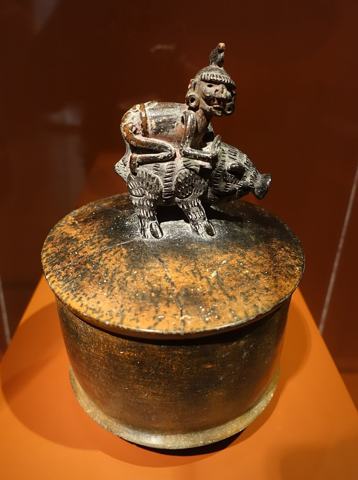
The aged creator — supreme sky god of the Maya, patron of writing, healing and divination, and the old man scholars know as God D.
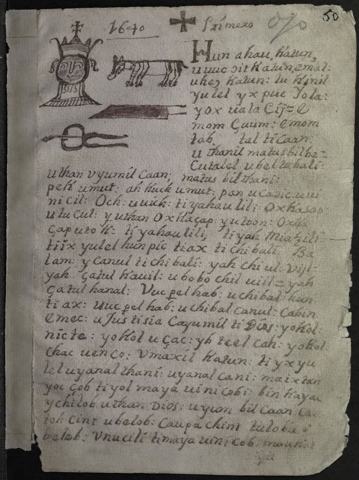
"The one god" of Yucatec Maya colonial texts — a name most scholars now read as a missionary translation for the Christian God, not an ancient Maya deity.
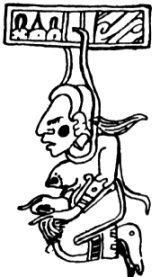
The "suicide goddess" of a single Landa passage and one Dresden Codex image — an identification recent scholarship seriously disputes.
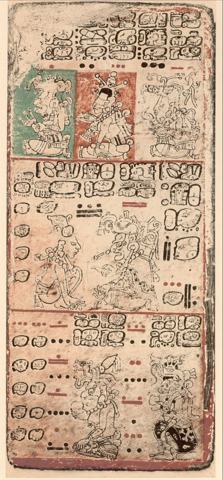
The oldest surviving book of the Americas — a Maya screenfold of astronomical tables, deciphered by a Dresden librarian, that survived a 1945 firestorm.
Colonial Yucatec Maya town books mixing prophecy, history, medicine and Christian material — named for a jaguar-priest said to have foreseen the Spanish.
The underworld maiden of the Popol Vuh who is impregnated by a talking skull, survives her own execution, and becomes the mother of the Hero Twins.
Sources & Further Reading
- 1.Diego de Landa, Relacion de las cosas de Yucatan (c. 1566).
- 2.The Dresden Codex (Postclassic Maya screenfold), including the flood scene on page 74.
- 3.The Madrid Codex (Postclassic Maya screenfold).
- 4.Taube, Karl. The Major Gods of Ancient Yucatan. Dumbarton Oaks, 1992.
- 5.Miller, Mary & Karl Taube. The Gods and Symbols of Ancient Mexico and the Maya. Thames & Hudson, 1993.
- 6.Ardren, Traci. 'Mending the past: Ix Chel and the invention of a modern pop goddess.' Antiquity 80, no. 307 (2006): 25–37.
- 7.Sharer, Robert J. with Loa P. Traxler. The Ancient Maya, 6th edition. Stanford University Press, 2006.
Spot an error or have a source to suggest? Write to info@viseterna.com. We cite primary sources and modern scholarship, and we correct fast.