
Lares and Penates (Roman Household Gods)
The small gods of the Roman house — the Lares who guard the family line and the Penates who guard its stores, worshipped daily at a shrine by the hearth.
Bronze statuette of a dancing Lar, Roman, 1st century AD (Metropolitan Museum of Art) · CC0 · source
Two Gods, One Shrine
Roman household religion centred on two different kinds of small god, worshipped side by side but not interchangeable. The Lares were guardians of place and family line — a household had its Lar familiaris, a crossroads had its Lares compitales, and even the state had its own public Lares — while the Penates were guardians of the penus, the household's store of food, and by extension of its continued survival as a going concern 7. Both were kept at a small shrine, the lararium, typically near the hearth or entrance, where the family made daily offerings of food, wine, and incense 7. The two categories blurred constantly in practice — the same niche often held images of both, plus the family's genius and any favourite minor spirits — and Roman writers themselves are not always consistent about which name covers which figure 5,7.
The God Who Spoke the Prologue
The best evidence for how ordinary Romans actually treated their Lar comes from comedy. Plautus's Aulularia, staged around 195 BCE, opens with the household's own Lar familiaris addressing the audience directly: he explains that he has kept a pot of buried gold hidden in the house for generations, out of loyalty to the family, and that he intends to let the miserly old owner Euclio find it now because his daughter has shown the god proper respect while her father has not 2. The premise only works if the audience already accepted a Lar as a being with memory, opinions, and the standing to meddle in a family's fortunes — not an abstraction, but a small resident god who had watched the house for generations and took sides in what happened inside it 2,6.
Lara's Sons
Ovid supplies the Lares with an origin story that is really an origin story for gossip itself. In the Fasti, the nymph Lara warns the river-nymph Juturna that Jupiter is pursuing her, then reports the god's intentions to Juno as well; furious at her talkativeness, Jupiter tears out her tongue and orders Mercury to escort the now-mute nymph to the underworld. On the way, Mercury seduces her, and the children of that union become the Lares, "who guard the crossroads and keep watch over our city forever" 3. It is a strange myth to attach to household gods so central to ordinary decency — a story about silence forced on a woman who talked too much, producing the gods who watch everyone else's business — and Ovid does not pretend the pieces fit together neatly 3.
The Gods Aeneas Carried
The Penates have a grander foundation story. In the Aeneid, as Troy burns, Aeneas carries his father Anchises on his shoulders and, in Anchises's arms, the city's sacra and its Penates — the household gods of the Trojan royal line itself, saved from the sack and carried west across the Mediterranean 4. Virgil treats their eventual resting place as a real question with real stakes: an oracle sends the Trojans first to Crete by mistake before the true destination, Italy, is confirmed, and the poem repeatedly frames Aeneas's whole voyage as an errand to find these gods a permanent home 4. Roman tradition held that the Trojan Penates were eventually installed in the Temple of Vesta in the Forum, tended by the Vestals alongside the sacred fire — a public, state-level version of exactly the private cult practised in every Roman kitchen 7.
Keeping the Gods When You Move
Cato the Elder's manual for running a farm assumes household religion as a matter of course rather than a topic worth explaining: he instructs the farm manager's wife to keep the hearth garlanded on the calends, nones, and ides, and to pray to the household Lar before any offering is made, folding the god into the routine business of running the property 1. That everyday, unglamorous quality is the real substance of the cult. Unlike the great state gods with their temples and public festivals, Lares and Penates belonged to a single household and moved with it; recent scholarship built around excavated shrines and inscriptions treats them as evidence for how religion actually worked at the level of ordinary families, slaves and freedmen included, rather than at the level of senators and priesthoods 6.
Not Necessarily Ancestors
Older scholarship, going back over a century, generally explained the Lares as spirits of the dead — deified ancestors kept close to protect their descendants, which would make the household cult a form of ancestor worship parallel to funeral rites. Flower's study argues this consensus rests on thin ancient evidence and proposes instead that the Lares were always understood as a distinct class of cheerful, protective godlings, closer in spirit to the small guardian snakes often painted beside them in household shrines than to the family dead 6. The debate has not fully settled either way, and it is a useful reminder that even Rome's most intimate, best-attested household cult still leaves basic questions about what people actually believed open to argument 6,7.
After the Old Religion
Augustus revived the Compitalia, the crossroads festival of the Lares, as part of his broader religious restoration, reorganising the ward-level colleges of freedmen and slaves who ran the local shrines and pairing the Lares of each neighbourhood with his own guardian spirit 6,7. The household cult itself simply continued for centuries afterward, low-visibility and largely undocumented in literature precisely because it was too ordinary to need explaining, until Christianization eventually displaced the daily offering at the hearth-side shrine with other habits 6.
Continue Exploring
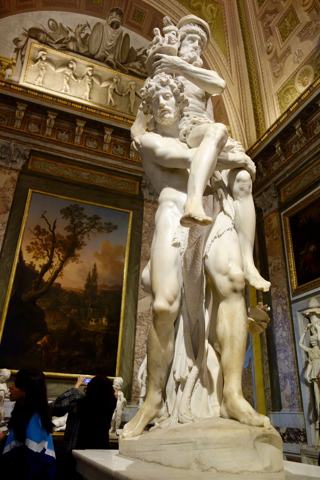
The Trojan prince who escaped burning Troy carrying his father and household gods, wandered the Mediterranean, and became Rome's mythical ancestor.
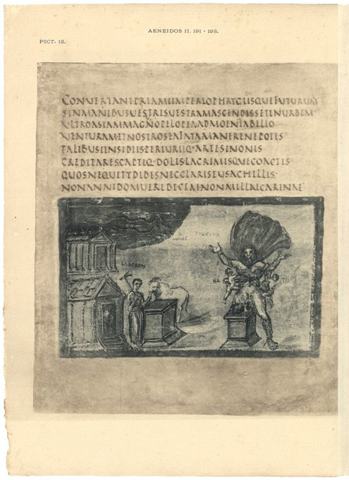
Virgil's unfinished epic of Aeneas's flight from Troy and the founding of Rome — composed for Augustus, nearly burned at its author's own request.
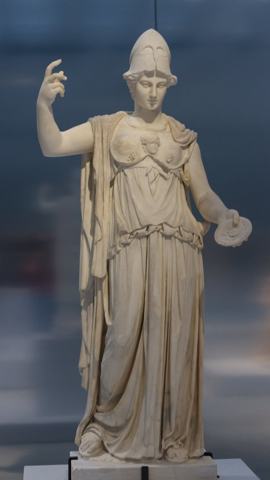
Goddess of wisdom and the crafts — third of the Capitoline Triad, and Rome's patron of every skilled trade from weaving and teaching to medicine.

Rome's hearth goddess, worshipped as a living fire rather than a statue, tended in the Forum by six priestesses for over a thousand years.
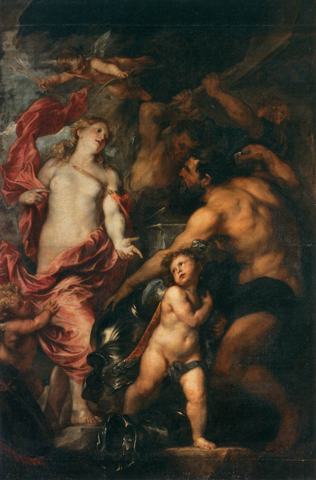
Rome's fire god, honored to keep flame from the wooden city, later remade as the mythical blacksmith who forged arms for gods and heroes.
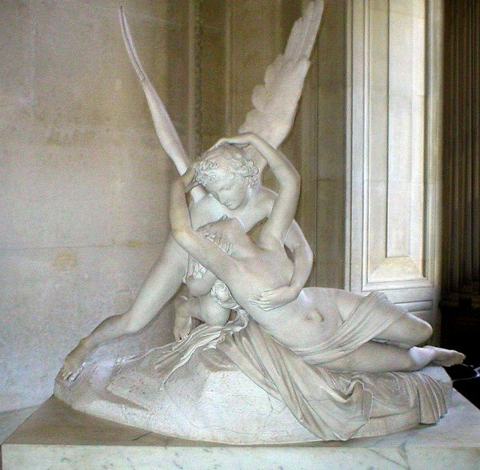
The winged god of desire, son of Venus — best known through Apuleius's tale of his secret marriage to the mortal Psyche and the trials Venus set her.
Sources & Further Reading
- 1.Cato the Elder, De Agri Cultura (c. 160 BCE).
- 2.Plautus, Aulularia (c. 195 BCE) — prologue.
- 3.Ovid, Fasti (8 CE), Book 2.
- 4.Virgil, Aeneid (29-19 BCE), Books 2-3.
- 5.Flower, Harriet I. The Dancing Lares and the Serpent in the Garden: Religion at the Roman Street Corner. Princeton University Press, 2017.
- 6.Bodel, John & Saul M. Olyan, eds. Household and Family Religion in Antiquity. Wiley-Blackwell, 2008.
- 7.Beard, Mary, John North & Simon Price. Religions of Rome, Volume 1: A History. Cambridge University Press, 1998.
Spot an error or have a source to suggest? Write to info@viseterna.com. We cite primary sources and modern scholarship, and we correct fast.