
The Aeneid
Virgil's unfinished epic of Aeneas's flight from Troy and the founding of Rome — composed for Augustus, nearly burned at its author's own request.
Death of Laocoon, Vergilius Vaticanus fol. 18v, 5th century, photographic facsimile 1899 (Vatican Library, Vat. lat. 3225) · Public domain · source
What the Poem Is
The Aeneid is a twelve-book Latin epic in dactylic hexameter, composed by Publius Vergilius Maro between roughly 29 and 19 BCE at the encouragement of the emperor Augustus, telling the story of Aeneas's escape from the fall of Troy and his long, costly journey to found the settlement that would eventually become Rome 1. It was written to sit alongside Homer's Iliad and Odyssey as a national epic for a city that had never had one of its own, and it borrows the shape of both poems deliberately — six books of wandering echoing the Odyssey, six books of war echoing the Iliad — while making the destination, rather than the return home, the point of the journey 1,4. Almost every major figure in Rome's foundation legend beyond Aeneas himself, from Romulus and Remus to the Lares and Penates he carries out of the burning city, is either introduced or given its fullest ancient treatment somewhere in its books 1. The underlying claim, that Rome's founders descended from Trojan refugees, was not new advertising invented for the occasion: Greek cities had traded on claimed Trojan ancestry for diplomatic advantage for centuries before Virgil, and the Aeneid is best understood as the most successful and permanent use that older tradition was ever put to, rather than an Augustan invention from nothing 7.
A Deathbed Order Overruled
The poem almost did not survive its author. Virgil died at Brundisium in September 19 BCE, having spent eleven years on the Aeneid and still regarding it as unfinished — the text contains several dozen incomplete half-lines scattered through the books, most visibly in Books 2 through 10, where a thought simply stops mid-metre 2. According to the biography attributed to Suetonius and preserved through the later writer Donatus, Virgil asked on his deathbed that the manuscript be burned rather than published in its unpolished state; Augustus overruled him and assigned two of the poet's friends, Varius Rufus and Lucius Plotius Tucca, to prepare it for publication, with strict instructions to cut nothing essential and add nothing of their own 2. The half-lines were left standing rather than smoothed over, which is why a reader today can still see, book by book, exactly where the poet's own work stopped.
What It Contains
The first half follows Aeneas from Troy's fall through seven years of wandering — the doomed love affair with Dido of Carthage, a landing in Sicily, and a visit to the underworld guided by the Sibyl of Cumae, where his dead father Anchises shows him a preview of Roman history yet to happen 1. The second half turns to war in Italy, as Aeneas's arrival in Latium draws him into conflict with Turnus, the scorned suitor of the princess he is fated to marry; the poem ends abruptly with Turnus's death and no scene of peace or founding to follow it, a choice that has unsettled readers since antiquity 1,5. Throughout, the poem functions as a kind of mythological infrastructure for later Roman religion and politics at once: it supplies origin stories for Roman religious practice, for the enmity between Rome and Carthage, and for the divine ancestry the Julian family claimed through Aeneas's mother Venus 1.
How It Survived
Virgil was a school text almost immediately, and that status is the main reason the poem survived at all. The late-antique commentator Servius wrote a line-by-line commentary around 400 CE explaining vocabulary, mythology, and Roman antiquarian detail for students, and his notes were copied alongside the poem itself for centuries, preserving information about Roman religion and history that would otherwise be lost entirely 3. The oldest surviving illustrated copies, the Vergilius Vaticanus and the closely related Vergilius Romanus, both produced in the fourth or fifth century CE and now held in the Vatican Library, are among the very few illustrated manuscripts of any classical Latin text to survive from late antiquity, and their damaged, gap-filled pages are themselves a record of just how much handling the poem received across the collapse of the Western empire and the medieval copying that followed 1,4.
Reading Augustus Into It, and Against It
Because the poem was written under Augustus's patronage and ends with Jupiter promising Rome "empire without end," it was long read as straightforward political praise. Putnam's 1965 study helped found what later scholars call the "Harvard School" of interpretation, arguing that the Aeneid's recurring scenes of grief, loss, and unresolved violence, especially its abrupt, rage-driven ending, undercut any simple reading of the poem as propaganda and instead show Virgil deeply ambivalent about what founding an empire actually costs 5. Horsfall's survey of the field treats this "pessimistic" reading as valuable but overstated on its own, and argues that the poem is built to sustain both an Augustan and an anti-Augustan reading simultaneously rather than resolve into either one — which he takes to be a deliberate feature of Virgil's design, not a puzzle later critics have failed to solve 4.
Translations across Centuries
The Aeneid has been translated into English continuously since the Renaissance, and the differences between versions track changing ideas of what an epic should sound like as much as they track Latin scholarship. Robert Fitzgerald's 1983 translation, still widely assigned in American classrooms in its Vintage Books edition, aimed for a fluent, speakable modern verse line in place of the more formal diction of earlier twentieth-century renderings 6. Its persistence in classrooms and its regular reprinting are themselves part of the poem's afterlife: a text originally shaped to give a very specific Roman regime a usable past has gone on, largely intact, to become the standard introduction to Roman mythology for readers who have no stake in Augustus's politics at all 6.
Continue Exploring
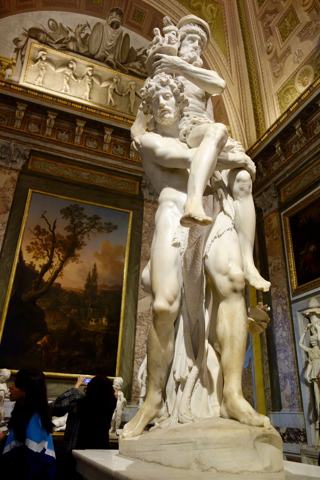
The Trojan prince who escaped burning Troy carrying his father and household gods, wandered the Mediterranean, and became Rome's mythical ancestor.
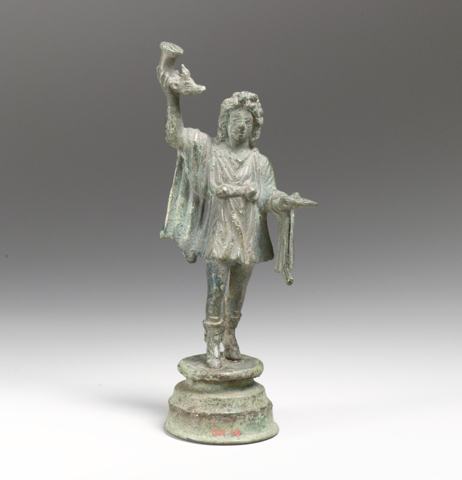
The small gods of the Roman house — the Lares who guard the family line and the Penates who guard its stores, worshipped daily at a shrine by the hearth.
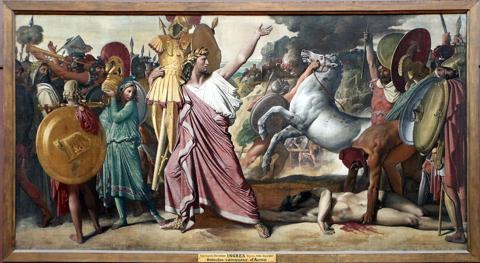
Twin sons of Mars, saved by a she-wolf and raised by shepherds, who quarreled over where to found Rome — a quarrel that ended with only one of them ruling it.
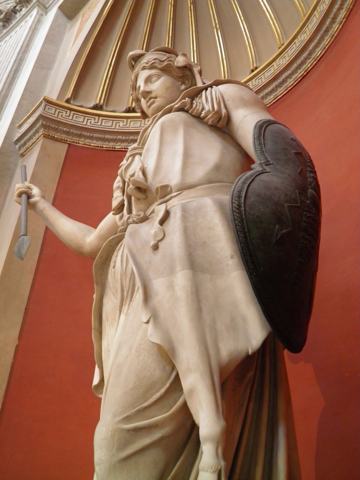
Queen of the gods — Rome's guardian of women, childbirth and the state, whose sacred geese warned the Capitol and whose temple gave us the word money.
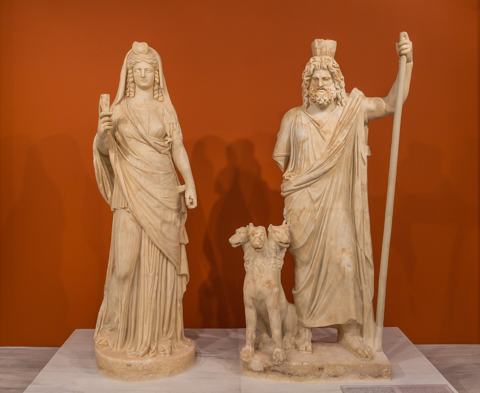
Lord of the underworld — the Roman god of the dead whose older name, Dis Pater, means "the rich father": wealth is what lies buried in the ground.
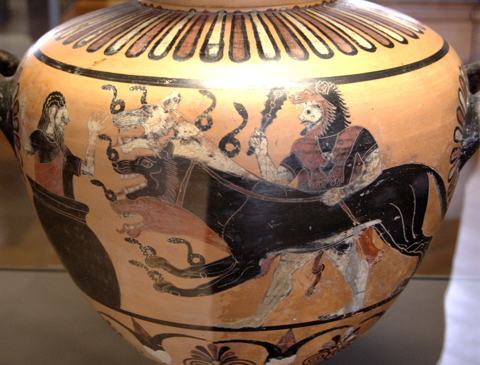
The many-headed hound who guards the gates of the underworld. He fawns on everyone who enters and devours anyone who tries to leave.
Sources & Further Reading
- 1.Virgil, Aeneid (29-19 BCE).
- 2.Suetonius (attrib.), Life of Virgil, in De Poetis (2nd century AD, preserved through Donatus).
- 3.Servius, In Vergilii Aeneidos Libros Commentarii (c. 400 AD).
- 4.Horsfall, Nicholas, ed. A Companion to the Study of Virgil. Brill, 1995 (2nd ed. 2000).
- 5.Putnam, Michael C. J. The Poetry of the Aeneid — Four Studies in Imaginative Unity and Design. Harvard University Press, 1965.
- 6.Fitzgerald, Robert, trans. The Aeneid. Vintage Books, 1990.
- 7.Erskine, Andrew. Troy between Greece and Rome — Local Tradition and Imperial Power. Oxford University Press, 2001.
Spot an error or have a source to suggest? Write to info@viseterna.com. We cite primary sources and modern scholarship, and we correct fast.