
Sirin, Alkonost and Gamayun (Bird-Women of Slavic Lore)
Human-headed bird-women of Russian legend, descended from the Greek siren and halcyon by way of Byzantium, and spread for centuries on cheap lubok prints.
Sirin and Alkonost: The Birds of Joy and Sorrow, Viktor Vasnetsov, 1896 (Tretyakov Gallery, Moscow) · Public domain · source
Three Birds, One Family
Sirin, Alkonost and Gamayun are Russian legend's paradise birds: creatures with a bird's body and wings and a woman's face, and often her arms as well, usually shown crowned or haloed and perched in a flowering tree 1,2. Sirin and Alkonost are consistently paired, first as a matched set of temptation and consolation and later, in the popular imagination, as a matched set of sorrow and joy; Gamayun runs on a separate track as a bird of prophecy, closer to a messenger than a temptress 1,2,5. None of the three belongs to the pre-Christian Slavic pantheon documented in the chronicles — they enter the record already as literary and iconographic borrowings, and everything that follows should be read with that in mind 1,2.
A Greek Bird in Slavic Dress
The name Sirin is simply the Slavic rendering of the Greek seirenes, the sirens, carried north through Byzantine translated literature — bestiaries, chronicles, and moralized natural histories — rather than through any native Slavic tradition of its own 1,2,5. Alkonost's name has the same kind of journey behind it, from the Greek alkyon, the kingfisher into which the grieving Alcyone was transformed, whose nesting at sea was said to calm the winter waves for her "halcyon days" 1,2. Both birds therefore arrive in Rus already dressed as moral emblems out of translated Greek natural history, and the Slavic material adds a folk life to them rather than inventing them from nothing 1,2.
What They Do
In the texts and images that circulated in Muscovite Rus, Sirin is the more dangerous of the two: her singing is so beautiful that anyone who hears it can lose their reason or their life, an inheritance direct from the man-luring Greek sirens of the Odyssey tradition filtered through Byzantine bestiary literature 1,2,5. Alkonost's song is gentler and is said to bring forgetfulness of grief rather than death, and in some tellings she nests on the seashore and, for the days she broods her eggs, calms the water — the halcyon myth transposed with barely a change 1,2. Both are placed in paradise, and both cross freely between that world and this one, which is the core of what "paradise bird" meant to the audiences who copied and printed them 1,5.
It is worth being cautious about how sharply later tradition separates them. The clean opposition of Sirin as sorrow and Alkonost as joy, so familiar today, is not fixed in the older manuscript and print tradition, where both birds shade between comfort and danger depending on the text; the strict two-term contrast owes a great deal to a single, very famous painting discussed below 1,2.
Gamayun, the Bird Who Knows
Gamayun belongs to a different job description. Early modern Russian sources and folk imagery describe her as a prophetic bird who knows the future and the past and can be consulted, sometimes explicitly called a messenger of higher powers rather than a temptress of travelers 1,2,4. The etymology of her name is unsettled — proposals connect it to onomatopoeic words for a bird's cry and to older Iranian-influenced vocabulary carried through steppe contact, and neither is conclusively established 2. Modern neo-pagan writing has built an entire "Book of Gamayun" mythology around her prophecies; that material is a contemporary literary invention with no basis in the medieval or early modern sources and should not be mistaken for attested folklore 2.
Printed on Cheap Paper
Long before any of the birds became fine art, they were market goods. Russian lubki — cheap woodblock- and later copperplate-printed sheets, sold at fairs and pasted on cottage walls from the seventeenth century onward — carried Sirin and Alkonost among their most popular religious-folkloric subjects, usually captioned with verses identifying the birds and explaining their paradise home 3,6. Dianne Farrell's study of these prints situates the paradise birds within a broader lubok repertoire that recycled Byzantine-derived and hagiographic imagery for a mass popular audience largely outside elite control, and Olga Kuznetsova's research on the birds' afterlife in early modern Rus traces exactly how the pair drifted from bestiary gloss to household devotional decoration over these centuries 3,4. Dmitry Rovinsky's monumental nineteenth-century catalogue of Russian folk prints preserves a large sample of this material, including many Sirin-and-Alkonost sheets, as primary evidence of how ordinary buyers actually encountered the birds 6.
Vasnetsov's Canvas
The image most people now call to mind is a single painting. Viktor Vasnetsov's Sirin and Alkonost: The Birds of Joy and Sorrow (1896, Tretyakov Gallery) sets a dark-plumed, weeping Sirin against a golden, singing Alkonost, and it is this canvas — not any older text — that hardened the pair into a clean emotional opposition for modern audiences 1,2. Vasnetsov's Gamayun, painted around the same period, did the same work for the prophetic bird, and Alexander Blok's 1899 poem "Gamayun, the Bird of Prophecy," written in response to the painting, carried her into modern Russian literature 2,5. Between the lubok sheet and the gallery wall, these birds moved from anonymous Byzantine-derived emblem to some of the most recognisable faces in Russian visual folklore, alongside figures such as the firebird and the bogatyrs of Ilya Muromets painted by the same artist 1,2,5.
Continue Exploring
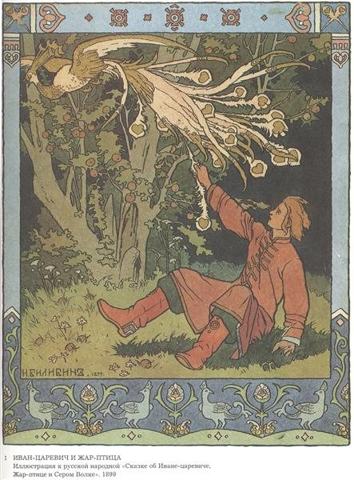
The glowing bird of Russian wonder tale whose single stolen feather starts a fatal quest — first collected by Afanasyev, later Stravinsky's ballet subject.
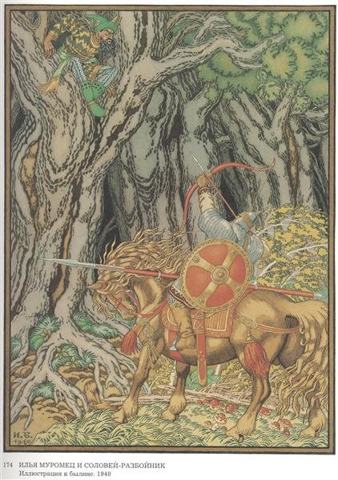
The paralysed peasant's son of Murom who rose from the stove to become Russia's greatest epic hero, and shot down the monstrous Nightingale the Robber.
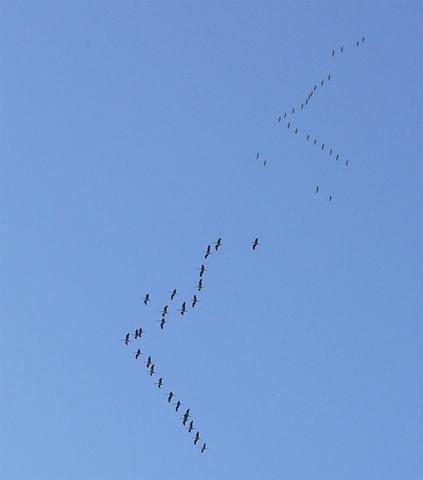
A warm otherworld at the earth's edge where migratory birds winter and, per some folklore, the dead go too - modern ethnography only, no medieval attestation.
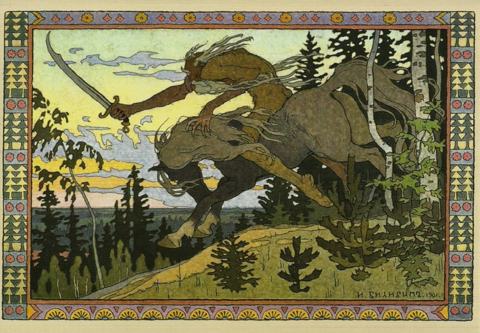
The undying sorcerer of Russian folktale who hid his death in a needle, inside an egg, inside a duck, inside a hare, inside a chest, beneath an oak.
The Slavic forest lord who leads travellers in circles, owns the wolves and the game, and can stand taller than the pines or shorter than the grass.
Slavic water spirit of the restless dead: a drowned or unbaptised girl who leaves the river for one week each summer to walk the fields and the woods.
Sources & Further Reading
- 1.Tokarev, S.A., ed. Mify narodov mira - Entsiklopediya (Myths of the Peoples of the World - An Encyclopedia). Moscow, Sovetskaya Entsiklopediya, 1980-1982.
- 2.Dixon-Kennedy, Mike. Encyclopedia of Russian and Slavic Myth and Legend. ABC-CLIO, 1998.
- 3.Farrell, Dianne Ecklund. "Medieval Popular Humor in Russian Eighteenth-Century Lubki." Slavic Review, vol. 50, no. 3, 1991, pp. 551-565.
- 4.Kuznetsova, Olga. "Ptichiy rai - o sud'be raiskikh ptits na Rusi v Novoe vremya" (Paradise Birds - the Fate of the Paradise Birds in Rus' in the Early Modern Era). Acta Universitatis Lodziensis. Folia Litteraria Rossica, no. 14, 2021.
- 5.Warner, Elizabeth. Russian Myths. British Museum Press, 2002.
- 6.Rovinsky, Dmitry. Russkie narodnye kartinki (Russian Folk Pictures), 9 vols. St Petersburg, 1881.
Spot an error or have a source to suggest? Write to info@viseterna.com. We cite primary sources and modern scholarship, and we correct fast.