
Koliada (Slavic Winter Festival)
The Slavic midwinter cycle of caroling, mumming and fortune-telling around the solstice - not, despite popular retellings, evidence of a god named Koliada.
Christmastide Divination, Konstantin Makovsky · Public domain · source
A Season, Not Just a Night
Koliada (Russian koliada, Ukrainian koliada, Polish kolęda) names the Slavic midwinter festival cycle running from Christmas Eve to Epiphany, the same stretch of nights Russian folk custom calls Sviatki, "the holy days" 3,5. It clusters around the winter solstice, and its practices — caroling, house-to-house begging in disguise, and divination — are recorded across the entire Slavic-speaking world, from Russia and Ukraine to Poland, Bulgaria, and the South Slavic lands, with local variation but a recognisably shared core 3,5,6. The name itself is widely, though not universally, traced to the Latin calendae, "the first day of the month," suggesting an early borrowing carried alongside Roman and then Byzantine Christian calendar-keeping rather than a native Slavic coinage 4,6.
Caroling House to House
The festival's best-known custom is koliadovanie, caroling: bands of young people, often children, walked from house to house singing songs called koliadki that praised the household, wished it prosperity and a good harvest, and asked for treats or small coins in return, sometimes carrying a pole-mounted star to represent the Star of Bethlehem in later, Christianised versions of the custom 3,5. Propp's study of the Russian ritual calendar places this house-to-house wish for a good harvest squarely inside the same family of agrarian rites as spring and summer festivals, rather than as a wholly separate winter tradition 1. Refusal to give was met, in the milder tellings, with a mock curse wishing the stingy household bad luck in the coming year, a transactional structure ethnographers have compared to a form of ritualised begging rather than pure entertainment 3,5.
Masks and Mumming
Caroling bands were frequently disguised, a practice called ryazhenye — dressing as a goat, bear, horse, or crane, blackening or masking the face, and cross-dressing between sexes — and this mumming layer is generally treated as older and less thoroughly Christianised than the songs themselves 3,5. The goat costume in particular recurs across the Slavic world as a stock Koliada figure, led on a leash from house to house and made to "die" and be revived as part of the performance, a piece of theatre folklorists have long read as an echo of fertility and renewal ritual, though no medieval text describes its origin or explains what it originally meant 5,6.
Divination Nights
Sviatki was also, distinctly from the caroling, the single most important stretch of the year for girls' fortune-telling, particularly divination about marriage 2,3. Recorded methods include letting a rooster loose among piles of grain, coins, and other objects and reading a girl's future from what it pecked first; melting wax or lead into cold water and reading shapes from the hardened result; and listening at crossroads or windows for the first sound of the new year 2,3. W.F. Ryan's survey of Russian magic and divination treats Sviatki fortune-telling as one of the best-documented folk-magic complexes in the whole record, precisely because it survived open Church disapproval by attaching itself to an otherwise respectable Christian season 2.
God, Ritual, or Borrowed Word?
Nineteenth-century Russian mythographers, working in a comparative style that treated most calendar customs as survivals of named pagan deities, presented "Koliada" as a god or goddess of the winter solstice with an implied lost cult 4,6. Later philology has been considerably more cautious. No medieval chronicle or sermon condemns worship of a god called Koliada in the way the Primary Chronicle condemns the cult of Perun or Mokosh; the word is attested only as the name of the festival and its songs, never as an object of prayer or sacrifice, and much of the historical linguistic evidence points toward the term and elements of the custom arriving with early Christian calendar culture rather than surviving from an older Slavic solstice cult beneath it 4,6. The honest position, and the one most modern reference works take, is that Koliada is a ritual complex with a probably ancient midwinter core — mumming and divination of this kind are widespread well beyond Slavic Europe — wrapped in a name and song-tradition that owe at least as much to Christianisation as to anything predating it 4,6.
From Village Custom to Modern Revival
Christianisation folded Koliada into the celebration of Christ's Nativity rather than replacing it outright, and the songs, mumming, and divination survived deep into the twentieth century as folk practice alongside, not instead of, church observance 3,5. The Soviet period suppressed the festival's religious associations while partly preserving its secular shell in New Year custom, and post-Soviet revival has restored open caroling and mumming in Ukraine, Belarus, and Russia 5. Contemporary Rodnover and neo-pagan groups have gone considerably further, presenting Koliada as the recovered worship of an authentic solstice god — a claim the medieval and early modern record, taken on its own terms, does not support 4,6.
Continue Exploring
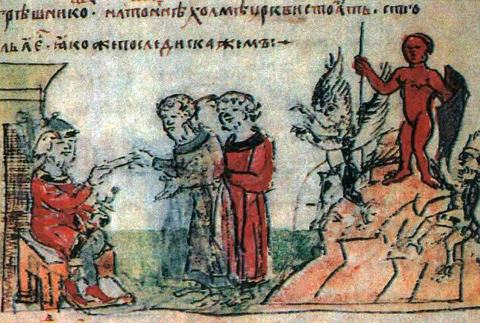
God of thunder and the striking bolt — the oak-crowned sky lord of the early Slavs, sworn by in treaties and thrown into the Dnieper at Rus' baptism.
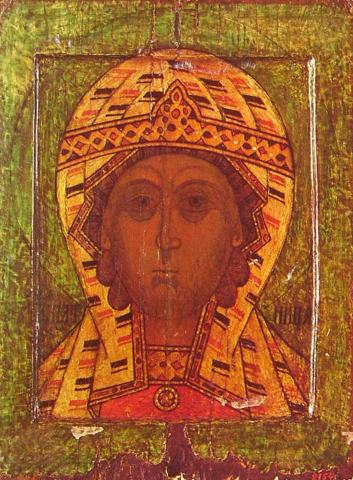
Mother of the damp earth and the spun thread — the only goddess on Vladimir's hill, who outlived her own cult as a night spirit and as Saint Friday.
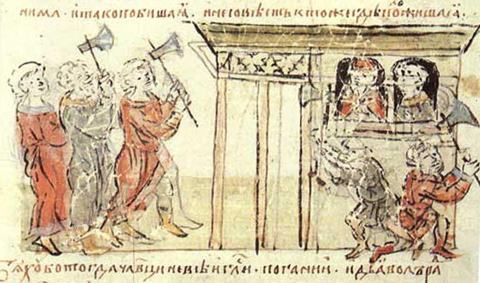
The founding chronicle of Kyivan Rus', c. 1113 - the only narrative source for Vladimir's pagan pantheon of 980 and its fall eight years later.
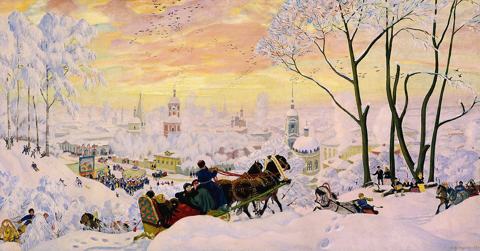
A week of pancakes, sledding and a burned straw effigy before Orthodox Lent - folk sun-worship by reputation, church calendar by attestation.
God of fire and the forge — a smith-god known from one glossed line in a Kyivan chronicle, and one of the most over-reconstructed figures in Slavic myth.
Lord of the cattle and the world below — the second god the Rus' swore by, whose name survived as a curse, a saint's herd, and a beard of grain in the field.
Sources & Further Reading
- 1.Propp, Vladimir Ya. Russkie agrarnye prazdniki (Russian Agrarian Feasts). Leningrad, 1963.
- 2.Ryan, W.F. The Bathhouse at Midnight: An Historical Survey of Magic and Divination in Russia. Sutton, 1999.
- 3.Ivanits, Linda J. Russian Folk Belief. M.E. Sharpe, 1989.
- 4.Warner, Elizabeth. Russian Myths. British Museum Press, 2002.
- 5.Dixon-Kennedy, Mike. Encyclopedia of Russian and Slavic Myth and Legend. ABC-CLIO, 1998.
- 6.Machal, Jan. Slavic Mythology, in The Mythology of All Races, vol. III. Marshall Jones, 1918.
Spot an error or have a source to suggest? Write to info@viseterna.com. We cite primary sources and modern scholarship, and we correct fast.