
Rabinal Achi
A pre-conquest K'iche' Maya dance-drama of capture and sacrifice, still performed each January in Guatemala and honored by UNESCO as intangible heritage.
The plaza and market of Rabinal, Baja Verapaz, Guatemala, 1927 (the town where the dance-drama is still performed) · Public domain · source
The Dance of the Tun
Rabinal Achi is the Spanish-language name by which this K'iche' Maya dance-drama is best known outside Guatemala; its own name is Xajoj Tun, "Dance of the Tun," after the tun, the upright slit-log drum that anchors its music alongside trumpets or shawms 1,3. It is performed in the town of Rabinal, in the department of Baja Verapaz, and is one of the very few Mesoamerican theatrical works whose text and performance tradition both reach back, in some form, to before the Spanish conquest 1,3.
Unlike the Popol Vuh, which is cosmology and dynastic history, Rabinal Achi is a single sustained scene of formal confrontation: dialogue, not narration, carried by masked and costumed dancers rather than read from a page 3,4. It is usually classed among Maya texts alongside the Popol Vuh and the Books of Chilam Balam, but it is the only one of the three still enacted as living theatre rather than read as literature 1,3.
What Happens On Stage
The drama is set at Kajyub', the fifteenth-century capital of the Rabinaleb', and stages a formal trial 3,4. A captured warrior, called Cawek or K'iche' Achi, is brought before the Rabinaleb' king, Job Toj, escorted by the local warrior Rabinal Achi, who gives the piece its familiar title 3,4. Across a long sequence of ritualized, repetitive speeches, the captive and his captor recount their shared history of war between the K'iche' and Rabinaleb' peoples, trade formal insults and boasts, and negotiate — unsuccessfully — for the prisoner's life 3,4. The drama ends with his execution.
Dennis Tedlock's translation corrected a detail that had passed largely unquestioned through earlier French- and Spanish-derived English versions: the captive's death is a beheading, not the heart-extraction sacrifice long assumed by readers used to Aztec accounts, an exoticizing error Tedlock traces back toward Brasseur de Bourbourg's own nineteenth-century rendering 3. Getting this right matters for what the play is actually staging — a K'iche' rite of a defeated warrior's death with its own specific form, not a borrowed Aztec one 3.
Rescued Twice
The drama's transmission runs through two rescues a century apart. Research by the Guatemalan scholar Ruud van Akkeren, incorporated into Alain Breton's critical edition, established that a Rabinal dancer and cofradia member named Bartolo Sis had already transcribed the spoken dialogue from his lineage's guarded oral performance tradition in the 1850s 4. Charles Etienne Brasseur de Bourbourg, the French priest and antiquarian who also carried the Popol Vuh manuscript out of Guatemala, witnessed a performance at Rabinal, obtained a text from Sis, and published the first French translation in Paris in 1862 — the drama's first appearance in print anywhere 2,4.
A second manuscript, known as the Perez Manuscript, was recorded in 1913 and became the basis for the fuller twentieth-century scholarship on the play, including Breton's 1994 French critical edition and its 2007 English translation 4. Tedlock's 2003 translation is the only complete English version made directly from the K'iche' rather than through French or Spanish intermediaries 3.
Still Danced Every January
Rabinal Achi has never stopped being performed by the community that owns it. It is staged annually on January 25, the feast of Rabinal's patron saint, by dancers wearing carved wooden masks and elaborate costume, in a performance that can run for hours and involves much of the town 1,3. In 2005 UNESCO proclaimed it one of the Masterpieces of the Oral and Intangible Heritage of Humanity, formally inscribing it in 2008 on the Representative List created under UNESCO's 2003 convention — recognition aimed in part at supporting a tradition scholars and practitioners alike describe as under real pressure from migration, economic change, and the retreat of K'iche' and Achi-language fluency in the region 5.
History, Staged as Ritual
Scholars are careful not to read Rabinal Achi as a simple historical transcript. Kajyub' was real, and the K'iche'-Rabinaleb' conflicts it dramatizes fit the wider pattern of highland Guatemalan warfare in the century before the conquest that Sharer and Traxler describe for the Postclassic period generally, but the play compresses and stylizes that history into a fixed ceremonial confrontation whose repetitive, formal speeches serve ritual and dynastic memory as much as documentary record 4,6. It sits, in that sense, close to the political and genealogical concerns of the Popol Vuh — a K'iche'-world text using inherited story to state who its community is and where it came from — performed rather than written down, and, unusually among Mesoamerican traditions, still performed by the descendants of the people who made it 1,4.
Continue Exploring
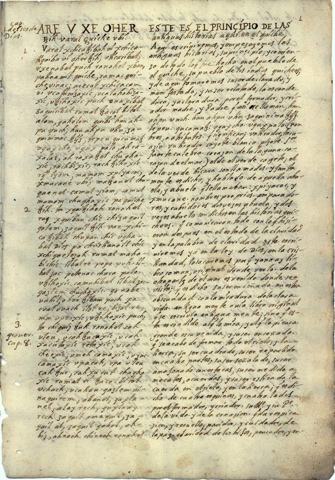
The K'iche' Maya "Book of Council" — creation, the Hero Twins, and a dynasty's history, saved by one Dominican friar's copy of a lost original.
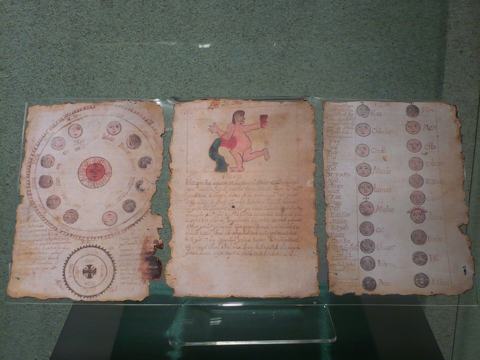
Colonial Yucatec Maya town books mixing prophecy, history, medicine and Christian material — named for a jaguar-priest said to have foreseen the Spanish.
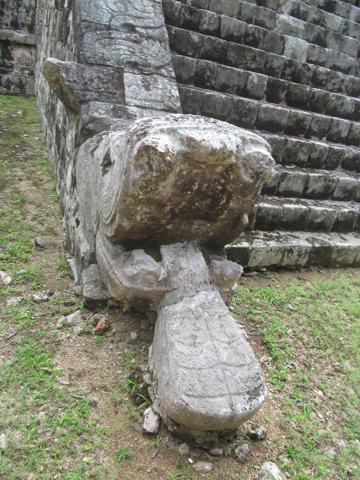
The Feathered Serpent of the Maya — creator's voice in the Popol Vuh, patron of Chichen Itza, and the shadow that descends its pyramid at the equinox.
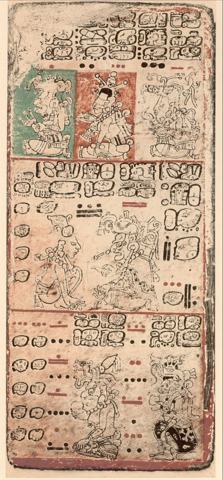
The oldest surviving book of the Americas — a Maya screenfold of astronomical tables, deciphered by a Dresden librarian, that survived a 1945 firestorm.
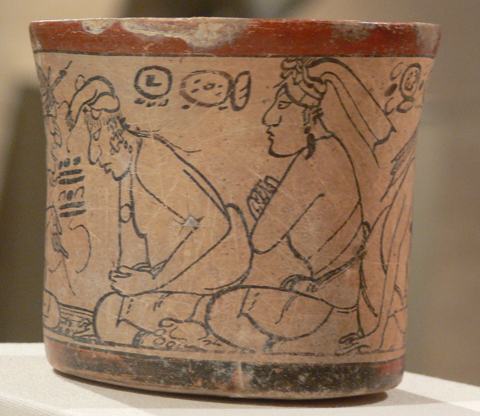
"Place of Fear" — the K'iche' Maya underworld of the Popol Vuh, a court of disease lords whose houses of trial the Hero Twins survived and overturned.
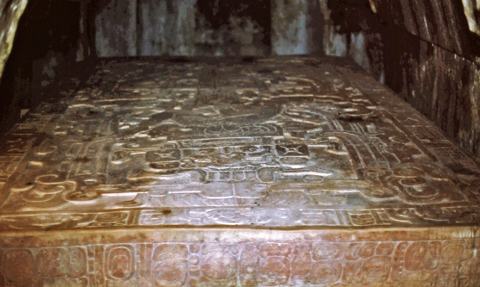
The carved limestone lid over King Pakal's tomb at Palenque — a scene of death and rebirth at the World Tree, and the most misread monument in Maya art.
Sources & Further Reading
- 1.Rabinal Achi / Xajoj Tun — K'iche' Maya dance-drama, performed annually at Rabinal, Baja Verapaz, Guatemala.
- 2.Brasseur de Bourbourg, Charles Etienne (trans.). Rabinal-Achi. Paris, 1862.
- 3.Tedlock, Dennis (trans.). Rabinal Achi: A Mayan Drama of War and Sacrifice. Oxford University Press, 2003.
- 4.Breton, Alain. Rabinal Achi: A Fifteenth-Century Maya Dynastic Drama. Trans. Teresa Lavender Fagan and Robert Schneider. University Press of Colorado, 2007 (French original 1994).
- 5.UNESCO. 'Rabinal Achi Dance Drama Tradition.' Representative List of the Intangible Cultural Heritage of Humanity, proclaimed 2005.
- 6.Sharer, Robert J. with Loa P. Traxler. The Ancient Maya, 6th edition. Stanford University Press, 2006.
Spot an error or have a source to suggest? Write to info@viseterna.com. We cite primary sources and modern scholarship, and we correct fast.