
Bellona (Roman War Goddess)
Rome's own war goddess — named straight from the Latin word for war, whose temple hosted the Senate's dealings with generals and enemies alike.
Bellona, Rembrandt van Rijn, 1633 (Metropolitan Museum of Art) · Public domain · source
An Old Goddess of a Plain Word
The name Bellona comes straight out of bellum, "war" — unlike Mars, whose name is of uncertain and possibly pre-Roman origin, Bellona is built directly out of the Latin word for the thing she governs 1. Roman antiquarian tradition already assumed a working cult for her by the early Republic, but she never accumulated the biography Mars did: no surviving myth tells of her birth, her lovers, or her children 5,6. She appears in Roman religion almost entirely as an office rather than a character, and that gap is itself informative about how differently the same city could personify the same idea twice 6.
The Temple Outside the Walls
Her most important shrine, traditionally dated to 296 BCE and vowed by the censor Appius Claudius Caecus during Rome's wars against the Etruscans and Samnites, stood in the Campus Martius — deliberately outside the pomerium, the sacred boundary that kept armed soldiers and the war god's own field out of the city proper 6,7. That siting made the temple useful in a very practical way. A general still under arms and awaiting a triumph, or an ambassador from a foreign king, could not legally cross into the city itself, so the Senate went to them instead: Livy records sessions held at Bellona's temple specifically to hear a commander's claim to a triumph or to receive envoys who had no standing to enter Rome proper 5,6.
The Spear and the Little Column
Immediately in front of the temple stood a small pillar, the columna bellica, and Ovid describes the ritual that made it Rome's actual instrument of declaring war: a fetial priest, following the old formal procedure for opening hostilities, hurled a spear over the column into a patch of ground treated as enemy territory 3. As Rome's wars moved further from Italy, marching a priest to an actual frontier stopped being practical, so the fiction was simply relocated — a strip of earth by the column was formally designated foreign soil for the ceremony, letting the rite continue unchanged while the empire it served kept growing 3,7. The mechanism, not the geography, was what Rome insisted on keeping intact.
The Bellonarii and the Day of Blood
By the late Republic, Bellona's name had also attached itself to a very different, imported cult. Priests called the Bellonarii, linked to an Anatolian war-and-mother goddess known in Latin sources as Ma-Bellona, marked her rites with self-inflicted wounds — cutting their own arms or legs with a double axe and either pouring the blood at her altar or drinking it, then prophesying in a state Roman writers describe as frenzy 2,6. Tibullus gives the fullest surviving picture: a priestess "moved by Bellona," untroubled by fire or blows, gashes her own arms with an axe, spatters herself with blood, and chants what the goddess reveals to her 2. Scholars are careful to keep this ecstatic, bloody cult, closer in character to the imported rites of Cybele than to old Roman state religion, separate from the sober fetial ceremony at the little column; both used Bellona's name, but they arrived in Rome from different centuries and different parts of the Mediterranean 6.
Civil War's Own Goddess
Lucan pushed Bellona a further step from cult toward pure metaphor. In the Pharsalia, his epic on the civil war between Caesar and Pompey, he invokes her repeatedly as the personification of the war itself — Romans turning their weapons on other Romans, a nation cutting itself the way her own priests cut their arms 4. The image was not an accident of poetic convenience. The Bellonarii's self-wounding gave Lucan a ready-made picture for what he took civil war to be: violence with no external enemy, the state's own blood drawn by the state's own hand 4.
After Rome
Bellona outlived her cult mostly as a label. Renaissance and Baroque painters used "Bellona" as a respectable mythological costume for portraits of armed, martial figures, and Rembrandt's 1633 painting — generally identified as a portrait of his wife Saskia van Uylenburgh posed in gleaming parade armour behind a Gorgon-faced shield — is among the best known results 6. The goddess who once had her own temple, her own priests, and her own bloody festival on the Roman calendar ended up doing quieter work afterward: a stock figure standing in for "war" in general, available to any painter who needed one, with none of the state machinery that had once surrounded her name 6.
Continue Exploring
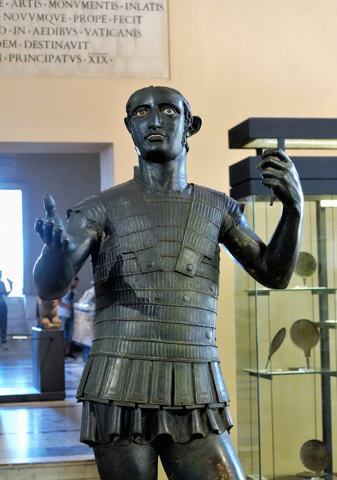
God of war and father of Rome — honoured above almost every other deity, with his own month, his own dancing priests, and the twins he fathered on a Vestal.
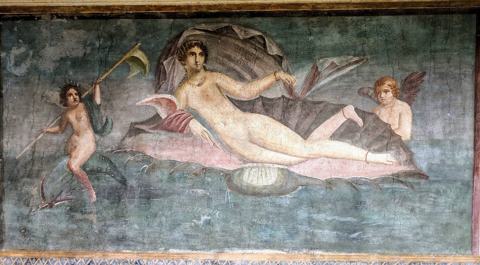
Goddess of love and desire — and the divine ancestress of Rome itself, mother of Aeneas and the claimed forebear of the family of Julius Caesar.
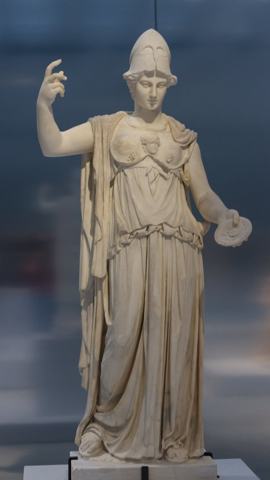
Goddess of wisdom and the crafts — third of the Capitoline Triad, and Rome's patron of every skilled trade from weaving and teaching to medicine.
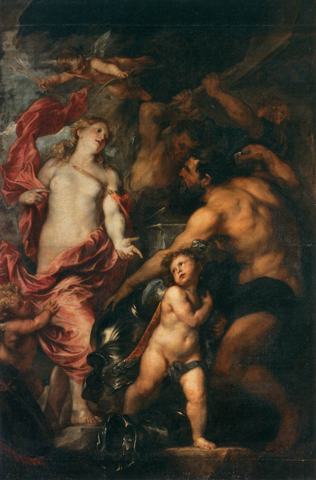
Rome's fire god, honored to keep flame from the wooden city, later remade as the mythical blacksmith who forged arms for gods and heroes.
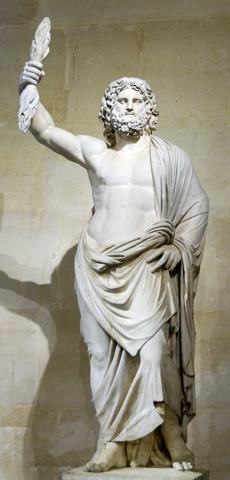
King of the gods and of the Roman state — lord of the bright sky, hurler of the lightning bolt, and the guarantor behind every oath and treaty.
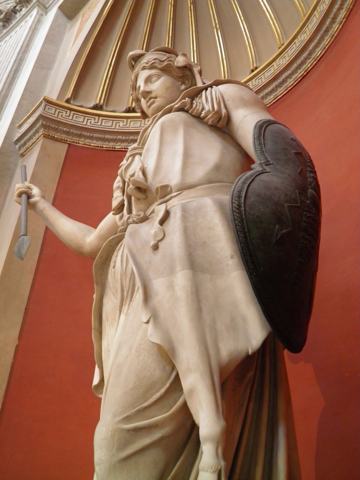
Queen of the gods — Rome's guardian of women, childbirth and the state, whose sacred geese warned the Capitol and whose temple gave us the word money.
Sources & Further Reading
- 1.Varro, De Lingua Latina (1st century BCE).
- 2.Tibullus, Elegies (1st century BCE), Book 1.
- 3.Ovid, Fasti (8 CE), Book 6.
- 4.Lucan, Pharsalia (Bellum Civile), (1st century AD), Book 1.
- 5.Livy, Ab Urbe Condita (c. 27 BCE).
- 6.Beard, Mary, John North & Simon Price. Religions of Rome, Volume 1: A History. Cambridge University Press, 1998.
- 7.Orlin, Eric M. Temples, Religion, and Politics in the Roman Republic. Brill, 1997.
Spot an error or have a source to suggest? Write to info@viseterna.com. We cite primary sources and modern scholarship, and we correct fast.