
Lupa, the She-Wolf
The she-wolf of Rome — the beast that suckled the abandoned twins Romulus and Remus, and the most durable emblem the city ever gave itself.
Lupa Capitolina (Capitoline Wolf), bronze she-wolf with Renaissance twins (Musei Capitolini, Rome) · Public domain · source
The Story as Rome Told It
A usurper deposes his brother at Alba Longa and forces the rightful king's daughter, the Vestal Rhea Silvia, into a priesthood that should end the line. She bears twins anyway and names Mars as their father. The king orders the infants exposed; the servants set the basket in the flooding Tiber and leave, and the receding water strands it at the foot of the Palatine 1,3.
There a she-wolf coming down to drink hears the crying, turns aside, and gives the babies her teats, licking them clean — Livy adds the detail that she was so gentle the king's herdsman found her nursing them 1. The herdsman Faustulus takes the boys home to his wife Larentia, and they grow up among shepherds until the truth of their birth surfaces and they set out to found a city of their own 1,4.
The Rationalists' Reading
Roman writers were not naive about this. Livy pauses in the middle of the tale to report an alternative: Larentia was called lupa by the herdsmen because she made her body common to them, and lupa in ordinary Latin was a slang word for a prostitute — from which Rome's brothels were called lupanaria 1. Plutarch reports the same rationalisation, and Dionysius of Halicarnassus lays out the sceptical and the miraculous versions side by side for his readers to judge 3,4.
The debunking is as old as the story's written form, then, and Romans passed it on without discarding the wolf. That combination — an official miracle and a knowing shrug preserved in the same paragraph — is very characteristic of Roman historical writing 6,7.
Why a Wolf
The choice of animal is not arbitrary. The wolf was sacred to Mars, and in the fuller versions a woodpecker, also his bird, brings food to the twins alongside her 3. The nursing is therefore the father acknowledging his sons through his own creatures, which is how the story answers the awkward question of whether Rhea Silvia was telling the truth 3,7.
The place mattered too. The cave at the foot of the Palatine where it was said to have happened, the Lupercal, remained a real site in the city, shaded by the Ficus Ruminalis, the fig tree named for Rumina, an old goddess of suckling 2,7. Romans could point at the spot.
The Lupercalia
On 15 February, Rome held the Lupercalia, one of its oldest and least explicable festivals. Young men of two priestly bands sacrificed goats and a dog at the Lupercal, smeared blood on the foreheads of two of their number, wiped it off with wool dipped in milk, and were required to laugh; then, naked or nearly so and carrying thongs cut from the goat hides, they ran a circuit striking anyone in reach, with women deliberately putting themselves in the way to secure fertility 2,7.
Ovid tries several explanations for it and settles on none convincingly 2. It was still going in Julius Caesar's lifetime: the Lupercalia of 44 BCE is when Mark Antony, running with the Luperci, publicly offered Caesar a diadem, and Caesar publicly refused it 7. Modern scholars are cautious about tying the festival too neatly to the she-wolf, since the ritual may be older than the foundation legend attached to it, and the wolf may have been drawn in to explain a rite whose original point was already lost 6,7.
How Old Is the Legend?
Wiseman's work on the twins traces how the story assembled itself. The essential claim — Rome founded by a son of Mars — is old, but Remus is harder to date, and Wiseman argues he was introduced comparatively late, in the fourth or early third century BCE, as a way of representing the two orders of the Roman state, patrician and plebeian, in a single founding pair 6.
That timing fits the physical evidence. The earliest securely dated image of the wolf and twins is on a Roman silver coin of about 269 BCE, and ancient authors record statue groups of the subject standing in Rome from at least the early third century 6,7. Cicero refers more than once to a gilded she-wolf with the infants on the Capitol that was struck by lightning in 65 BCE, an omen he worked into his account of the Catilinarian crisis 5.
The Bronze in the Capitoline Museums
The wolf everyone recognises is the bronze Lupa Capitolina, a snarling, sharply modelled animal in the Capitoline Museums. The suckling twins beneath her are not original: they were added during the Renaissance, and are generally attributed to Antonio del Pollaiuolo's workshop 7,8.
The wolf herself was long assumed to be Etruscan work of the fifth century BCE. That has come apart. In 2006 the restorer Anna Maria Carruba published a technical study arguing that the bronze was cast in a single pour using a method characteristic of the Middle Ages rather than of antiquity, and subsequent radiocarbon analysis of organic residues in the casting cores gave a date in the eleventh or twelfth century CE 8. The conclusion is not universally accepted, but it is now the mainstream position among specialists, and it means Rome's most famous ancient object is probably medieval 8.
The irony is a good one to end on. The Romans left plenty of evidence that they worshipped the story; the statue that carried it into every schoolbook, every football crest and every civic seal turns out to be a later act of devotion by people who had inherited the same myth and wanted it in bronze 7,8.
Continue Exploring
God of war and father of Rome — honoured above almost every other deity, with his own month, his own dancing priests, and the twins he fathered on a Vestal.
Twin sons of Mars, saved by a she-wolf and raised by shepherds, who quarreled over where to found Rome — a quarrel that ended with only one of them ruling it.
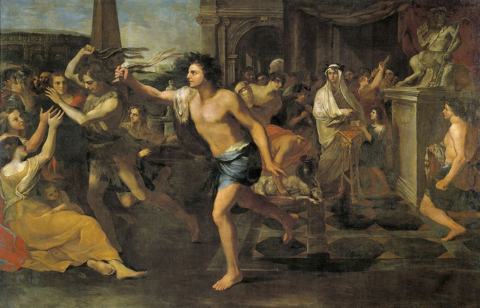
Rome's February fertility rite at the wolf's cave, where near-naked priests struck bystanders with goat-hide thongs — its link to Valentine's Day is unproven.
How Roman magistrates read the will of the gods from bird-flight and lightning before every public act — the state's oldest form of applied religion.
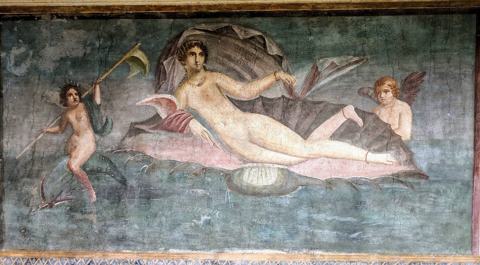
Goddess of love and desire — and the divine ancestress of Rome itself, mother of Aeneas and the claimed forebear of the family of Julius Caesar.
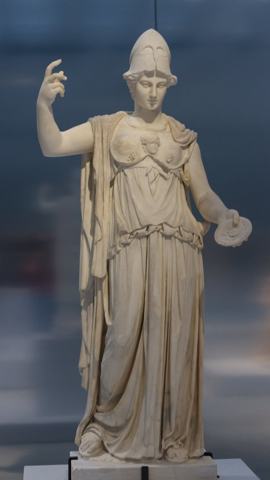
Goddess of wisdom and the crafts — third of the Capitoline Triad, and Rome's patron of every skilled trade from weaving and teaching to medicine.
Sources & Further Reading
- 1.Livy, Ab Urbe Condita (c. 27 BCE), Book 1.
- 2.Ovid, Fasti (c. 8 CE) — esp. Books 2 and 3.
- 3.Dionysius of Halicarnassus, Roman Antiquities (late 1st century BCE), Book 1.
- 4.Plutarch, Life of Romulus (Parallel Lives, c. 100 CE).
- 5.Cicero, De Divinatione (44 BCE) and In Catilinam III (63 BCE).
- 6.Wiseman, T. P. Remus: A Roman Myth. Cambridge University Press, 1995.
- 7.Wiseman, T. P. The Myths of Rome. University of Exeter Press, 2004.
- 8.Carruba, Anna Maria. La Lupa Capitolina: un bronzo medievale. De Luca Editori d'Arte, 2006.
Spot an error or have a source to suggest? Write to info@viseterna.com. We cite primary sources and modern scholarship, and we correct fast.