
Jorogumo (Spider Woman Yokai)
A giant spider of Japanese folklore that takes the shape of a beautiful woman to lure victims into her web, haunting Edo ghost stories and mountain waterfalls.
Jorogumo, Taihei Hyakumonogatari, 1732 · Public domain · source
A Spider That Becomes a Woman
Jorogumo is most often written 絡新婦, "entangling bride," a set of characters read against their literal sense to mean 女郎蜘蛛, "woman spider" — the entire name is built on a pun about what the creature is and what it appears to be 1,5. In folklore she is a spider of great age and size, four hundred years by the figure most often quoted, who has gained the power to take the form of a beautiful woman; in that shape she draws a man close, binds him in silk finer than any human weaver could produce, and feeds on him at leisure 1,5. The belief left a permanent mark on Japanese natural history: Trichonephila clavata, a strikingly large and colourful orb-weaver common across the country, is known in Japanese simply as jorogumo and lent that name, transliterated, to the "Joro spider" now familiar to English-language readers as well 5.
Two Edo Ghost Stories
The two texts usually credited with fixing the type are both Edo-period kaidan collections. In the 1677 Tonoigusa, a samurai grows suspicious of a woman he meets carrying what looks like an infant in her arms and strikes at her with his sword; returning the next day, he finds not a woman but a slashed, dead spider, and a ceiling crawlspace above it packed with human bones 2. In the 1732 Taihei Hyakumonogatari, a man named Magoroku, travelling through Sakushu, is drawn by an old woman into a grand house where a young maiden urges him to marry her; something makes him flee, and back on his own veranda he finds only a tiny spider and an enormous mass of web under the eaves, the whole encounter revealed as an illusion spun around him 3. Both stories share the same shape: a domestic scene that turns out to be silk, and a threat that is disarmed only once its true, much smaller body is exposed 2,3.
The Falls at Joren
Jorogumo also attaches to specific places, most famously Joren Falls in Izu, on the Izu Peninsula of what is now Shizuoka Prefecture. Local tradition there folds together more than one motif — a woodcutter's dropped tool returned by a mysterious woman on condition that he tell no one, and a length of thread that, followed back, turns out to be wound not around a fallen branch but around the falls' own hidden mistress. In the fullest tellings the jorogumo of the falls seizes whatever the thread is fastened to and hauls it under the water with sudden, disproportionate force, and the men who glimpse her and break their promise of silence come to bad ends 5. Foster situates stories of this kind among Japan's broader tradition of dangerous water-yokai, in which an isolated pool or waterfall is treated as the private territory of something that is not, strictly, human 5.
Kin to the Earth Spider, but Not the Same
Jorogumo has an older and distinct relative in tsuchigumo, the "earth spider" of the medieval war tales, best known from the legend in which Minamoto no Yorimitsu (Raiko) — the same warrior credited with beheading Shuten-doji — cuts down a monstrous spider that has been causing him a wasting illness. Noriko Reider's study of the fourteenth-century Tsuchigumo Soshi picture scroll traces how that earlier, more overtly monstrous earth-spider tradition fed into the emergence of a specifically female, shape-shifting spider figure over the centuries that followed, a process she is careful to describe as gradual and uneven rather than a clean one-step transformation from one figure into the other 4. By the time the Edo-period kaidan collections were being written, the two had diverged enough that jorogumo belongs to local ghost-story and place-legend tradition, while tsuchigumo remains tied to the courtly, political register of the Raiko cycle 4.
Toriyama Sekien's Web
Toriyama Sekien's Gazu Hyakki Yagyo of 1776 gave the jorogumo her standard printed image: a woman's upper body attended by a scatter of small spiders, sometimes shown breathing fire, spun from the web she commands rather than from her own body directly 1. That composite image — beautiful face, monstrous household — became the template later artists worked from, much as his contemporaneous plates fixed the look of the kappa and other now-standard yokai 1.
A Seduction Without Love
Set beside Japan's other dangerous, beautiful women, jorogumo is notable for how little tenderness survives in her stories. The kitsune fox-wife of the old tale collections marries for years and grieves at discovery; the yuki-onna spares the man who keeps her secret, sometimes for the sake of children she has borne him. Jorogumo's victims are simply prey, and the stories built around her are built to be solved — the thread traced, the small spider found — rather than mourned 2,3,5.
Continue Exploring
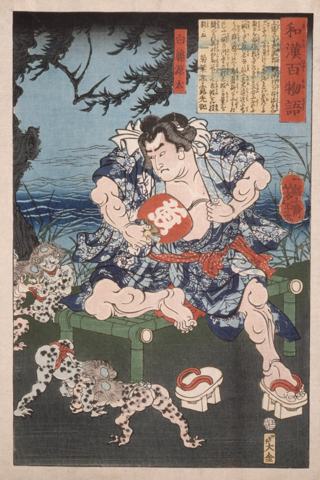
Japan's river-dwelling yokai — beaked and shell-backed, it drowns livestock and challenges travelers to sumo, yet is now a beloved mascot.
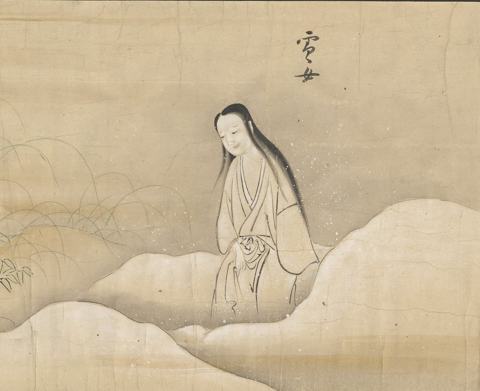
Japan's snow spirit, who freezes travelers on winter nights — known worldwide through Hearn's Kwaidan, though the folklore is far older and less romantic.
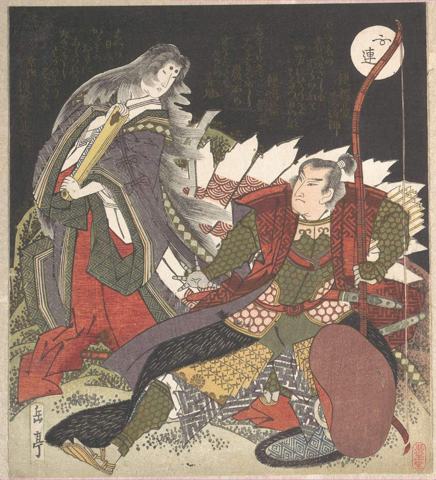
Japan's fox spirits — shapeshifters who gain tails and power with age, feared as deceivers and revered as the messengers of the rice kami Inari.
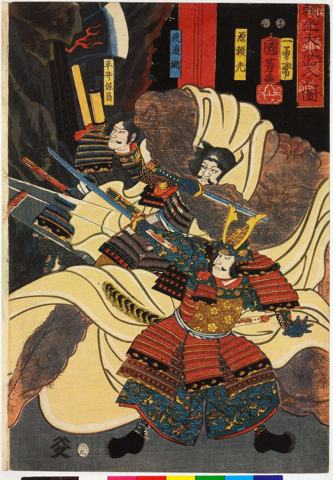
Japan's most famous oni — a demon king who ruled Mount Oe from a stolen palace, until Minamoto no Raiko brought him down with poisoned sake and a sword.
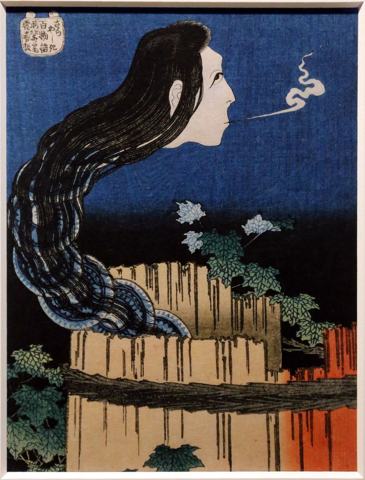
Japan's ghosts of specific dead people, bound by grievance to one place until it is resolved — white-robed, black-haired, and famous through Oiwa and Okiku.
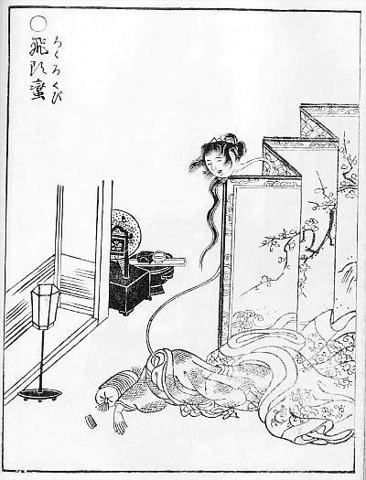
A cursed woman whose neck stretches, or whose head detaches outright while she sleeps: two distinct yokai that Western readers have long treated as one.
Sources & Further Reading
- 1.Toriyama Sekien. Gazu Hyakki Yagyo (1776), in Sekien Toriyama's Japandemonium Illustrated — The Yokai Encyclopedias of Toriyama Sekien. Translated by Hiroko Yoda and Matt Alt. Dover Publications, 2016.
- 2.Ogita Ansei (attrib.). Tonoigusa (1677).
- 3.Ichinaka Sanjin Yusa. Taihei Hyakumonogatari (1732).
- 4.Reider, Noriko T. "Tsuchigumo Soshi — The Emergence of a Shape-Shifting Killer Female Spider." Asian Ethnology 72, no. 1 (2013), 55-83.
- 5.Foster, Michael Dylan. The Book of Yokai — Mysterious Creatures of Japanese Folklore. University of California Press, 2015.
Spot an error or have a source to suggest? Write to info@viseterna.com. We cite primary sources and modern scholarship, and we correct fast.