
Yurei (Japanese Ghosts)
Japan's ghosts of specific dead people, bound by grievance to one place until it is resolved — white-robed, black-haired, and famous through Oiwa and Okiku.
Sarayashiki (The Dish Mansion), from the series Hyakumonogatari (One Hundred Ghost Stories), Katsushika Hokusai, circa 1831 · CC BY 3.0 · source
Not Every Spirit Is a Yurei
Japanese folklore keeps a real distinction between yokai, the broad and often placeless category of supernatural creatures, and yurei (幽霊, "faint spirit"), the specific ghost of a specific dead person 6. A yurei is not a species; it is what is left of someone who died with business unfinished — a grudge, a broken promise, a death too sudden or too violent for the proper rites to settle them — and it is bound, usually, to the place or the person connected with that unfinished business rather than roaming freely the way a kappa or a tengu might 4,6. Resolve the grievance, in the logic of these stories, and the haunting is supposed to end.
The Shape Everyone Recognizes
The standard yurei costume is one of the most stable images in Japanese visual culture: a white burial kimono, long black hair unbound as it would be for a funeral rather than dressed for daily life, hands hanging limp at the wrist, and, in the most iconic versions, no visible legs at all, the figure simply trailing off into nothing below the waist 3,5. A drifting will-o'-the-wisp, hitodama, often marks a haunting is underway even before the figure itself appears 3. This costume did not exist from the start of Japanese ghost storytelling; it consolidated over the eighteenth and early nineteenth centuries into something close to a uniform, recognizable across painting, kabuki staging, and cheap printed fiction alike 3,5.
An Attribution Too Neat to Take Whole
Popular accounts credit the painter Maruyama Okyo with inventing the legless convention outright, in a painting usually called Yurei-zu, "The Ghost of Oyuki." The claim is repeated everywhere and is not quite solid: only a small number of ghost paintings are attributed to Okyo at all, the best-known example's own history has been questioned by specialists working from the surviving painting and its later copies, and legless or dissolving ghost figures were not unique to him even in his own period 3. Stephen Addiss's survey of the genre treats Okyo less as a lone inventor than as the artist whose version happened to become the one everyone later copied — a useful reminder that "first" and "most famous" are not always the same claim 3.
Oiwa, Wronged and Furious
The single most famous yurei by name is Oiwa, from Tsuruya Nanboku IV's 1825 kabuki play Tokaido Yotsuya Kaidan. Poisoned and disfigured by her husband Iemon, who wants her out of the way so he can marry into money, Oiwa dies consumed by fury rather than resignation, and returns to destroy Iemon's new household piece by piece — the template for the onryo, the specifically vengeful ghost, that later fiction and film would draw on for two centuries 1. The role is still treated with real caution in Japanese theatre: productions and film crews conventionally visit Oiwa's grave, at the temple Myogyo-ji in Tokyo, before filming or staging the story, a piece of living ritual practice that has outlasted the original play by two hundred years 1,5.
Okiku and the Missing Plate
Okiku belongs to a different kind of story, the local death legend rather than the stage tragedy. In the Bancho Sarayashiki tradition, a servant is falsely accused of losing one of a set of precious plates entrusted to her, and is killed by her employer for it — thrown down a well in most tellings — after which her ghost rises from the well each night to count the plates aloud, always stopping at nine, forever short of the number that would let her rest 2. Iwasaka and Toelken's study of Japanese death legends treats stories of exactly this shape, tied to a specific well or building that real visitors can still point to, as a distinct and well-documented genre in its own right, and note that more than one site — Himeji Castle's "Okiku's well" is the best known — has been identified by local tradition as the true location, a rivalry the legend itself never resolves 4.
Ghosts With Jobs to Finish
Both women belong to what is sometimes called the "Three Great Yurei" of Japanese tradition, alongside the lovesick Otsuyu of the Botan Doro ghost-lantern story, and all three point to the same underlying rule: a yurei's horror is inseparable from its reason 5. Where a kappa or a jorogumo is simply what it is, dangerous by nature rather than by history, a yurei is always the record of a specific wrong, which is why exorcism in these stories so often looks less like a fight and more like an apology, a memorial service, or — as with the nightly count at the well — an ending that never quite arrives. Compare rokurokubi, where a similar female-coded transformation happens to the living rather than the dead, and tsukumogami, where the same logic of neglect and unfinished business is applied to objects instead of people.
Continue Exploring
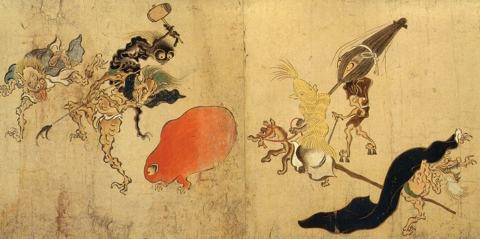
Tools that, discarded near their hundredth year, rise up as spirits in a Muromachi handscroll built to teach a Buddhist lesson about ordinary things.
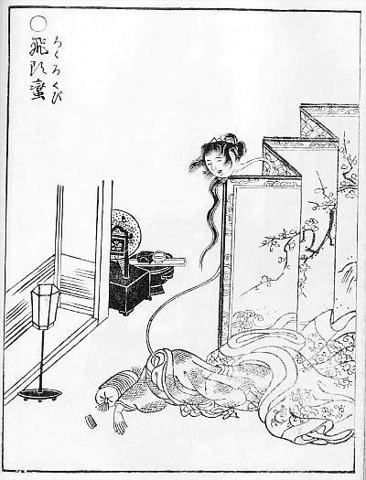
A cursed woman whose neck stretches, or whose head detaches outright while she sleeps: two distinct yokai that Western readers have long treated as one.
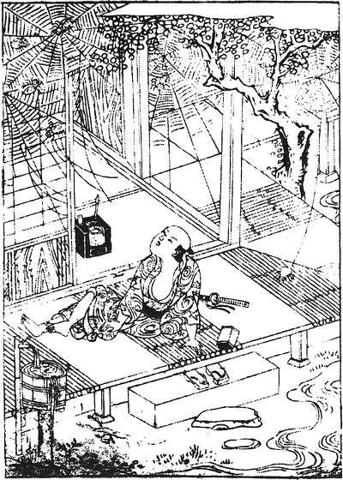
A giant spider of Japanese folklore that takes the shape of a beautiful woman to lure victims into her web, haunting Edo ghost stories and mountain waterfalls.
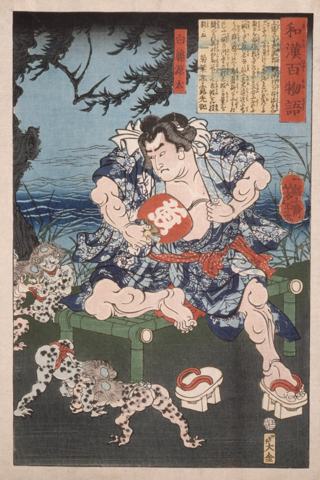
Japan's river-dwelling yokai — beaked and shell-backed, it drowns livestock and challenges travelers to sumo, yet is now a beloved mascot.
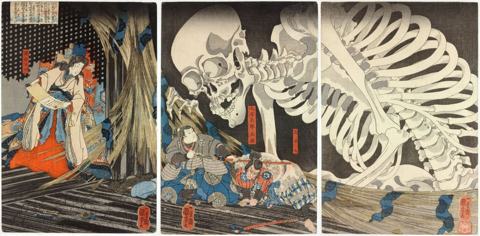
A building-sized skeleton yokai widely presented as ancient folklore, though the figure itself was invented in illustrated books of the 1960s and 70s.
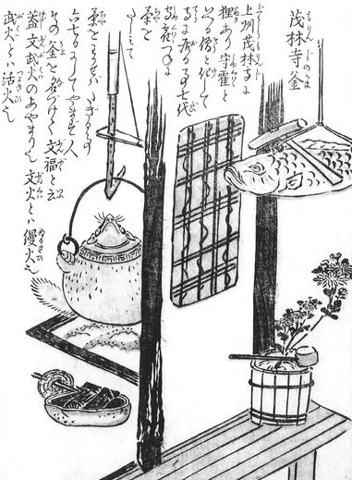
Japan's comic shapeshifter — a pot-bellied raccoon dog that drums on its belly, turns into teakettles, and plays the fool beside the more dangerous kitsune.
Sources & Further Reading
- 1.Tsuruya Nanboku IV. Tokaido Yotsuya Kaidan (1825), kabuki play, translated in Kabuki Plays on Stage, Volume 3: Darkness and Desire, 1804-1864. Edited by James R. Brandon and Samuel L. Leiter. University of Hawai'i Press, 2002.
- 2.Bancho Sarayashiki — the Edo-period legend and kabuki/rakugo tradition of Okiku and the nine plates.
- 3.Addiss, Stephen, ed. Japanese Ghosts and Demons: Art of the Supernatural. George Braziller, in association with the Japan Society, 1985.
- 4.Iwasaka, Michiko, and Barre Toelken. Ghosts and the Japanese: Cultural Experience in Japanese Death Legends. Utah State University Press, 1994.
- 5.Davisson, Zack. Yurei: The Japanese Ghost. Chin Music Press, 2015.
- 6.Foster, Michael Dylan. The Book of Yokai: Mysterious Creatures of Japanese Folklore. University of California Press, 2015.
Spot an error or have a source to suggest? Write to info@viseterna.com. We cite primary sources and modern scholarship, and we correct fast.