
Tanuki (Bake-danuki, the Shapeshifting Raccoon Dog)
Japan's comic shapeshifter — a pot-bellied raccoon dog that drums on its belly, turns into teakettles, and plays the fool beside the more dangerous kitsune.
Morinji no Kama (The Kettle of Morin-ji), Toriyama Sekien, Konjaku Hyakki Shui, 1781 · Public domain · source
The Fox's Bumbling Cousin
The tanuki (狸) is a real animal, Nyctereutes procyonoides, the raccoon dog — a small, stocky canid native to Japan and often mistranslated into English as "badger" or "raccoon," neither of which it is 1. It is also, like the fox, a yokai: an ordinary creature credited with the power to shapeshift, deceive travelers, and meddle in human affairs once it lives long enough. U.A. Casal's 1959 survey treats the fox and the tanuki (along with the badger proper, or mujina, a name folk usage often blurs together with tanuki) as Japan's two great "witch animals," paired by their shared power of transformation but sharply different in character: the fox is elegant, often dangerous, and aristocratic in its haunts; the tanuki is fat, funny, and almost always the butt of its own tricks rather than a genuine threat 1. Violet Harada's later survey of the same material found the tanuki and the badger treated almost interchangeably in many regional tellings, a confusion the folklore itself never bothered to resolve 2.
A Bellyful of Tricks
Tanuki mischief runs to spectacle rather than seduction. The best known is tanuki-bayashi, phantom drumming heard from the mountains at night, explained as tanuki beating out a rhythm on their own distended bellies — a party trick with no human victim required 4,5. Beyond that they disguise themselves as Buddhist monks, as piles of fallen leaves that pass for money until the spell wears off in a merchant's hand, and as household objects, most famously teakettles 1,4. Michael Dylan Foster notes that tanuki transformations tend to be sloppier and more easily seen through than a fox's — a stray tail, a badly maintained illusion — which is part of why the tanuki reads in folklore as a figure to laugh at rather than fear 5.
The Inexhaustible Teakettle of Morin-ji
The tanuki's signature story is Bunbuku Chagama, tied to the Zen temple Morin-ji in Tatebayashi, Gunma, whose own temple tradition holds that a shabby old teakettle used there was in fact a transformed tanuki, sometimes named Shukaku, who repaid the monks' kindness by supplying tea without ever running dry 4,5. The popular version of the tale, spread through Edo-period picture books, has the half-transformed kettle sold to a peddler, sprouting legs, a face, and a tail mid-sale, and going on to earn its new owner a fortune performing acrobatics on a tightrope before being returned to the temple in gratitude 4. Toriyama Sekien's illustration for his 1781 Konjaku Hyakki Shui shows the object at the heart of the legend as exactly that fusion — kettle body, animal face and tail — rather than a fully formed tanuki 4. The story reached English readers unusually early: the diplomat A.B. Mitford included a version, "The Accomplished and Lucky Teakettle," in his 1871 Tales of Old Japan, one of the first collections to carry Japanese folklore into Western print at all 3.
An Unlikely Fortune
No tanuki motif is stranger or better attested than its scrotum. Edo-period artists delighted in showing tanuki with an enormous, elastic kintama put to every conceivable use — spread as a sail, thrown over the shoulder as a sack, beaten flat as a drumhead — and the joke has a real-world root: goldsmiths in Kanazawa wrapped gold between sheets of tanuki hide when hammering out gold leaf, because the skin could reportedly be stretched thin enough to cover eight tatami mats without tearing 1,5. Because a small gold nugget, kin no tama, sounds almost identical to the crude word for testicle, the pun stuck, and the tanuki's oversized anatomy became, by extension, a folk emblem of expanding wealth — carried through to the money pouches and good-luck charms sold under its image today 5.
Tanuki and the Fox
Set beside the kitsune, the tanuki clarifies by contrast what Japanese folklore expects of its two great shapeshifters. Where the fox-wife tales turn on real loss and real deception discovered too late, tanuki stories are built to be funny even when a human is briefly cheated of money or sleep; where the fox is bound tightly to a single cult, that of Inari, the tanuki has no comparable patron deity and answers to no one 1,5. Casal's essay treats this as a genuine difference in cultural function rather than a simple matter of degree — the fox carries the tradition's anxiety about deception, the tanuki carries its capacity to laugh at itself 1.
From Farmhouse Nuisance to Garden Statue
The modern tanuki most visitors to Japan actually meet is ceramic: a round-bellied statue in a straw hat, holding a sake flask and a promissory note, standing outside restaurants and bars across the country. Foster traces this figure to twentieth-century commercial art built on the older folklore rather than to any Edo-period belief, alongside similarly domesticated afterlives for the kappa and the tengu — each a once-dangerous or at least unpredictable being reduced to a friendly mascot for modern commerce 5. The drumming in the night and the vanishing gold have mostly gone quiet; the statue at the door, purse and sake bottle in hand, is what is left of them.
Continue Exploring
Japan's river-dwelling yokai — beaked and shell-backed, it drowns livestock and challenges travelers to sumo, yet is now a beloved mascot.
Japan's fox spirits — shapeshifters who gain tails and power with age, feared as deceivers and revered as the messengers of the rice kami Inari.
Winged mountain spirits of Japan: crow-beaked tricksters and long-nosed masters of the sword, once Buddhist demons, later guardians of the peaks.
Japan's snow spirit, who freezes travelers on winter nights — known worldwide through Hearn's Kwaidan, though the folklore is far older and less romantic.
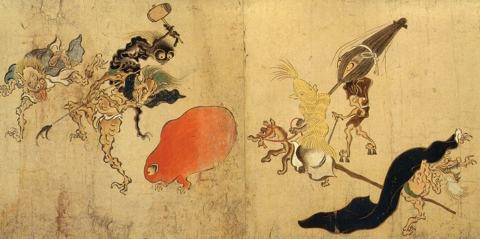
Tools that, discarded near their hundredth year, rise up as spirits in a Muromachi handscroll built to teach a Buddhist lesson about ordinary things.
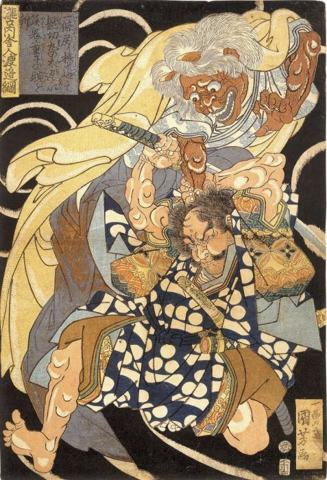
Horned, fanged ogres of Japanese folklore: hell's wardens, mountain bandits and village guardians, driven out with beans every February.
Sources & Further Reading
- 1.Casal, U.A. "The Goblin Fox and Badger and Other Witch Animals of Japan." Folklore Studies 18 (1959), 1-93.
- 2.Harada, Violet H. "The Badger in Japanese Folklore." Asian Folklore Studies 35, no. 1 (1976).
- 3.Mitford, A.B. Tales of Old Japan. Macmillan and Co., 1871.
- 4.Toriyama Sekien. Gazu Hyakki Yagyo (1776) and Konjaku Hyakki Shui (1781), in Sekien Toriyama's Japandemonium Illustrated — The Yokai Encyclopedias of Toriyama Sekien. Translated by Hiroko Yoda and Matt Alt. Dover Publications, 2016.
- 5.Foster, Michael Dylan. The Book of Yokai — Mysterious Creatures of Japanese Folklore. University of California Press, 2015.
Spot an error or have a source to suggest? Write to info@viseterna.com. We cite primary sources and modern scholarship, and we correct fast.