
Fortuna (Roman Goddess of Luck)
Rome's goddess of luck, worshipped under dozens of specific titles and consulted through a wooden-lot oracle at Praeneste that Cicero called a fraud.
Statue of Isis-Fortuna with rudder and cornucopia, Roman, 2nd century AD · CC BY-SA 4.0 · source
A Goddess for Every Kind of Luck
No Roman deity accumulated more specific titles than Fortuna. Roman religion split her single name across dozens of narrow, situational cults — Fortuna Primigenia ("firstborn," governing the start of a life), Fortuna Redux (safe return from a journey), Fortuna Huiusce Diei ("of this very day," invoked before a single battle), Fortuna Virilis and Fortuna Muliebris (male and female fortune, worshipped separately) — a fragmentation Jacqueline Champeaux's two-volume study treats as the central fact about the goddess: Fortuna was less a single personality than a name attached, again and again, to whatever moment felt most exposed to chance 5,7.
The Oracle of Praeneste
Her oldest and grandest sanctuary stood at Praeneste, modern Palestrina, where a monumental terraced complex housed Fortuna Primigenia — whose cult statue, unusually, showed her cradling the infant Jupiter and Juno — alongside a lot-oracle, the sortes, that drew pilgrims from across Italy: a boy would draw an inscribed wooden lot from a container to answer a petitioner's question 1. Cicero, writing a philosophical treatise arguing against the validity of divination in general, singles out the Praeneste sortes for particular scorn, calling them oak tablets carved with archaic letters and suggesting the whole apparatus was maintained more by local financial interest and popular credulity than by any real connection to the goddess — a rare case of a Roman senator dismissing a major, state-tolerated oracle by name 1,6.
A King's Secret Lover
Fortuna's most persistent legend ties her to Servius Tullius, Rome's sixth king, traditionally the son of a slave woman who rose to the throne with the goddess's favor. Ovid tells the story that Fortuna loved Servius and visited him secretly by night, slipping through a small window of his palace rather than by the door — a tale later writers used to explain the joint temple of Fortuna and Mater Matuta in the Forum Boarium, and one Plutarch discusses among his collected Roman Questions as a puzzle about a shrouded cult statue he says was Servius's own image, too sacred to be seen unveiled 2,4. Modern historians treat the romance as folklore rather than history, but read it as evidence that Fortuna, alone among the major Roman gods, could be imagined as a literal lover and patron of one specific, humbly-born king — an unusual role for a Roman deity to play 6,7.
Fortuna of the Women
Fortuna also had a cult built entirely around one act of female persuasion. Livy tells how, when the exiled patrician Gnaeus Marcius Coriolanus led a hostile army to the gates of Rome, the Senate's male envoys failed to turn him back, and it was his mother Veturia and his wife Volumnia, accompanied by a procession of Roman matrons, who finally persuaded him to withdraw; the Senate afterward voted a temple to Fortuna Muliebris, "Women's Fortune," on the spot where the meeting was said to have happened 3. Beard, North and Price note that the cult's own foundation legend, unusually, makes this explicit: the temple existed because Roman matrons, acting collectively and outside any male magistracy, had saved the city, and their goddess commemorated that specific, gendered act rather than female fortune in general 3,6.
Fortuna and the State
Beyond these local and legendary cults, Fortuna also attached herself to the Roman state's fortunes in the most literal sense, worshipped as Fortuna Publica Populi Romani on the Quirinal and, under the Empire, as Fortuna Redux and Fortuna Augusta, protector of the emperor's own safe travel and person, with altars voted whenever an emperor returned from a dangerous campaign abroad 6,7. Scheid reads this expansion as typical of how Roman religion handled genuinely unpredictable outcomes — war, childbirth, a magistrate's term of office, an emperor's journey — by giving each its own narrowly addressed version of the same goddess, rather than leaving chance to a single, all-purpose power, much as Janus presided narrowly over thresholds and beginnings rather than time in general 7.
Wheel, Rudder, Horn
Fortuna's standard attributes — a ship's rudder, for the sense that she steers events beyond human control, and a cornucopia, for the good luck she could equally grant — appear on statues and coins across the Roman world, including provincial images that merge her with the Egyptian goddess Isis under the composite name Isis-Fortuna 5,6. The spinning wheel now most associated with her, the rota Fortunae of medieval and Renaissance art, is a later elaboration built on this Roman foundation rather than a genuine Roman attribute; ancient Fortuna steers and gives, but the image of blind, mechanical turning belongs to philosophers writing well after Rome's temples to her had gone 5,7.
Continue Exploring

The two-faced Roman god of doors, beginnings and endings, named first in every prayer, whose gates in the Forum stood open only while Rome was at war.
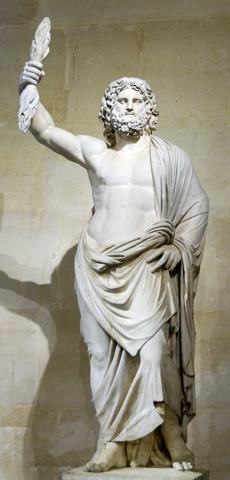
King of the gods and of the Roman state — lord of the bright sky, hurler of the lightning bolt, and the guarantor behind every oath and treaty.
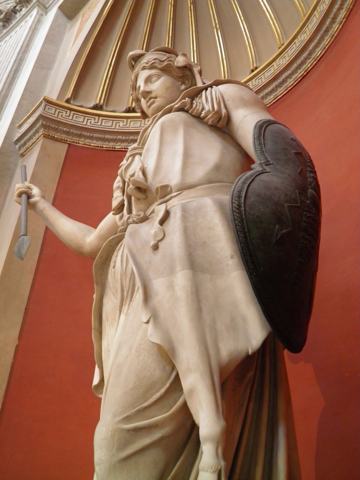
Queen of the gods — Rome's guardian of women, childbirth and the state, whose sacred geese warned the Capitol and whose temple gave us the word money.
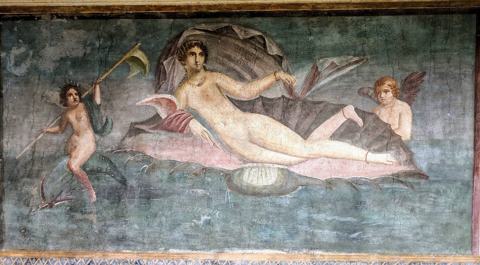
Goddess of love and desire — and the divine ancestress of Rome itself, mother of Aeneas and the claimed forebear of the family of Julius Caesar.
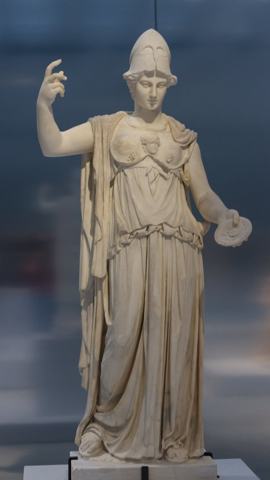
Goddess of wisdom and the crafts — third of the Capitoline Triad, and Rome's patron of every skilled trade from weaving and teaching to medicine.

Rome's god of sowing and the lost Golden Age, whose temple held the state treasury and whose December festival turned the social order upside down.
Sources & Further Reading
- 1.Cicero, De Divinatione — Book II (44 BCE).
- 2.Ovid, Fasti — Book VI (c. AD 8).
- 3.Livy, Ab Urbe Condita — Book II.40 (Fortuna Muliebris and Coriolanus).
- 4.Plutarch, Roman Questions (Quaestiones Romanae), c. AD 100.
- 5.Champeaux, Jacqueline. Fortuna — Recherches sur le culte de la Fortune à Rome et dans le monde romain, des origines à la mort de César. 2 vols. École française de Rome, 1982-1987.
- 6.Beard, Mary, John North & Simon Price. Religions of Rome, Volume 1: A History. Cambridge University Press, 1998.
- 7.Scheid, John. An Introduction to Roman Religion. Edinburgh University Press, 2003.
Spot an error or have a source to suggest? Write to info@viseterna.com. We cite primary sources and modern scholarship, and we correct fast.