
The Books of Chilam Balam
Colonial Yucatec Maya town books mixing prophecy, history, medicine and Christian material — named for a jaguar-priest said to have foreseen the Spanish.
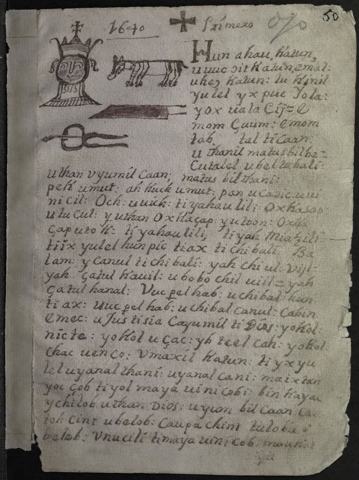
Book of Chilam Balam of Ixil, colonial Yucatec Maya manuscript (Museo Nacional de Antropologia, Mexico City) · CC BY 2.0 · source
Nine Towns, Nine Books
The Books of Chilam Balam are not one text but a family of manuscripts, each kept and copied by a different Yucatec Maya town: Chumayel, Tizimin, Mani, Kaua, Ixil, Tekax, and Nah are the best known, with extracts also surviving from Oxkutzcab and elsewhere 1,6,7. Each town's book carries its settlement's name, was written and rewritten by local scribes over generations, and mixes prophecy, chronicle, ritual calendar, medical formulas, and Christian doctrine into a single running miscellany with no fixed table of contents 1,4,6.
None of the surviving physical manuscripts is older than the eighteenth century — the Chumayel copy used by most translators was made in 1782 by a scribe named Juan Jose Hoil — but the material inside is demonstrably layered, with sections that read as much older oral and written tradition recopied alongside colonial-era additions 1,4.
The Office Behind the Name
Chilam (more precisely chilan) names an office: a priestly spokesman who, in a trance, delivered the pronouncements of a god to the community, and balam means jaguar, a common Maya title of respect and power 1,6. Chilam Balam was, by Yucatec tradition, a particular such priest-diviner at Mani who was said to have prophesied the arrival of bearded strangers and a new religion before the Spanish appeared 4,6. Whether that tradition is itself pre-conquest or a story shaped after the fact to make the conquest look foretold is exactly the kind of question the genre keeps raising, and colonial Maya scribes seem to have used his name partly as a genre label — "the book of the jaguar-priest's sayings" — as much as a claim about a single historical author 4.
What Fills the Pages
The most quoted material is the k'atun prophecy: cyclical predictions tied to the k'atun, a 20-year period, in which each named k'atun in its recurring 260-year round was believed to bring characteristic troubles or blessings, so that history could be read forward from precedent as much as recorded backward as fact 4,6. Alongside this sit medical recipes and incantations, astrological almanacs adapted from the same 260-day count found in the Dresden Codex, origin narratives for the Yucatec Maya and their migrations, and passages lifted or adapted from European almanacs, missals, and works on astrology that Maya scribes had evidently read and repurposed in their own idiom 1,4.
Deities named across the corpus include the feathered serpent Kukulkan, whose festival at Mani the books describe within their k'atun-based ritual calendar, and the aged goddess associated with Ix Chel 4. The books also preserve the phrase hunab ku, "the one god" — a piece of missionary-engineered vocabulary for the Christian God rather than an ancient Maya high deity, as the entry on Hunab Ku sets out in detail 4.
Chumayel and Tizimin, Read Differently
The two most-translated books do not agree in tone, and neither do their translators. Ralph Roys's 1933 translation of the Chumayel manuscript remains the standard reference edition and reads the text primarily as a historical and ethnographic record, glossed line by line 2. Munro Edmonson's later translations of both Chumayel and Tizimin take the opposite approach, arguing that the material is composed in a strict parallel-couplet poetic form throughout and rendering it as verse, chronologically reordered by k'atun rather than left in the manuscripts' own sequence 3,5. The difference is not cosmetic — it changes what the text is taken to be, sober chronicle or performed prophecy — and Knowlton's more recent study of the Chumayel creation passages treats both readings as partial, arguing that the books are best understood as colonial Maya intellectuals' own deliberate literary strategy for preserving a worldview under pressure, not as damaged fragments of something purer that came before 5.
A Book Arguing With Its Conquerors
The colonial hand in the Books of Chilam Balam is visible everywhere, and unusually candid about it. The same pages that repeat Christian teaching also record grief and anger at the conquest and at the imposition of Spanish rule and religion, in passages several scholars read as coded resistance rather than simple acceptance 4,5,6. Diego de Landa's mid-sixteenth-century account of Yucatec religion and calendar customs, written by the friar most responsible for burning the earlier Maya books, supplies an outside colonial description that can be checked against what the Chilam Balam books say about the same festivals and gods from the inside 4,6.
Taken together, the books are less a single scripture than an argument Yucatec Maya communities kept having with their own history across two and a half centuries of colonial rule — a genre, not a text, and one that current scholarship still reads for what it preserves of pre-conquest thought rather than for prophecy taken literally 5,6,7.
Continue Exploring
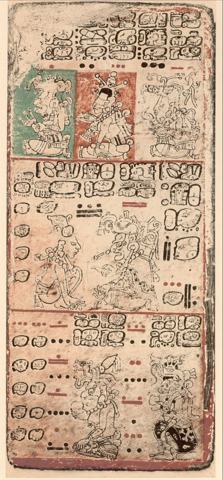
The oldest surviving book of the Americas — a Maya screenfold of astronomical tables, deciphered by a Dresden librarian, that survived a 1945 firestorm.
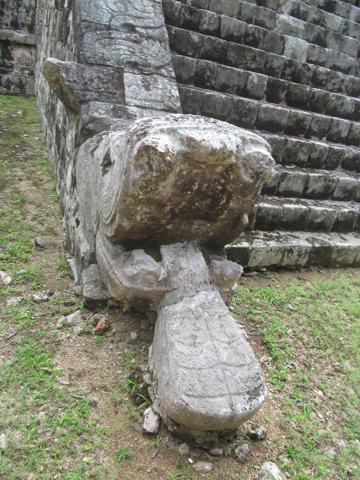
The Feathered Serpent of the Maya — creator's voice in the Popol Vuh, patron of Chichen Itza, and the shadow that descends its pyramid at the equinox.
"The one god" of Yucatec Maya colonial texts — a name most scholars now read as a missionary translation for the Christian God, not an ancient Maya deity.
"Rainbow Lady" — the Maya goddess of childbirth, weaving, medicine and divination, and the two distinct goddesses tangled together behind her name.
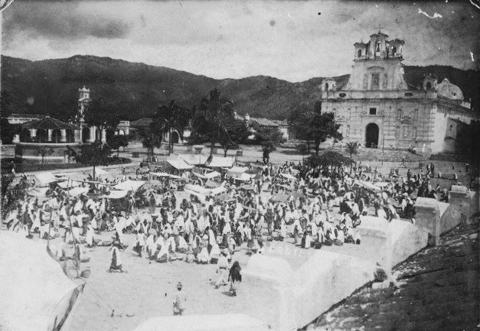
A pre-conquest K'iche' Maya dance-drama of capture and sacrifice, still performed each January in Guatemala and honored by UNESCO as intangible heritage.
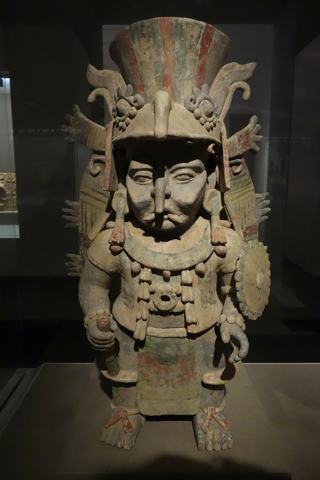
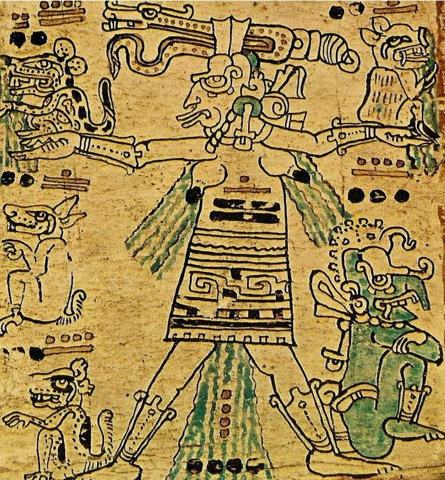
The rain god who splits the clouds with a lightning axe — one god and four, the most frequently depicted deity in the surviving Maya books.
Sources & Further Reading
- 1.The Book of Chilam Balam of Chumayel (Yucatec Maya, colonial era; extant copy made 1782 by Juan Jose Hoil).
- 2.Roys, Ralph L. (trans.). The Book of Chilam Balam of Chumayel. Carnegie Institution of Washington, 1933.
- 3.Edmonson, Munro S. (trans.). Heaven-Born Merida and Its Destiny: The Book of Chilam Balam of Chumayel. University of Texas Press, 1986.
- 4.Edmonson, Munro S. (trans.). The Ancient Future of the Itza: The Book of Chilam Balam of Tizimin. University of Texas Press, 1982.
- 5.Knowlton, Timothy W. Maya Creation Myths: Words and Worlds of the Chilam Balam. University Press of Colorado, 2010.
- 6.Diego de Landa, Relacion de las cosas de Yucatan (c. 1566).
- 7.Sharer, Robert J. with Loa P. Traxler. The Ancient Maya, 6th edition. Stanford University Press, 2006.
Spot an error or have a source to suggest? Write to info@viseterna.com. We cite primary sources and modern scholarship, and we correct fast.