
Zhong Kui
The ugly failed scholar who killed himself on the palace steps and came back as heaven's demon-catcher — hung on doors at New Year to eat what haunts the house.
The Night Excursion of Zhong Kui, Dai Jin (1388-1462), Ming dynasty (Palace Museum, Beijing) · Public domain · source
The Ugly Judge of Ghosts
Zhong Kui (鍾馗) is the demon queller: a huge, black-bearded, glaring figure in scholar-official's robes and a soft black cap, sword drawn, usually with a swarm of subdued imps carrying his hat, his wine or his umbrella 4,6. He is not a benign god. He is a bureaucrat with a grudge and a licence to kill, and his function in Chinese religion is to be pointed at whatever is troubling the household 5,6.
His image was hung at the New Year and later at the Duanwu (Dragon Boat) festival, pasted on doors and gates to keep out plague and malignant spirits — a use documented in the seasonal literature and still visible in printed door-god sheets 5,6. Where the paired door gods are guards, Zhong Kui is an exterminator: he is shown catching demons, binding them, and in some paintings eating them 4,7.
The Tang Legend
The story that fixed him is set in the Tang court and told in Shen Kuo's Mengxi bitan of about 1088, which presents it as an account attached to an old imperial painting 1. The emperor Xuanzong, ill with fever after a trip to Mount Li, dreams of a small imp stealing a jade flute and an embroidered purse. A giant appears, tears the imp apart and eats it. Asked who he is, he answers that he is Zhong Kui, a candidate who failed the palace examination, dashed his head against the palace steps in shame, was buried in green robes by imperial favour, and swore in gratitude to rid the empire of evil 1. The emperor wakes cured and orders the court painter Wu Daozi to paint what he described; Wu produces the image at once, as if he had seen it too 1.
Every part of this needs hedging. Shen Kuo is writing three centuries after the reign in question, and the anecdote's purpose in his text is connoisseurial — it explains a picture 1,4. No Tang source records the dream, and no painting by Wu Daozi survives. Little's long study of Zhong Kui imagery treats the Xuanzong tale as the legend's literary crystallisation rather than its origin, and traces the pictorial tradition as a continuous line of copies and reinventions from the Song onward 4.
Older Than the Legend
There is reasonable evidence that Zhong Kui predates the Tang dream story. His name appears in Dunhuang manuscripts connected with the nuo exorcism — the great year-end rite in which masked performers drove pestilence out of the capital — where he functions as a demon-eating power in a liturgical setting rather than a character in a biography 2,4.
A separate and long-running argument, associated with late-Ming and Qing philologists and given its best-known statement by Gu Yanwu, derives the name from zhongkui (終葵), a term for a mallet or club — in one reading a peach-wood exorcist's mallet used to beat out evil, in another a personal name already in use in the Northern and Southern dynasties 3,4. On that account the "failed scholar" is a story invented backward from a ritual implement that had acquired a name 3. This remains a hypothesis rather than a settled result, but it is the mainstream scholarly position that the figure grew out of exorcistic practice and was given a biography afterwards 3,4.
The Sister's Wedding, and Other Stories
Later tradition expanded him considerably. The most-painted episode after the demon hunt is Zhong Kui marrying off his sister: the ghost-judge, having become a spirit, returns to reward the friend who paid for his burial by giving him his sister in marriage, and the wedding procession is carried by a rabble of demons acting as bearers, musicians and porters 4,7. The subject let painters be funny — grotesque imps struggling with a sedan chair — while keeping the moral about repaying a debt 4.
Other recurring scenes show him drunk and being carried by his own captives, having his ear cleaned by an imp, travelling on his New Year rounds, or reading a scroll of accounts as an official of the underworld courts of Diyu 4,7. The comedy is deliberate: the demons are made ridiculous by being made to work.
Why He Endures
Zhong Kui's appeal has always been partly satirical. He is the man the examination system rejected — in some versions rejected specifically for being ugly — who is vindicated by heaven and given power over everyone's nightmares 4,5. Painters used him to say things about merit and office that were safer said about a ghost. Scholar-officials commissioned his portrait as a personal emblem, and eccentric painters through the Ming and Qing kept re-drawing him because the subject licensed distortion 4.
He remains one of the standard figures of Chinese festival print culture, alongside the Eight Immortals and the door gods, and he passed into Japanese tradition as Shoki, a warding figure on banners and roof tiles for the Boys' Festival 5,6. Modern film, opera, comics and video games have found him readily usable, generally amplifying the sword and losing the failed examination — which was the point of him 4,5.
Continue Exploring
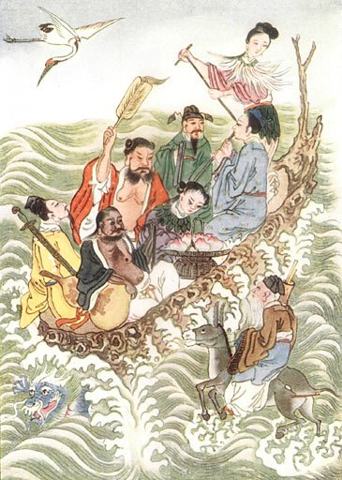
Eight Daoist immortals — a beggar, a drunk, a girl, a courtier, a flute player — who cross the sea by their own strange powers instead of by boat.
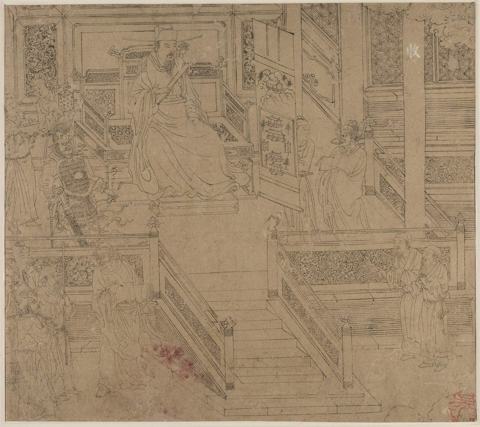
The Chinese underworld — a bureaucracy of ten courts where the dead are tried, serve sentences for what they did, and are then sent back into rebirth.
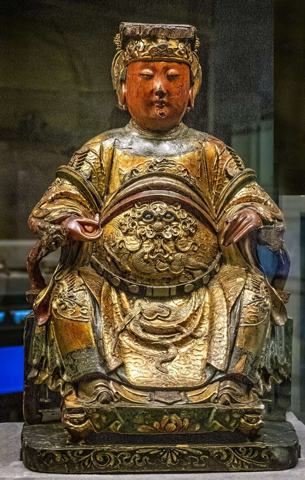
A Fujian fisherman's daughter who died young around 987 and rose, title by imperial title, to become Empress of Heaven and the sea goddess of the Chinese coast.
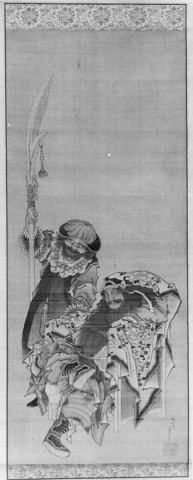
The Three Kingdoms general executed in 220 CE who rose, title by title, into a god of war, loyalty, and wealth worshipped across the Chinese-speaking world.
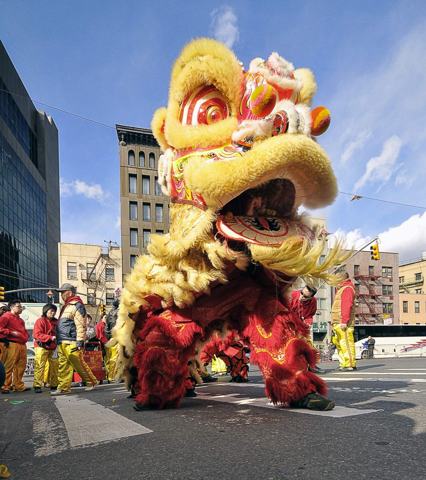
The horned beast said to terrorize villages once a year until scared off by firecrackers, fire, and red — a legend newer than the New Year customs it explains.
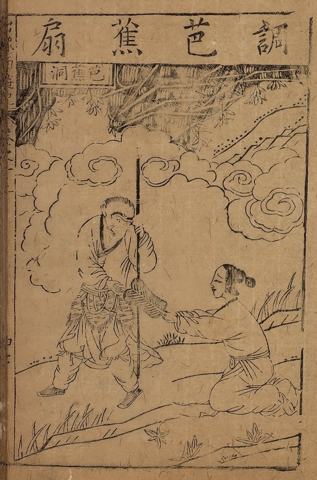
The Monkey King — a stone-born immortal with seventy-two transformations who fought heaven to a standstill, then walked to India as a monk's disciple.
Sources & Further Reading
- 1.Shen Kuo, Mengxi bitan (Dream Pool Essays), c. 1088 — the Tang Xuanzong dream and the painting by Wu Daozi.
- 2.Dunhuang manuscripts of the Nuo exorcism liturgy naming Zhong Kui (Tang dynasty; Pelliot and Stein collections).
- 3.Gu Yanwu, Rizhilu (Record of Daily Knowledge), 17th century — the argument that the name derives from a ritual mallet.
- 4.Little, Stephen. 'The Demon Queller and the Art of Qiu Ying.' Artibus Asiae 46.1/2 (1985), 5-128.
- 5.Eberhard, Wolfram. Chinese Festivals. Henry Schuman, 1952.
- 6.National Museum of Asian Art, Smithsonian Institution. 'Zhong Kui and the Lunar New Year.'
- 7.Ashmolean Museum, Jameel Centre. 'Zhong Kui the demon queller' — collection entry.
Spot an error or have a source to suggest? Write to info@viseterna.com. We cite primary sources and modern scholarship, and we correct fast.