
Dobrynya Nikitich (Bogatyr Hero)
The courtly bogatyr of Kyivan byliny who slew the dragon Zmey Gorynych, outwitted a sorceress, and returned home from a false report of his death.
Dobrynya Nikitich, Ivan Bilibin, 1902 · Public domain · source
Second of the Bogatyrs
Dobrynya Nikitich ranks immediately behind Ilya Muromets in the "Kyivan cycle" of Russian byliny - a grouping Vladimir Propp used to sort the songs by the court and period they are set in, rather than by when they were actually composed or sung 5 - the heroic songs collected only in the nineteenth century, chiefly in the far north around Lake Onega 1,2,3. Unlike Sadko of the separate Novgorod cycle, every Dobrynya song is set at Prince Vladimir's court in Kyiv 2,6. Where Ilya is the peasant-born strongman, Dobrynya is consistently drawn as the courtier: well-born, educated, diplomatic, and skilled at things other bogatyrs are not - he plays the gusli, wrestles, shoots, swims, and is repeatedly the one Vladimir sends on missions requiring tact rather than force 1,2. His standard epithet, vezhlivyi, "the courteous one," marks that difference directly, and several songs turn on his skill at conversation succeeding where a blunter hero would fail 2,6.
A Historical Uncle
Behind the epic figure stands a documented one. The Russian Primary Chronicle names a Dobrynya as the uncle of Prince Vladimir Sviatoslavich and his military governor in Novgorod, a real tenth-century figure who led campaigns and helped install Vladimir's short-lived pantheon of idols before the conversion to Christianity in 988 4. A later and more doubtful source, the so-called Ioakim Chronicle, known only through the eighteenth-century historian Vasily Tatishchev's paraphrase of a text no longer extant, credits this Dobrynya with forcing Novgorod's baptism "by fire" while his colleague Putyata did the same "by the sword" - a vivid line often quoted, but resting on a chronicle whose authenticity and dating scholars have long disputed 4,6. Whether the historical governor and the epic hero are the same figure, related figures, or simply share a fashionable name is not something the sources settle; the epic Dobrynya, in any case, serves a Vladimir who is himself a legendary composite rather than a specific historical prince 4,6.
Nastasya, the Warrior Bride
Dobrynya's marriage is itself a bylina. Riding the steppe, he meets a polyanitsa - one of the armed and mounted warrior-women who appear scattered through the Kyivan cycle - and the two fight before either learns who the other is; in the best-known telling he is thrown from his horse and is seconds from death under her before she asks his name and recognizes a match. The polyanitsa is Nastasya Mikulichna, daughter of the plowman-hero Mikula Selyaninovich, and the combat becomes a courtship: they marry, and Nastasya, unusually for a bylina wife, remains a fighting figure in the songs that follow rather than disappearing into the background once married 1,2,6.
The Dragon at the Puchai River
Dobrynya's most famous exploit belongs to another entry in fuller detail: swimming against his mother's warning in the river Puchai, he is attacked by the dragon Zmey Gorynych, beats it off bare-handed, and later kills it outright after it breaks a truce and carries off the Prince's niece Zabava Putyatichna 1,2,6. The songs treat the fight as only one labor among several rather than his defining feat the way the Nightingale Robber defines Ilya - Dobrynya's cycle is broader, and gives him a domestic life, a rival, and a second wife's worth of trouble that Ilya's songs never touch 2,6.
Marinka the Sorceress
A stranger tale pairs him against a witch rather than a monster. In the songs of Dobrynya and Marinka, a sorceress of that name in Kyiv has already turned nine of her lovers into oxen with her spells by the time Dobrynya, out hunting, sees a dove and a gray she-cuckoo courting on her windowsill and shoots the dove for sport - only for the birds to turn back into Marinka and her demon lover mid-transformation, and for Marinka to swear revenge 1,2. She lures Dobrynya to her, turns him into an aurochs by magic, and it takes his mother's own sorcery, or in some tellings his sister's, to reverse the spell before he kills Marinka in turn - one of the few byliny in which a bogatyr is genuinely, if briefly, beaten by magic rather than force 1,2,6.
The Wedding Interrupted
The cycle's most theatrical episode sends Dobrynya away from home for years, first on a mission for Vladimir and then, in some tellings, delayed past all expectation, until word reaches Kyiv that he has died. Alyosha Popovich, the youngest and most opportunistic of the three great bogatyrs, presses his suit on the widowed Nastasya, and a wedding is set; Nastasya herself resists, citing the years still left on the term Dobrynya had asked her to wait, but is overruled by Vladimir. Dobrynya, warned by his horse or by a chance encounter on the road, races home, arrives disguised as a wandering minstrel, is let into the feast to play, and reveals himself only when the moment calls for it - in some tellings by dropping his ring into a cup handed to his own wife - before claiming Nastasya back and sparing Alyosha's life at Ilya's request 1,2,6,7. Viktor Vasnetsov's 1898 painting The Bogatyrs fixed the trio's final image side by side on the steppe frontier, and it is that grouping, Ilya flanked by Dobrynya and Alyosha, that most people now picture when they picture a bogatyr at all 6,7.
Continue Exploring
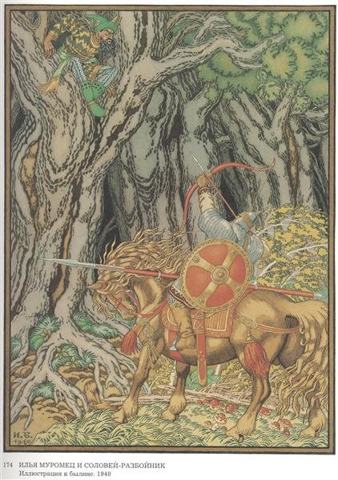
The paralysed peasant's son of Murom who rose from the stove to become Russia's greatest epic hero, and shot down the monstrous Nightingale the Robber.
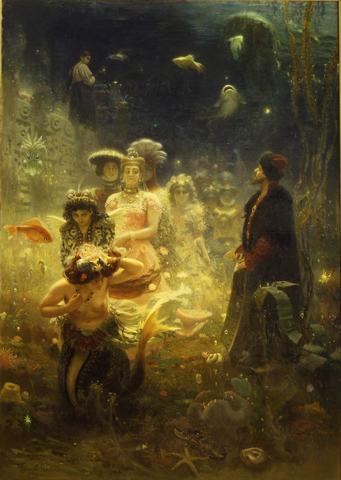
The poor gusli-player of Novgorod who wagered with the Sea Tsar, grew rich, and nearly stayed in the Tsar's underwater hall forever.
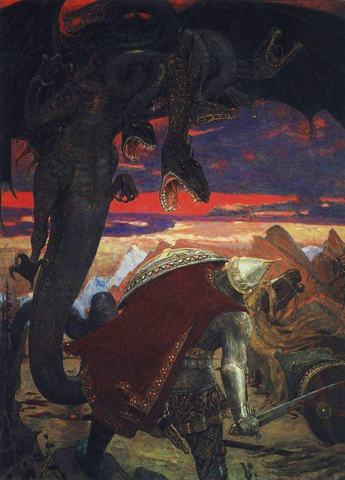
The many-headed dragon — the fire-breathing serpent of Russian epic song, met at a river crossing, and beaten only by a hero who refuses to stop swinging.
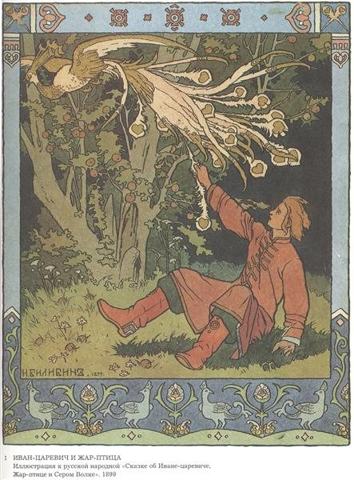
The glowing bird of Russian wonder tale whose single stolen feather starts a fatal quest — first collected by Afanasyev, later Stravinsky's ballet subject.
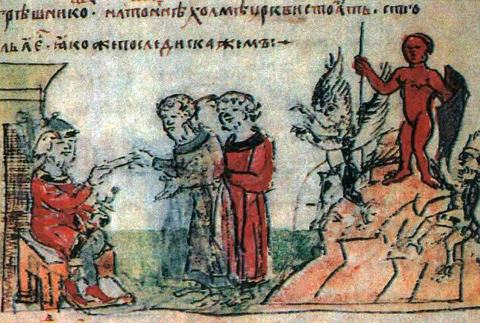
God of thunder and the striking bolt — the oak-crowned sky lord of the early Slavs, sworn by in treaties and thrown into the Dnieper at Rus' baptism.
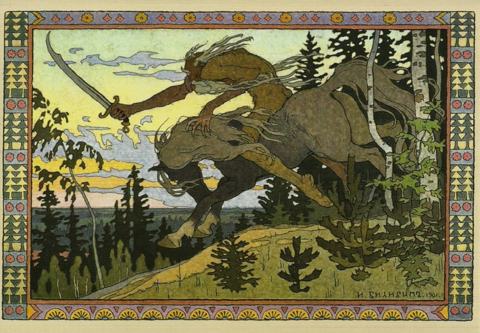
The undying sorcerer of Russian folktale who hid his death in a needle, inside an egg, inside a duck, inside a hare, inside a chest, beneath an oak.
Sources & Further Reading
- 1."Dobrynya and the Dragon," "Dobrynya the Dragon-Slayer and Marina," and "Dobrynya and Alyosha," in Hapgood, Isabel Florence. The Epic Songs of Russia. Charles Scribner's Sons, 1886.
- 2.Bailey, James & Tatyana Ivanova, trans. An Anthology of Russian Folk Epics. M.E. Sharpe, 1998.
- 3.Chadwick, N. Kershaw, trans. and ed. Russian Heroic Poetry. Cambridge University Press, 1932.
- 4.Cross, Samuel Hazzard & Olgerd P. Sherbowitz-Wetzor, trans. The Russian Primary Chronicle: Laurentian Text. Medieval Academy of America, 1953.
- 5.Propp, Vladimir. Russkii geroicheskii epos (The Russian Heroic Epic). Leningrad, 1955.
- 6.Dixon-Kennedy, Mike. Encyclopedia of Russian and Slavic Myth and Legend. ABC-CLIO, 1998.
- 7.Warner, Elizabeth. Russian Myths. British Museum Press, 2002.
Spot an error or have a source to suggest? Write to info@viseterna.com. We cite primary sources and modern scholarship, and we correct fast.