
Faunus
Rome's rustic god of forest and flock, an oracle who spoke through dreams and whose name the Romans linked to the Lupercalia and to Greek Pan and the satyrs.
Dancing Faun, bronze statuette, House of the Faun, Pompeii, c. 2nd-1st century BC (Naples National Archaeological Museum) · Public domain · source
A Rustic God, Older Than His Stories
Faunus belongs to the oldest stratum of Roman religion, a rustic protector of flocks, fields and wild woodland whose worship long predates any developed myth attached to his name — the same native layer of the pantheon that produced agrarian gods like Ceres and the hearth goddess Vesta, native to Italy well before Greek myth arrived 6,7. Georges Dumezil places him among a small group of Italic nature gods — Silvanus and the wood-spirits chief among his neighbors — whose original character was functional rather than personal: less a god with a biography than a presence felt at the edge of cultivated land, where the farm gave way to woods that were not fully safe 5,7.
Inuus and the Lupercalia
One of Faunus's oldest identities is Inuus, a name tied to animal fertility, and Livy names Inuus as the god originally honored at the Lupercalia, the wild February festival in which young men called Luperci, dressed in goatskins, ran through the city striking bystanders with goatskin thongs 4,6. Later Roman antiquarians treated Inuus simply as one of Faunus's names rather than a separate god, which fits a wider pattern: a deity who seems to have accumulated titles and local variants faster than he accumulated a fixed personality 6,7.
The God Who Spoke in Dreams
Faunus's stranger role is as an oracle who delivered prophecy not through a priestess or a set of lots but through dreams, heard by a sleeper who had performed the correct ritual at one of his sacred groves. Virgil sets one such scene at Albunea, a sulfurous spring near Tibur, where King Latinus, troubled by omens, sleeps on the fleeces of sacrificed sheep and hears Faunus's voice from the grove itself, warning him not to marry his daughter to a native suitor because a foreign son-in-law is coming — the prophecy that sets up the Trojans' arrival in the second half of the Aeneid 1. Horace's ode to Faunus, addressed to the god as protector of his own Sabine farm, treats the same rustic power more gently, asking him to watch over flocks and fields as he leaves his mountain haunt each winter 3.
Numa's Trap for Faunus and Picus
Ovid tells a rougher story about the same oracular power. Wanting to learn the ritual for turning aside Jupiter's lightning, King Numa set out bowls of wine at a spring where Faunus and the old prophetic king Picus were known to drink, waited until the two gods had fallen asleep, and bound them before they could escape; woken and trapped, they told Numa that the secret he wanted belonged to Jupiter alone, but agreed to help him draw the sky-god down to earth to ask directly 2. The story catches something true about how Romans generally imagined Faunus: approachable, a little disreputable, and useful mainly as a channel to higher powers rather than a source of authority in his own right 2,7.
A Legendary King, A Plural God
Roman legend also folded Faunus into human history, making him a former king of Latium, son of the prophetic Picus and father, in Virgil's genealogy, of King Latinus himself — an ancestor as much as a nature god, which is how the Aeneid can have him deliver dynastic advice from a grave that was also, somehow, a place people still consulted 1,6. Alongside this singular Faunus, Latin authors from the late Republic onward also speak of fauni in the plural, wild wood-spirits equated by educated Romans with the Greek satyrs and with Pan — a slippage that let Roman art and poetry borrow the whole goat-legged, panpipe-playing Greek image wholesale once the identification took hold 6,7.
Faunus and the Fauns
The Dancing Faun unearthed at Pompeii, which gave its name to the whole House of the Faun, shows how completely that Greek image had displaced whatever the wholly native Faunus might once have looked like: a bronze figure caught mid-dance, arm raised, entirely at home in a wealthy Roman's garden and entirely Hellenic in style 6. Much as Liber's own old fertility rites survived Hellenization only in fragments (see Bacchus), scholars generally treat this as the normal fate of an old, loosely defined Italian god once Greek mythology offered a fully worked-out equivalent: Faunus supplied the name and the rustic association, the satyrs and Pan supplied the face 5,6,7.
Continue Exploring
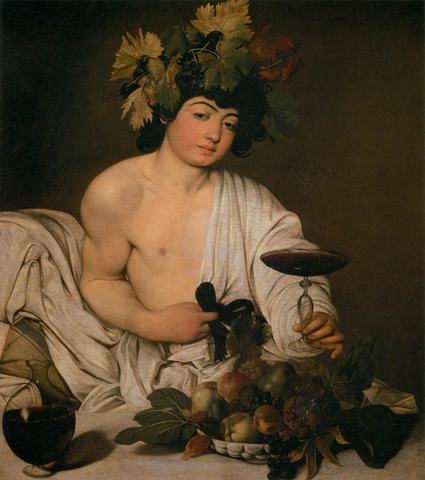
Rome's own wine and fertility god Liber, so thoroughly merged with Greek Bacchus that the Senate outlawed his mystery cult across Italy in 186 BC.
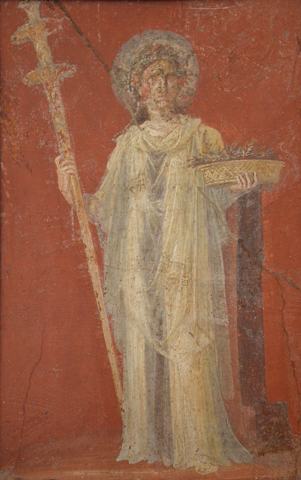
Rome's grain goddess, patron of the plebeian order, whose search for her stolen daughter gave the city its most solemn public festival.
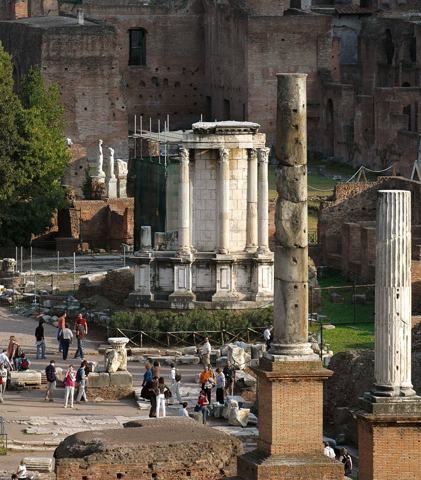
Rome's hearth goddess, worshipped as a living fire rather than a statue, tended in the Forum by six priestesses for over a thousand years.
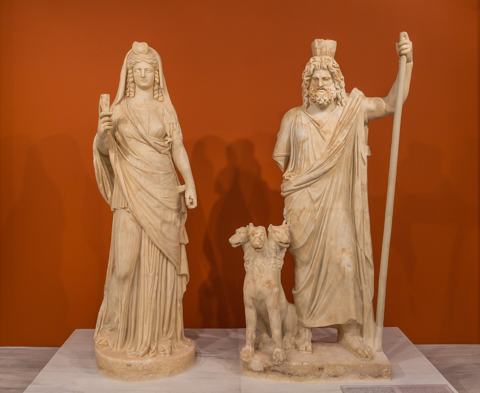
Lord of the underworld — the Roman god of the dead whose older name, Dis Pater, means "the rich father": wealth is what lies buried in the ground.
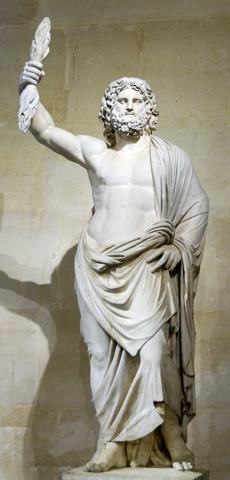
King of the gods and of the Roman state — lord of the bright sky, hurler of the lightning bolt, and the guarantor behind every oath and treaty.
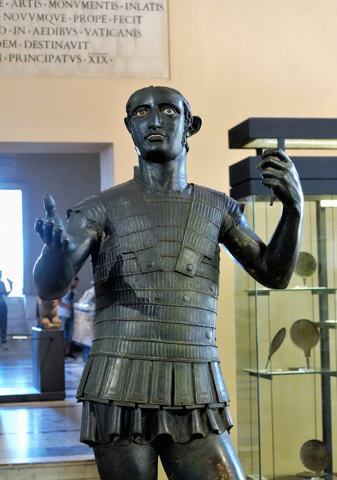
God of war and father of Rome — honoured above almost every other deity, with his own month, his own dancing priests, and the twins he fathered on a Vestal.
Sources & Further Reading
- 1.Virgil, Aeneid — Book VII (c. 19 BCE).
- 2.Ovid, Fasti — Book III (c. AD 8).
- 3.Horace, Odes — Book III.18 (c. 23 BCE).
- 4.Livy, Ab Urbe Condita — Book I.5 (on the Lupercalia and Inuus).
- 5.Dumezil, Georges. Archaic Roman Religion. Translated by Philip Krapp. Johns Hopkins University Press, 1996 (orig. 1966).
- 6.Beard, Mary, John North & Simon Price. Religions of Rome, Volume 1: A History. Cambridge University Press, 1998.
- 7.Scheid, John. An Introduction to Roman Religion. Edinburgh University Press, 2003.
Spot an error or have a source to suggest? Write to info@viseterna.com. We cite primary sources and modern scholarship, and we correct fast.