
Arkona (Temple of Svetovid)
A Rugian temple-fortress with the best-documented pagan cult in the Slavic world - and the site of its most precisely dated destruction, in 1168.
Cape Arkona, Rugen, Germany (photograph by Felix Konig, 2012) · CC BY 3.0 · source
The Rani's Holy Cape
Arkona occupies the northern tip of Cape Arkona on the German island of Rügen, a chalk headland fortified as Jaromarsburg, the stronghold of the Rani (also Rujani), a West Slavic tribe who controlled the island and a stretch of the neighbouring mainland from around the ninth century 2,3. The site was already fortified before it became famous as a temple; its religious importance grew sharply after 1068 or 1069, when a rival Slavic cult center at Rethra was destroyed, and Arkona absorbed much of that shrine's regional prestige, drawing tribute and pilgrims from Baltic Slavic peoples well beyond the Rani themselves 2,3. By the twelfth century it functioned as the paramount sanctuary of Svetovid, protected on three sides by sea cliffs and on the landward side by an earthen rampart roughly twenty-five metres high 3.
Saxo's Temple
Almost everything known about Arkona's cult comes from one source: Book 14 of Saxo Grammaticus's Gesta Danorum, a Latin history commissioned by the Danish church and completed in the early thirteenth century 1. Saxo describes a wooden temple at the fortress's center, richly carved outside and hung inside with red cloth, holding an idol taller than a man with four necks and four clean-shaven heads, two facing forward and two back, one hand gripping a drinking horn and the other bent against the hip, a sword and scabbard, and a bridle and saddle kept beside it for a sacred horse believed to belong to the god himself 1. Access to the inner chamber was restricted even to Svetovid's own priest, who was reportedly forbidden to exhale while inside it and had to step out to breathe 1. This is, by a wide margin, the most detailed description of any idol or temple recorded anywhere in Slavic paganism, precisely because it was written by an outsider with access to informants rather than reconstructed centuries later from folklore 4,5.
An Oracle With an Army
Arkona combined religious, political, and military functions in a way few other Slavic sites are recorded doing. Saxo describes an annual post-harvest festival at which the priest read the level of mead remaining in Svetovid's horn to forecast the coming year's abundance, and a war-divination ritual in which the god's white horse was led over rows of crossed spears, the outcome read from which foot it set down first 1. The temple held a levy from every household in Rani territory and a standing corps of mounted warriors dedicated to the god's service, making the sanctuary as much a treasury and garrison as a shrine 1,4.
The Fall, 1168
Arkona's end is dated with unusual precision for a Slavic religious site. In June 1168, the Danish king Valdemar I, acting with Bishop Absalon of Roskilde, led a campaign against Rügen that ended in the storming of Arkona and the forced destruction of Svetovid's temple and idol, felled, hacked apart, and burned in front of the assembled Rani, who were then compelled to accept Christian baptism 1,3. It is one of the few moments in the entire history of Slavic paganism where a named cult site's rise, practice, and violent end are attested by a single continuous narrative rather than assembled from scattered, unrelated mentions 1,5.
What the Ground Remembers
Archaeological excavation at Arkona has confirmed the broad outline of a fortified sanctuary while leaving Saxo's specific temple undiscovered; the German prehistorian Carl Schuchhardt led early twentieth-century fieldwork on the ramparts, and Joachim Herrmann's later surveys of the Baltic Slavic lands situate Arkona within the wider pattern of West Slavic hillfort sanctuaries destroyed during the twelfth-century Wendish Crusade 2. Sebastian Brather's archaeology of the western Slavs treats the site as archaeologically real but interpretively difficult, since coastal erosion has removed a substantial portion of the original fortress into the Baltic Sea over the intervening eight centuries 3. Today only the earthen ramparts of Jaromarsburg survive above ground, encircling a lighthouse and a nature reserve rather than any visible trace of the temple itself 3.
Arkona's Long Shadow
Arkona's fame outlasted its idol. Aleksander Gieysztor's survey of Slavic mythology places Svetovid, alongside Triglav and Chernobog and Belobog, among the handful of West Slavic gods known from named, dated, textual sources rather than reconstructed folklore 4. A separate and much-debated object, the Zbruch Idol, pulled from a riverbed deep in East Slavic territory in 1848, has been popularly identified with Svetovid since the nineteenth century largely because it echoes Saxo's four-faced idol — an identification most specialists now treat as geographically implausible rather than settled 4,5. Whatever their actual connection, both objects owe their modern fame to the same fact: Arkona is the one Slavic sanctuary whose god, temple, and downfall were all written down by someone who claimed to know what he was describing, a distinction Machal's early comparative survey already singled out a century ago 1,5,6.
Continue Exploring
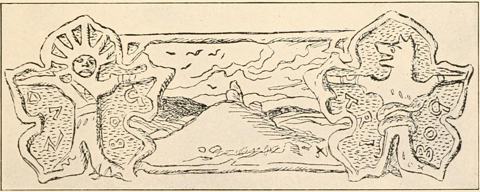
A genuinely attested "black god" of the Baltic Slavs, paired since the 1600s with a "white god" no medieval source actually names.
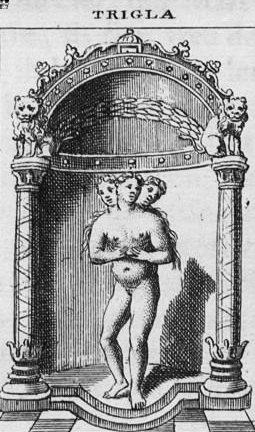
Chief god of the Pomeranian Slavs at Szczecin and Wolin, whose three joined heads were said to rule heaven, earth, and the underworld.
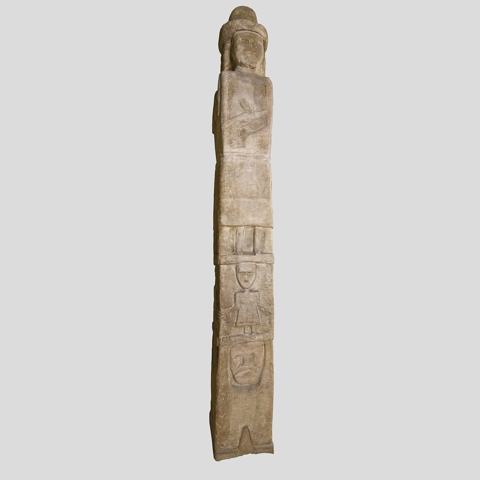
A carved limestone pillar recovered from the Zbruch river in 1848, popularly called Svetovid - though some scholars now argue it may be a 19th-century fake.
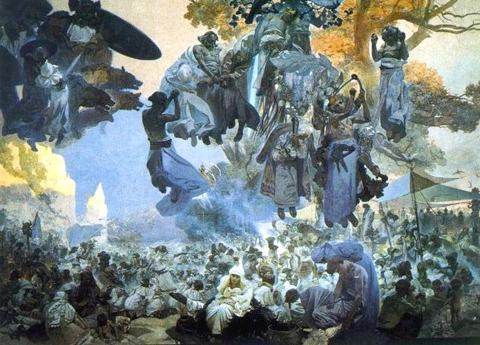
Four-headed war-oracle god of the Rugian Slavs at Arkona, described in unmatched detail by Saxo Grammaticus before Danes destroyed his temple in 1168.
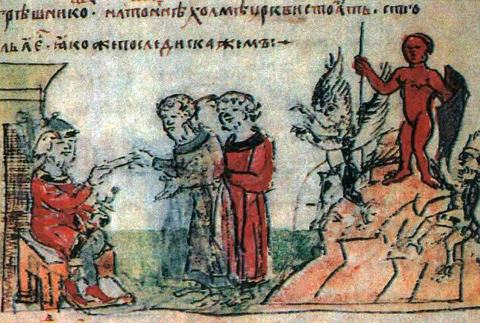
God of thunder and the striking bolt — the oak-crowned sky lord of the early Slavs, sworn by in treaties and thrown into the Dnieper at Rus' baptism.
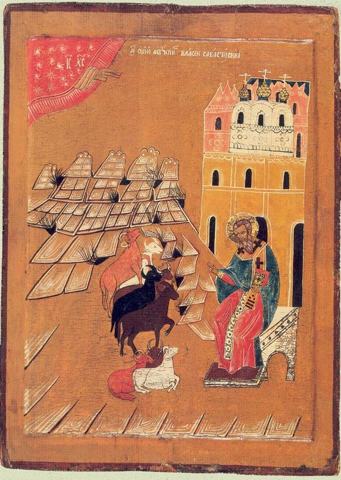
Lord of the cattle and the world below — the second god the Rus' swore by, whose name survived as a curse, a saint's herd, and a beard of grain in the field.
Sources & Further Reading
- 1.Saxo Grammaticus. Gesta Danorum, ed. Karsten Friis-Jensen, trans. Peter Fisher. Clarendon Press, 2015.
- 2.Herrmann, Joachim, ed. Die Slawen in Deutschland. Akademie-Verlag, 1985.
- 3.Brather, Sebastian. Archaologie der westlichen Slawen. De Gruyter, 2001.
- 4.Gieysztor, Aleksander. Mitologia Slowian. Wydawnictwa Artystyczne i Filmowe, 1982.
- 5.Dixon-Kennedy, Mike. Encyclopedia of Russian and Slavic Myth and Legend. ABC-CLIO, 1998.
- 6.Machal, Jan. Slavic Mythology, in The Mythology of All Races, vol. III. Marshall Jones, 1918.
Spot an error or have a source to suggest? Write to info@viseterna.com. We cite primary sources and modern scholarship, and we correct fast.