
Fenghuang
The radiant bird of Chinese myth — ruler of all birds, marked with the five virtues, whose rare appearance announces a just reign and an age of peace.
Fenghuang, Yu Sheng, 18th century, Qing dynasty · Public domain · source
What the Fenghuang Is
The fenghuang (鳳凰) is the sovereign bird of Chinese tradition: the ruler of all feathered creatures, a sign of virtue in a ruler and peace in an age, and — with the dragon — one of the two great emblems of Chinese art 7,8. English usually calls it the Chinese phoenix, which is convenient and misleading, and the mismatch is worth settling before anything else 8.
The name is a compound of two birds. Feng (鳳) was originally the male and huang (凰) the female, named and worshipped separately in early usage; over time the pair fused into a single creature, which then drifted toward being read as female when set opposite the male Chinese dragon 7,8. Modern Chinese uses fenghuang as one word for one bird.
The Bird of the Five Virtues
The classic description is in the Classic of Mountains and Seas, in the account of a mountain in the south. There is a bird shaped like a domestic fowl, patterned in five colours, called the fenghuang 1. Its markings are not decoration but text: the pattern on its head spells virtue, the pattern on its wings righteousness, on its back propriety, on its breast benevolence, and on its belly trustworthiness 1,7.
The passage adds that the bird eats and drinks as nature dictates, sings and dances of its own accord, and that when it appears the world is at peace 1. Birrell notes how thoroughly moralised the creature already is in this early text: it is not a monster catalogued for its danger but a walking statement of the Confucian virtues, which is unusual company for the Shanhaijing's often alarming bestiary 7.
The Zhuangzi supplies the bird's famous fastidiousness. A phoenix-like bird flying from the southern sea to the northern will rest on nothing but the wutong tree, eat nothing but the fruit of the bamboo, and drink from nothing but a sweet spring — a passage used in the text to shame a minister who assumed everyone wanted his job 6. Those three refusals became permanent attributes 7,8.
The Composite Body
Later descriptions assemble the fenghuang out of other animals, in the same manner as the dragon. Xu Shen's dictionary of about 100 CE, quoting an older authority, gives it the breast of a goose, the hindquarters of a stag, the neck of a snake, the tail of a fish, the forehead of a crane, the crown of a mandarin duck, the markings of a dragon, the back of a tortoise, the jaw of a swallow, and the beak of a cock 5.
The same source says it comes from the country of the gentlemen in the east, flies beyond the four seas, passes the Kunlun mountains, drinks at a pillar of stone, bathes in a stormy gorge, and returns to rest at night — and that when it is seen, all under heaven is at peace 5. In painting and embroidery, that description settles into a long-tailed, brilliantly plumed bird with trailing streamers, red and gold predominating 8.
The Bird as Omen
The fenghuang's real function in Chinese thought is prognostic. It is one of the four numinous creatures of the Book of Rites, alongside the unicorn-like qilin, the tortoise, and the dragon — the animals whose appearance measures the moral condition of the realm 4,7.
The most quoted line about it is Confucius's. In the Analects, facing the failure of his life's project, he says that the phoenix has not come and the river yields no chart, and concludes that it is over for him 3. The bird's non-appearance is the evidence: a sage-ruler has not arisen, and the age is not just 3,7.
Chinese bird numinousness runs deeper than the fenghuang alone. The Classic of Poetry preserves the Shang dynasty's own origin claim, that Heaven commanded a dark bird to descend and give birth to the Shang — a founding myth in which the ruling house descends from a bird 2,7.
It is also worth separating two creatures that are frequently confused: the fenghuang is not the Vermilion Bird, Zhuque, the red bird of the southern quadrant in Han directional cosmology, though the two overlap in colour, symbolism, and later art 8.
Dragon and Phoenix
Paired with the dragon, the fenghuang carries one of the most durable symbolic couplings in Chinese culture. In imperial usage the dragon stood for the emperor and the phoenix for the empress, whose formal headdress was the fengguan, the phoenix crown, its tiers of gilt and kingfisher-feather birds signalling rank 8.
That imperial pairing descended into ordinary life through weddings. The dragon-and-phoenix motif — embroidered on bridal dress, moulded onto cakes and candles, set on invitations — expresses the union of complementary powers and remains standard at Chinese weddings today 8. The everyday phrase for auspicious prosperity, longfeng chengxiang, simply names the two creatures 8.
Not the Phoenix of the West
The Mediterranean phoenix burns itself to ash and is reborn from it. The fenghuang, in the classical Chinese sources, does no such thing: it has no fire cycle, no self-immolation, and no death-and-return at all 8. Its rarity is moral rather than mortal — it stays away from a corrupt age and returns to a good one.
The rebirth motif attached to the Chinese bird only in modern usage, through translation and through twentieth-century literature that borrowed the Western image 8. Contemporary fiction, games, and film routinely give the fenghuang flames and resurrection, which is a legitimate modern development but should not be read back into the Shanhaijing 8.
The Fenghuang Today
The bird remains one of China's most visible symbols: in temple and palace ornament, in porcelain and cloisonné, on the emblems of institutions and cities, and in the name of the ancient riverside town of Fenghuang in Hunan 8. Yang and An place it among the mythological figures with the widest continuing life in Chinese material culture — less narrated than the dragon, but at least as often depicted 8.
Continue Exploring
China's oldest surviving catalogue of mountains, monsters, and gods — a text nobody can name an author for, and half this Codex's bestiary depends on.
China's dragon — a benevolent, scaled power of rain, river, and sea, emblem of imperial authority and the only mythical beast in the zodiac.
China's cosmic mountain in the far west — the Yellow Emperor's earthly capital, the Queen Mother's paradise, and, confusingly, a real Asian mountain range too.
The gentle omen-beast of Chinese myth — scaled, horned, treading on no living thing. It appears when a sage rules, and its capture foretold Confucius' death.
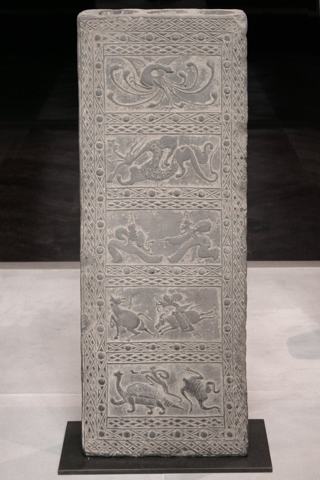
The four beasts of the Chinese sky — dragon, tiger, bird and tortoise-and-snake. A star map first, a mythology second, and both for over two thousand years.
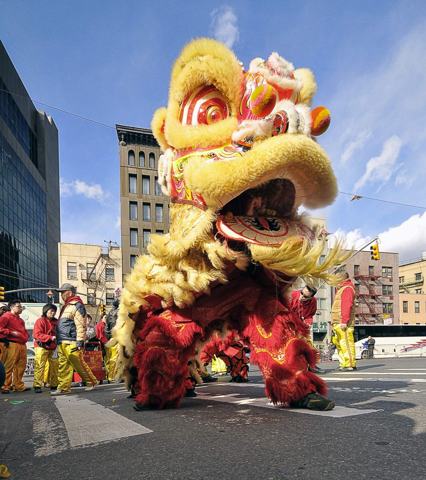
The horned beast said to terrorize villages once a year until scared off by firecrackers, fire, and red — a legend newer than the New Year customs it explains.
Sources & Further Reading
- 1.Shanhaijing — The Classic of Mountains and Seas; trans. Anne Birrell. Penguin Classics, 1999.
- 2.Shijing — The Classic of Poetry (c. 11th–7th c. BCE).
- 3.Lunyu — The Analects of Confucius (c. 5th–3rd c. BCE).
- 4.Liji — The Book of Rites (compiled Han dynasty).
- 5.Xu Shen, Shuowen jiezi — Explaining Graphs and Analysing Characters (c. 100 CE).
- 6.Zhuangzi (c. 3rd c. BCE).
- 7.Birrell, Anne. Chinese Mythology: An Introduction. Johns Hopkins University Press, 1993.
- 8.Yang, Lihui & Deming An. Handbook of Chinese Mythology. ABC-CLIO, 2005.
Spot an error or have a source to suggest? Write to info@viseterna.com. We cite primary sources and modern scholarship, and we correct fast.