
Beltane (Bealtaine)
The Gaelic May Day quarter-day, first recorded in a 10th-century glossary as two fires driven between by cattle — not proof of a god named Bel.
Bonfire at the Beltane Fire Festival, Calton Hill, Edinburgh, 2012 (photograph) · CC BY-SA 3.0 · source
May Day Between Two Fires
Beltane, Old Irish Beltaine or Belltaine, is the quarter day that opens the light half of the Gaelic year around the first of May, opposite Samhain at the year's other hinge 3,5. Its earliest and most detailed description comes from Sanas Cormaic, "Cormac's Glossary," compiled around the year 900 and attributed to Cormac mac Cuilennáin, bishop-king of Cashel. The glossary states that druids lit two fires "with great incantations" each May Day and drove cattle between them as a protection against disease for the coming year — the single most-quoted sentence in the entire literature of the festival 1.
Cormac also offers an etymology, deriving Beltaine from bil-tene, "lucky fire" 1. A rival theory, current since at least the nineteenth century, connects the first element instead to Bel or Belenos, a name attested as an epithet of a continental Gaulish healing god; philologists remain divided, and Whitley Stokes's own edition of the glossary treats the Belenos reading as one proposal among several rather than a settled fact 1. Neither reading is secure enough to say with confidence that Beltane was ever "the festival of the god Bel" — the glossary itself is interested in fire and cattle, not in naming a deity 1,3.
A Quarter Day, Not a Deity
Like Samhain, Beltane belongs to a four-part division of the year also including Imbolc and Lughnasadh, and its function was practical before it was symbolic: it marked the point when livestock could safely be driven out to summer pasture 3,6. Medieval and early modern sources treat it consistently as a calendar date governing farming decisions and protective custom, not as an occasion for worshipping a personified Beltane or Bel 3,5. Where later popular writing sometimes slides into calling Beltane a "fertility festival of the god Bel" without qualification, the primary evidence supports only the fire-and-cattle custom Cormac describes, plus the folk practices recorded much later 1,3.
Cakes, Wells, and Green Boughs
The fullest early eyewitness account of living May Day custom in the Gaelic world comes from Martin Martin, who described the Hebrides around 1695: households baked a special oatmeal cake, cut into pieces and distributed by a kind of lottery, with practices meant to protect livestock from harm over the coming year 2. Nineteenth- and twentieth-century Irish folklore, gathered by Danaher, adds green May boughs hung over doorways, visits to holy wells, and a widespread belief that the butter and milk yield of the whole year could be stolen away on May Eve by fairies or by an ill-wishing neighbour unless proper precautions were taken 4. These customs vary enormously by district, and Danaher is careful to present them as a patchwork of local practice rather than a single unbroken national ritual 4.
Uisneach and the Royal Fires
Later medieval place-lore attaches a grander story to the festival: the Hill of Uisneach, in the centre of Ireland, is remembered in legendary and annalistic tradition as the site of a great royal Beltane fire, lit at the "navel of Ireland" and said to have been visible, fire answering fire, from hilltop to hilltop across the country 6. As with much site-lore of this kind, the claim belongs to literary and antiquarian tradition rather than to excavated evidence, and it should be read as testimony to how important the idea of a unifying Beltane fire had become in later storytelling, not as a record of an actual nationwide signal system 6.
Beltane Revived
Beltane all but disappeared as a public practice in most of Ireland and Scotland by the twentieth century, surviving mainly in scattered rural custom and in scholarly description 3. It was picked up again from two directions: mid-twentieth-century Wiccan and neopagan movements adopted Beltane as one of the eight festivals of their "Wheel of the Year," and in 1988 a group of artists and performers founded the Beltane Fire Society in Edinburgh, staging a large public fire festival on Calton Hill each May Day night 3. That modern festival, with its processions, drumming, and central bonfire, draws loosely on The Druids' association with fire and on Cormac's glossary entry, but it is a late-twentieth-century arts event, not a survival of the medieval rite, and its organisers have generally been candid about the distance between the two 3.
Continue Exploring
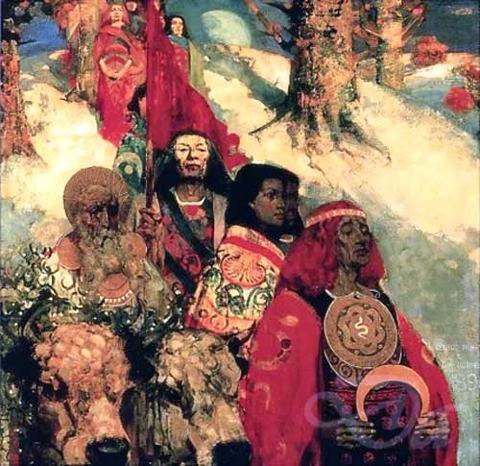
The learned class of Iron Age Gaul and Britain, known mostly through hostile Roman writers and later Irish legend — and reinvented from scratch in the 1700s.
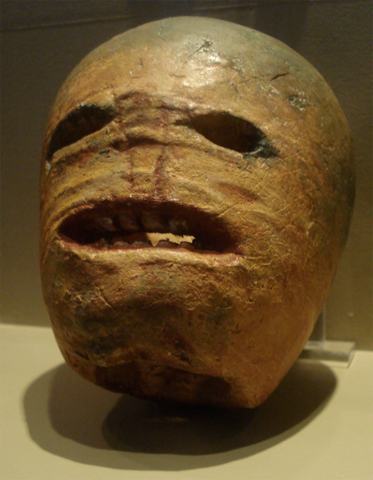
The Gaelic quarter day that opened winter and the Otherworld alike in medieval Irish literature — not, despite a popular myth, the name of a god of the dead.
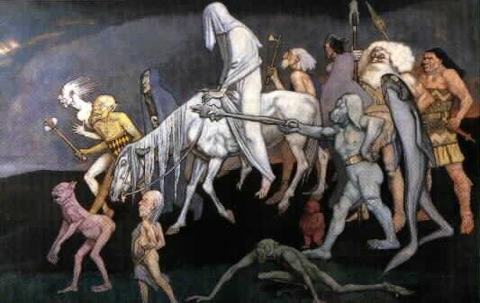
Ireland's monstrous sea-people — raiders, tribute-takers and kin to the gods they fight, led by Balor of the destroying eye.
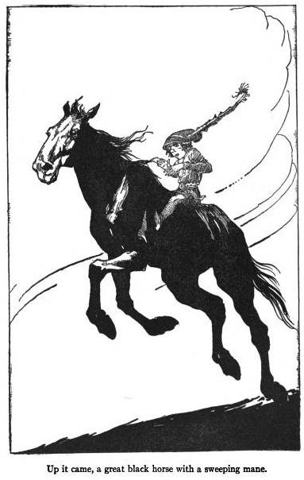
An Irish shapeshifting spirit, usually a wild black horse, who claims a share of the harvest at Samhain and is helpful or frightening depending on the teller.
Master of every skill — the young god admitted to Tara because he alone could do all the crafts at once, and who killed his own grandfather Balor.
The good god — not morally good but good at everything: the club-bearing, cauldron-owning father figure of the Tuatha De Danann, and their crudest comedian.
Sources & Further Reading
- 1.Sanas Cormaic (Cormac's Glossary), attrib. Cormac mac Cuilennain, trans. John O'Donovan, ed. Whitley Stokes. Calcutta, 1868.
- 2.Martin, Martin. A Description of the Western Islands of Scotland. 1703.
- 3.Hutton, Ronald. The Stations of the Sun: A History of the Ritual Year in Britain. Oxford University Press, 1996.
- 4.Danaher, Kevin. The Year in Ireland. Mercier Press, 1972.
- 5.MacKillop, James. Dictionary of Celtic Mythology. Oxford University Press, 1998.
- 6.Koch, John T. (ed.). Celtic Culture: A Historical Encyclopedia. ABC-CLIO, 2006.
Spot an error or have a source to suggest? Write to info@viseterna.com. We cite primary sources and modern scholarship, and we correct fast.