
Morana (Marzanna)
Slavic winter-and-death figure, drowned in effigy every spring. The rite is documented from 1420; whether a real goddess stood behind it is debated.
Zalov, from the cycle Vlast (Homeland), Mikolas Ales, 1880 (Czech National Theatre cycle) · Public domain · source
Names Across the Slavic World
She is Marzanna in Poland, Morana or Mařena in Czech and Slovak lands, Morena in Slovakia and parts of Russia, Marena in the east, and Mara in Belarusian and Ukrainian usage. Lithuanian folk custom preserves a parallel figure, Morė. The cluster of names is usually traced to a Proto-Slavic root connected with morъ, "death, pestilence", and possibly to the same Indo-European family that gives Latin mors and the nightmare-demon mara 3,5,7.
Whatever her origin, the figure that survives in the ethnographic record is unambiguous in function: she is winter, and winter must be killed. That equation, rather than any narrative myth, is the core of everything we actually know about her 3,5.
The Fifteenth-Century Record
The earliest firm evidence is not a myth but a complaint. Polish and Bohemian church authorities in the fifteenth century repeatedly tried to suppress a spring custom in which villagers carried an effigy called Death out of the settlement and threw it into water. The statutes associated with the Synod of Poznań in 1420 instruct clergy to stop parishioners parading and drowning this figure on the Sunday in question 2,5.
Slightly later, the chronicler Jan Długosz compiled a list of Polish gods in his Annales, and among them placed Marzana, whom he equated with the Roman Ceres — a goddess of grain and the agricultural year 1. Długosz was writing four and a half centuries after the conversion of Poland and working, by his own method, through analogy with classical mythology, which is exactly why his list has been fought over ever since 1,4.
Carrying Out Death
The rite itself is documented in dense detail from the eighteenth century onward and is still performed. A straw figure is dressed in white or in a girl's clothing, hung with ribbons, beads and sometimes eggshells, and carried through the village by children or unmarried women singing that Death is being taken away and spring brought in. At the boundary — a stream, a river, a pond — the effigy is burned, drowned, or both, and the procession returns with a green branch 3,5,6.
Certain taboos attach to the moment. In many recorded versions no one may look back at the effigy, touch it once it is in the water, or fall behind on the walk home, on pain of illness or death within the year. James Frazer collected dozens of European variants of this "carrying out of Death" and read them as survivals of vegetation sacrifice; later scholarship has been more cautious, treating the rite as an act of imitative magic and boundary-drawing rather than as evidence of an archaic human sacrifice 5,6.
Was There a Goddess?
Here the honest answer is that scholars disagree. Aleksander Brückner argued, influentially and caustically, that Długosz assembled his Polish pantheon out of misheard song refrains and Latin parallels, and that Marzanna was never a goddess at all — merely the name given to the straw doll, back-formed into a deity by a learned chronicler 4. On that reading the rite is genuinely old and the goddess is a fifteenth-century scholarly artefact.
Other researchers, including Andrzej Szyjewski, note that the name is too widely distributed across Slavic and Baltic territory, and too tightly bound to a single coherent ritual, to be pure invention, and allow that a pre-Christian personification of winter death plausibly stands behind it 5. Jan Máchal, writing in 1918, took a middle position, treating Morana as a personified season rather than a fully developed deity with cult and myth 3. Readers should treat any confident modern account of "Morana's mythology" — her marriage, her siblings, her palace — with real suspicion; most of it is nineteenth-century Romantic reconstruction or twentieth-century neo-pagan elaboration, not medieval testimony 4,5,7.
Winter, Water, and the Other World
What is well grounded is the symbolic grammar. The effigy leaves by way of water, and in Slavic belief water is the standard road to the world of the dead — the same road travelled by the drowned who become rusalki, and the same threshold that separates the living settlement from Nav, the realm of the departed 3,7. Killing Morana is therefore not destruction but expulsion: winter is escorted across a boundary and handed to the other side, and green branches are carried back in exchange.
In much of the surviving folklore her opposite number is Vesna or a similar spring maiden, and the pairing gives the year its two halves. Some traditions in the South Slavic lands also link Morana to the storm god Perun or set her against him as the barren season against the fertile one, though these connections are reconstructions built on comparative reasoning rather than attested texts 5,7.
Morana Now
The drowning of Marzanna never stopped. It is performed every year around the spring equinox in Poland, Slovakia, the Czech Republic and Lithuania, mostly by schoolchildren, and it has been argued about by environmental authorities more often than by theologians, since straw dolls in rivers are litter as well as ritual 5.
She has also had a substantial second life in art and fiction — from Mikoláš Aleš's 1880 painting of Morana escorting a hero into the land of the dead, to modern fantasy and games that treat her as a full death goddess with a developed court. That version is a modern creation, but it is built on a genuinely ancient-feeling gesture: once a year, a community decides that the cold has lasted long enough, makes it into a body, and throws it in the river 3,6.
Continue Exploring
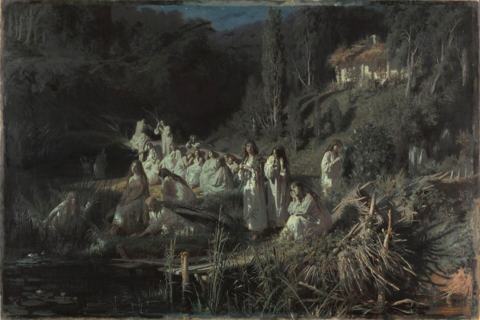
Slavic water spirit of the restless dead: a drowned or unbaptised girl who leaves the river for one week each summer to walk the fields and the woods.
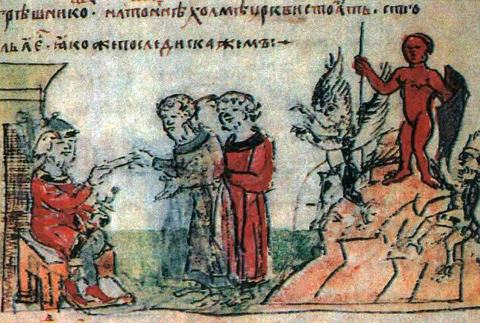
God of thunder and the striking bolt — the oak-crowned sky lord of the early Slavs, sworn by in treaties and thrown into the Dnieper at Rus' baptism.
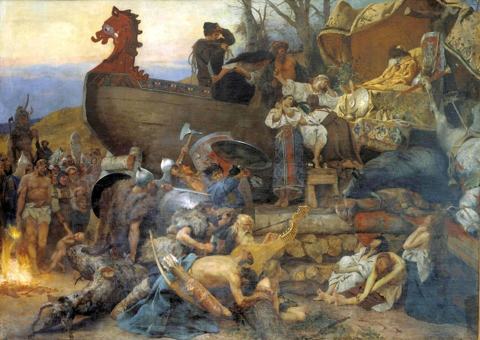
The land of the dead — an old Slavic word for a corpse and for the dead who come back, and the least documented otherworld in European mythology.
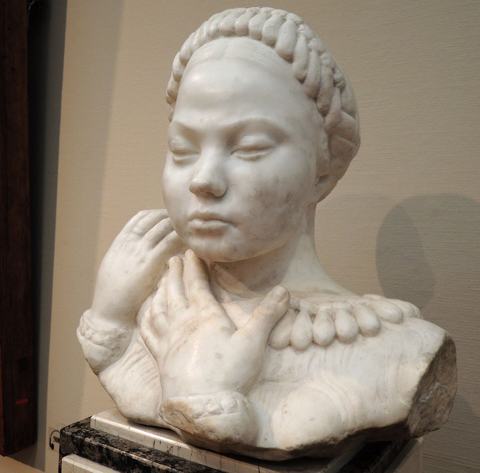
Popularly the Slavic goddess of love, spring and marriage. Most Slavists think she began as a song refrain misread as a divine name.
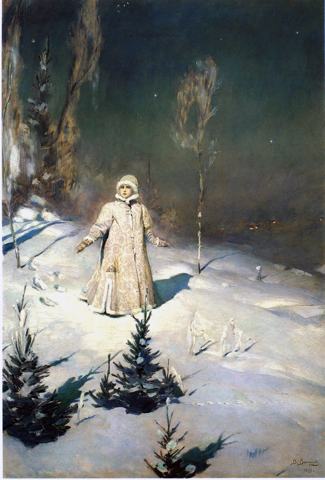
A Slavic spring figure known mainly from 18th- and 19th-century peasant rituals, not medieval texts — his "godhood" is largely later reconstruction.
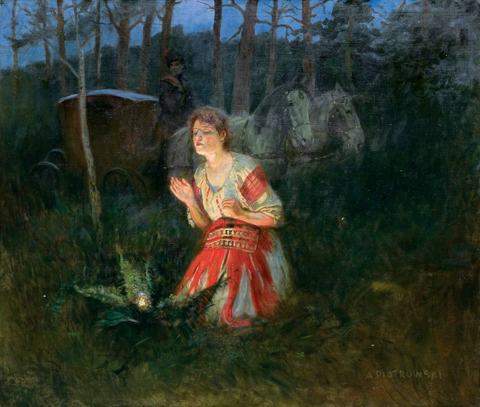
Slavic midsummer's eve of bonfires, floating flower wreaths and the legend of a fern that blooms once a year - grafted onto the feast of St John the Baptist.
Also mentioned inMaslenitsa
Sources & Further Reading
- 1.Jan Dlugosz, Annales seu cronicae incliti Regni Poloniae, Book I (written c. 1455-1480).
- 2.Prohibitions of the "carrying out of Death" rite in Polish and Bohemian church legislation, notably the statutes of the Synod of Poznan (1420).
- 3.Machal, Jan. Slavic Mythology, in The Mythology of All Races, vol. III. Marshall Jones, 1918.
- 4.Bruckner, Aleksander. Mitologia slowianska i polska. Warsaw, 1918/1924 (repr. PWN, 1980).
- 5.Szyjewski, Andrzej. Religia Slowian. Wydawnictwo WAM, 2003.
- 6.Frazer, James George. The Golden Bough, "The Carrying Out of Death". Macmillan, 1890.
- 7.Dixon-Kennedy, Mike. Encyclopedia of Russian and Slavic Myth and Legend. ABC-CLIO, 1998.
Spot an error or have a source to suggest? Write to info@viseterna.com. We cite primary sources and modern scholarship, and we correct fast.