
Pluto
Lord of the underworld — the Roman god of the dead whose older name, Dis Pater, means "the rich father": wealth is what lies buried in the ground.
Pluto-Serapis and Persephone-Isis, Roman marble, mid-2nd c. AD (Heraklion Archaeological Museum); photo Jebulon, CC0 · CC0 · source
Three Names for One Fear
The Romans had several names for the god of the dead, and the differences between them are the most informative thing about him.
Dis Pater is the old Latin title, and Cicero explains it plainly: the god is called Dives, "rich," because everything falls back into the earth and everything grows out of it — the same logic by which the Greeks called their underworld king Plouton, "wealth," rather than risk saying Hades out loud 1. Pluto is that Greek euphemism taken over directly into Latin. And Orcus is an older, harsher Italic figure of death itself, whose name survives in Italian orco and, by a long route, in the English "ogre" 6,7.
None of these is a name Romans used casually. The underworld god is the one power whose attention you specifically do not want, and Roman practice reflects it: almost no temples, almost no public festivals, and rites conducted at night, below ground, with black victims 7,8.
The Buried Altar in the Campus Martius
The one great state cult of Dis Pater was, appropriately, underground. At a spot on the Campus Martius called the Tarentum, an altar to Dis Pater and Proserpina stood buried in a pit and was uncovered only when it was needed, then covered over again 7.
It was needed for the Ludi Saeculares, the Secular Games, held to mark the passing of a saeculum — the longest span a human life could reach, so that no one present would ever see the ceremony twice 7. The rite involved nocturnal sacrifices of black animals to the powers below, and Augustus's celebration in 17 BCE, whose official record survives inscribed on stone, made it the centrepiece of a programme announcing that a dark age had ended and a new one begun 7,8. Even at its most triumphant, then, Roman public religion approached the god of the dead by digging down and working after dark 8.
Human Sacrifice After Cannae
Roman religion had one genuinely appalling episode connected with the powers below, and Livy records it without disguise. In 216 BCE, after Hannibal annihilated a Roman army at Cannae, the Romans consulted the prophetic books and buried alive two Gauls and two Greeks, a man and a woman of each, in the cattle market — the Forum Boarium 5.
Livy calls the rite "least Roman," and it was repeated only twice more in the historical record before being formally banned in 97 BCE 5,7. Modern scholarship treats it as a measure of how completely Cannae had broken Roman confidence, and as evidence that the chthonic powers were understood to require appeasement in kind when the state was near collapse 7,8.
Ordinary Romans met the underworld more mildly. Antiquarians describe the mundus, a ritual pit that was opened on three days of the year, on which the gates below were said to stand open and no public business could properly be transacted 6,7.
The Abduction of Proserpina
The great narrative attached to Pluto is Greek in origin but was thoroughly relocated by Latin poets. Ovid tells it twice — at length in the Metamorphoses and again in the Fasti — and sets the abduction at Enna in Sicily, where the god bursts out of the earth, seizes Proserpina as she gathers flowers, and carries her below in his chariot 2,3.
Ceres searches the world for her daughter with torches lit from Etna, blights the harvest in her grief, and finally wins a settlement from Jupiter: the girl may return, but only because she has eaten a few pomegranate seeds in the underworld she must spend part of every year there 2,3. The year's division into growth and dormancy follows from a technicality of hospitality law.
Placing the story in Sicily mattered. Sicily was Rome's first province and its grain supply, the Aventine cult of Ceres and Proserpina had been established in Greek rite in the third century BCE, and a myth about the goddess of grain and her stolen daughter had obvious political resonance in a city that fed itself on Sicilian wheat 7.
Virgil's Kingdom of Dis
The fullest Roman picture of Pluto's realm is Book 6 of the Aeneid, where Aeneas descends at Cumae with the Sibyl to consult his dead father 4. Virgil organises the underworld with a bureaucratic thoroughness that is entirely Roman: an entrance crowded with personified ills, a ferryman who refuses the unburied, a judge, a division of the road, Tartarus walled and echoing on one side and the blessed fields of Elysium on the other 4.
Pluto himself barely appears. He is "Dis," the unseen king whose consent the golden bough represents, and the drama belongs to the souls rather than to their ruler 4. That is characteristic. In Roman literature the underworld is a place, vividly imagined; its god is a name, deliberately unelaborated 4,7.
What the Romans Actually Believed
It is worth separating the poetry from the practice. Roman epitaphs run the full range from confident statements about the Manes, the collective divine dead honoured every February at the Parentalia, to flat declarations that after death there is nothing at all 7,8. Educated Romans could discuss the underworld as allegory, as Cicero does, while still attending their family's tomb rites on schedule 1,8.
Pluto sits inside that ambiguity. He is the least anthropomorphic of the major Roman gods, closer to a jurisdiction than a personality: the owner of everything under the surface, including the seed corn, the ore, the ancestors, and eventually you 1,7.
Continue Exploring
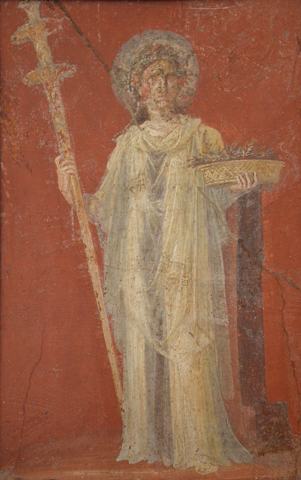
Rome's grain goddess, patron of the plebeian order, whose search for her stolen daughter gave the city its most solemn public festival.
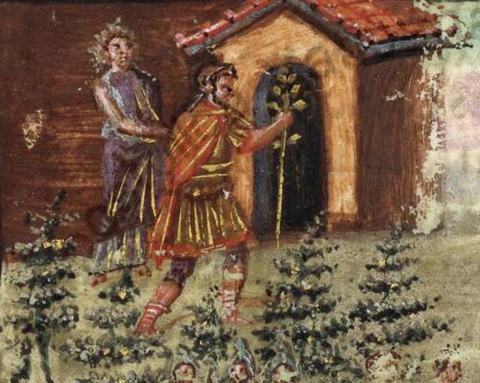
The blessed fields — an afterlife of light and ease that began as a plain at the world's edge and ended as a district of Virgil's underworld.
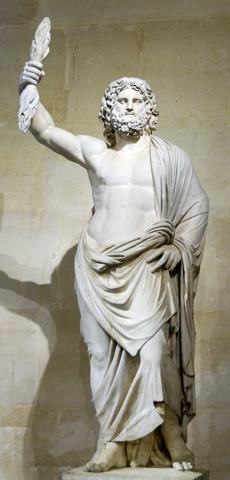
King of the gods and of the Roman state — lord of the bright sky, hurler of the lightning bolt, and the guarantor behind every oath and treaty.
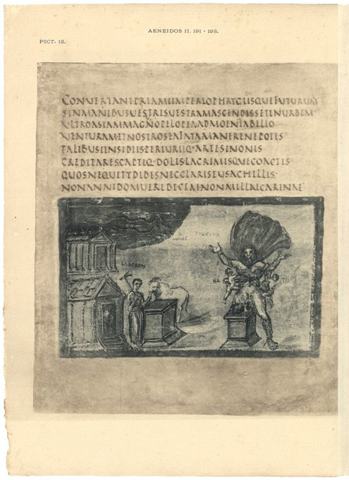
Virgil's unfinished epic of Aeneas's flight from Troy and the founding of Rome — composed for Augustus, nearly burned at its author's own request.
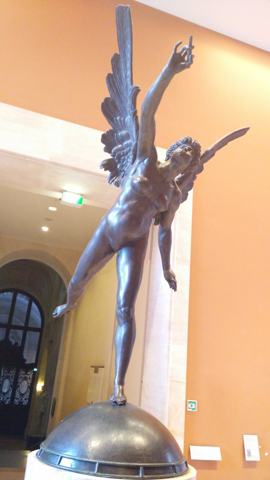
Rome's god of trade, profit and messages, later fused so completely with Greek Hermes that the two are barely distinguishable.
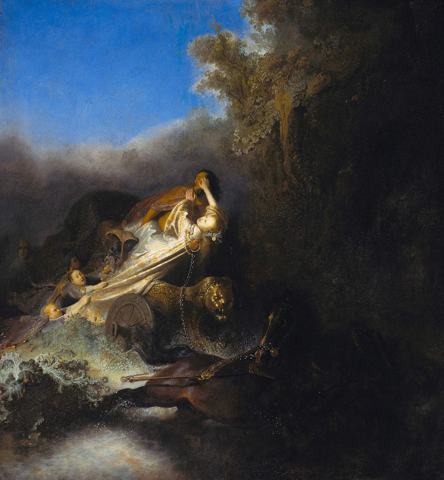
Lord of the underworld and of the wealth beneath the earth. Not a devil — a grim, lawful king whose only rule is that no one leaves.
Also mentioned inOvid's Metamorphoses
Sources & Further Reading
- 1.Cicero, De Natura Deorum (45 BCE), Book 2.
- 2.Ovid, Metamorphoses (8 CE), Book 5.
- 3.Ovid, Fasti (c. 8 CE), Book 4.
- 4.Virgil, Aeneid (29–19 BCE), Book 6.
- 5.Livy, Ab Urbe Condita (c. 27 BCE) — esp. Book 22.
- 6.Varro, De Lingua Latina (1st century BCE).
- 7.Beard, Mary, John North & Simon Price. Religions of Rome, Volume 1: A History. Cambridge University Press, 1998.
- 8.Scheid, John. An Introduction to Roman Religion. Edinburgh University Press, 2003.
Spot an error or have a source to suggest? Write to info@viseterna.com. We cite primary sources and modern scholarship, and we correct fast.