
Mercury (Roman Messenger God)
Rome's god of trade, profit and messages, later fused so completely with Greek Hermes that the two are barely distinguishable.
Mercury (Flying Mercury), Giambologna, bronze, 1580 (Musee du Louvre) · CC BY-SA 2.0 · source
A God Named for Commerce
Unlike Jupiter or Mars, Mercury's name announces his job description. Most scholars derive Mercurius from merx, "merchandise," making him, unusually among the major Roman gods, defined from the outset by an economic function rather than a natural force or an ancestral cult 5,6. Bernard Combet-Farnoux's study of the god argues that this commercial identity was native and Italian, not an import smuggled in under a Greek name, even though Mercury was equated with Hermes almost as soon as Roman sources mention him at all 5.
A Temple Born of Spite
Livy dates Mercury's first Roman temple, on the slope of the Aventine above the Circus Maximus, to 495 BCE, in the middle of a debt crisis between patrician creditors and plebeian debtors 1. The consuls quarreled over which of them would have the honor of dedicating it, so the Senate threw the decision to the popular assembly — which handed the honor not to a consul at all but to a mere centurion, Marcus Laetorius. Livy reads the choice as a deliberate insult to both men standing for the office: the plebs gave the god of trade to a soldier of their own rank, in a dispute that had nothing to do with trade 1,6.
The Mercuralia: Washing Away Bad Oaths
Mercury's festival, the Mercuralia, fell on the same day as that temple dedication, 15 May, and Ovid describes its central rite: merchants filled a jug from Mercury's sacred spring near the Porta Capena, carried it into his temple, and sprinkled it over their own heads and their merchandise while praying for the past year's business lies — broken oaths and short weights — to be washed away, and for honest profit to follow 2. The prayer Ovid records is disarmingly frank about what commerce actually involved: it asks the god to forgive deception already committed, not merely to bless future honesty, a detail Beard, North and Price cite as evidence that Roman religion accommodated ordinary moral compromise rather than pretending it away 2,6.
Borrowed Wings: Mercury as Hermes
Once identified with Hermes, Mercury absorbed the Greek god's entire kit: winged sandals and a broad traveler's hat, the herald's staff or caduceus, the role of divine messenger and guide of souls to Pluto's underworld, and a family tree crediting him as the son of Jupiter and the nymph Maia 6,7. Horace's ode addressed to Mercury — "eloquent grandson of Atlas," skilled at shaping wild men's manners through speech — treats this Greek inheritance as settled fact for an educated Roman audience by the late first century BCE, crediting the god with everything from the invention of the lyre to escorting the dead 4,7. Robert Turcan's survey of Roman religion notes that Mercury is a rare case where the Greek overlay did not so much cover an existing Roman figure as complete one that had always been partial — a function waiting for a mythology 7.
The Most Worshipped God in Gaul
Mercury's afterlife outside Italy was arguably bigger than his life inside it. Julius Caesar, describing Gallic religion in his own commentaries, claims Mercury was the most worshipped god among the Gauls, credited as inventor of every craft, guide of travelers, and patron of trade and profit — a description modern scholars read as Caesar's own interpretation laid over local gods such as Lugus, not evidence that the Gauls worshipped an imported Italian deity by name 3,6. The label stuck regardless: Gallo-Roman sanctuaries and inscriptions to "Mercury" multiplied across Gaul, Germany and Britain, including a colossal statue on the summit of the Puy de Dôme, and the god's Roman name became, in effect, the administrative filing category for a whole range of local trade and travel gods 3,5,6.
Legacy
Mercury's split identity — half native Italian trade-god, half borrowed Greek psychopomp — left him with an unusually wide portfolio for a single deity: merchants, thieves, travelers, orators and the dead all answered to him in different contexts, sometimes within the same festival 6,7. The flamen who served Vulcan sacrificed each May to the same old goddess Maia later poets made Mercury's mother, a coincidence of the calendar that hints at how tangled these early Italian cults were before literary myth sorted them out 5,7. That tangle is why Mercury's iconography settled early into the version still recognizable today, the winged messenger caught mid-flight — an image that owes as much to Hermes as to whatever plainer trade-god the Aventine merchants first built a temple for in 495 BCE 5,7.
Continue Exploring
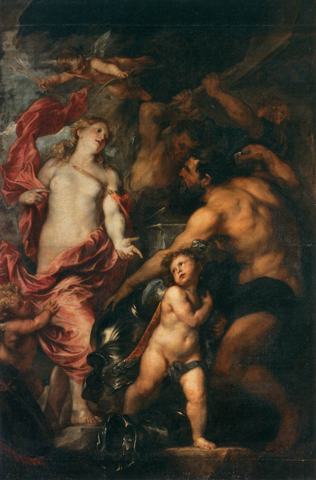
Rome's fire god, honored to keep flame from the wooden city, later remade as the mythical blacksmith who forged arms for gods and heroes.
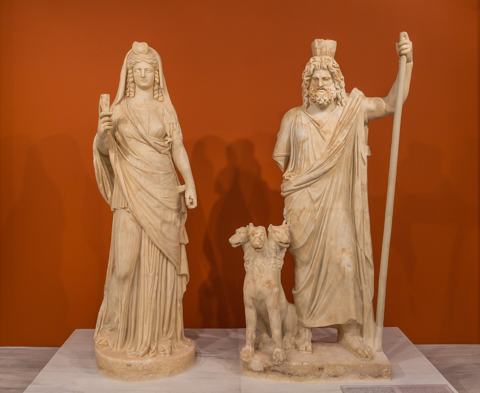
Lord of the underworld — the Roman god of the dead whose older name, Dis Pater, means "the rich father": wealth is what lies buried in the ground.
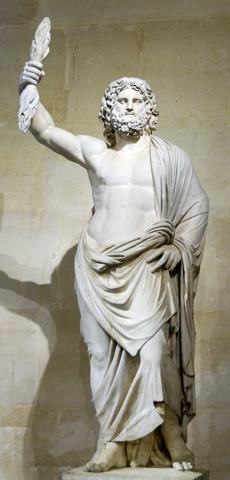
King of the gods and of the Roman state — lord of the bright sky, hurler of the lightning bolt, and the guarantor behind every oath and treaty.
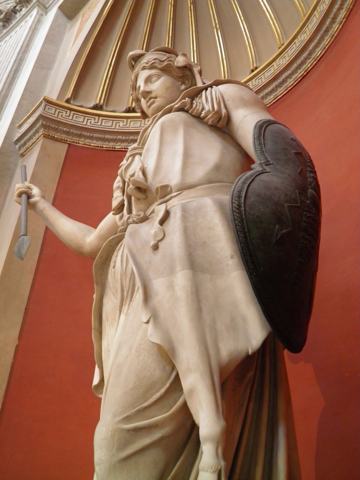
Queen of the gods — Rome's guardian of women, childbirth and the state, whose sacred geese warned the Capitol and whose temple gave us the word money.
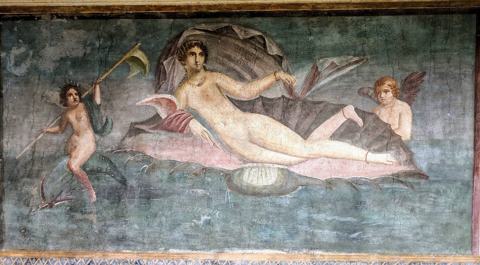
Goddess of love and desire — and the divine ancestress of Rome itself, mother of Aeneas and the claimed forebear of the family of Julius Caesar.
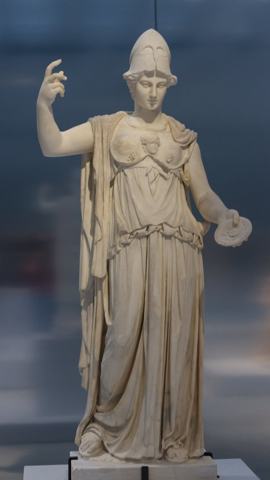
Goddess of wisdom and the crafts — third of the Capitoline Triad, and Rome's patron of every skilled trade from weaving and teaching to medicine.
Sources & Further Reading
- 1.Livy, Ab Urbe Condita — Book II.27 (dedication of the temple, 495 BCE).
- 2.Ovid, Fasti — Book V (the Mercuralia, c. AD 8).
- 3.Julius Caesar, Commentarii de Bello Gallico — Book VI.17 (Mercury among the Gauls, 1st century BCE).
- 4.Horace, Odes — Book I.10 (c. 23 BCE).
- 5.Combet-Farnoux, Bernard. Mercure romain — le culte public de Mercure et la fonction mercantile à Rome de la République archaïque à l'époque augustéenne. École française de Rome, 1980.
- 6.Beard, Mary, John North & Simon Price. Religions of Rome, Volume 1: A History. Cambridge University Press, 1998.
- 7.Turcan, Robert. The Gods of Ancient Rome — Religion in Everyday Life from Archaic to Imperial Times. Routledge, 2000.
Spot an error or have a source to suggest? Write to info@viseterna.com. We cite primary sources and modern scholarship, and we correct fast.