
Ovid's Metamorphoses
Ovid's 15-book Latin epic of transformation myths — the single work that shaped how the post-classical West came to know Greek and Roman mythology.
Prometheus creates mankind, illumination from a French translation of Ovid's Metamorphoses, Bodleian Library MS Douce 117, early 16th century · Public domain · source
Fifteen Books, One Governing Idea
Ovid's Metamorphoses runs to roughly twelve thousand lines of Latin hexameter across fifteen books, telling something like two hundred and fifty stories linked by a single loose rule: nearly every episode ends, or turns, on a transformation, usually of a person into an animal, plant, star, or stone 1. The poem's span is cosmic, opening with the creation of the world out of formless chaos and closing, fifteen books later, with the deification of Julius Caesar and a prophecy of Augustus's own future apotheosis, so that the whole work moves from myth toward very recent Roman history without ever announcing a clean break between the two 1,6.
Completed in the Shadow of Exile
Ovid was finishing the poem around AD 8, the same year Augustus abruptly exiled him to Tomis on the Black Sea, for reasons the poet himself later describes only obliquely, as "a poem and a mistake" 2. In the Tristia, written from exile, Ovid claims he burned his own manuscript of the Metamorphoses in grief and anger before leaving Rome, and that it survived only because friends already held copies — a story most scholars treat as a literary pose rather than a reliable account of what actually happened, since it echoes a well-worn Roman trope about a poet's reluctant, falsely modest relationship to his own work 2,6.
A Chain, Not a List
What holds fifteen books of largely disconnected myth together is structural cleverness rather than plot. Ovid moves between stories by association, frame narrative, and sometimes outright sleight of hand — one character in the middle of a tale will pause to tell a second story to a third, who then tells a fourth — producing a poem that reads less like a single epic than a long, formally unified anthology 1,5. Brooks Otis's influential study argued that Ovid organizes the whole into four loosely thematic movements, running roughly from the divine world through love stories, then Theban and other mortal-crime narratives, and finally Rome's own legendary and historical past, though later scholars have pushed back on how rigid that scheme really is in the poem as actually written 5,6.
Serious Epic Played for Irony
The poem's tone is famously slippery. It borrows the dactylic hexameter and grand machinery of epic — the meter of Homer and Virgil — while routinely undercutting epic solemnity with wit, sudden shifts of register, and a narrator who seems more interested in the psychology and absurdity of desire than in heroism for its own sake 5,6. Even its most violent stories, Tereus and Philomela, Actaeon torn apart by his own hounds, Marsyas flayed alive, are told with a controlled, almost clinical elegance that has struck readers across the centuries as unsettling precisely because the horror is never allowed to overwhelm the poem's formal polish 6,7.
The Book That Carried Greek Myth West
For enormous stretches of later European culture, the Metamorphoses was not one source among several for Greek mythology — it was effectively the source, transmitted in Latin to readers who had little or no Greek of their own 6. Stories that survive in fuller or more vivid form nowhere else, including the theft of the Palladium worked into Ulysses's courtroom speech in Book 13, or the account of the world's four ages under the rule of Saturn that opens Book 1, reached the medieval and Renaissance West chiefly through Ovid's telling rather than through the Greek originals behind them 1,6. That transmission came with a filter attached: Ovid's versions are literary, knowing, and often ironic reworkings by a sophisticated Roman court poet, not transcripts of anyone's religious belief, and treating them as a neutral window onto "what the Greeks believed" understates how much editorial personality sits between the myths and the reader 5,6,7.
From Manuscript to Modern Shelf
The poem survived the collapse of the Western Roman Empire through manuscript copying in monastic and later university contexts, acquiring in the Middle Ages a thick overlay of Christian allegorical readings — most famously the vast French Ovide moralisé — that reinterpreted its pagan transformations as moral or even scriptural lessons, a use of the text Ovid could not have anticipated and that modern scholarship treats as a separate reception history rather than a guide to the poem's original meaning 6,7. Arthur Golding's English translation of 1567, which William Shakespeare demonstrably knew and drew on, and the many translations since — Dryden's in the seventeenth century, and in the twentieth Ted Hughes's free adaptation Tales from Ovid — kept individual stories such as Diana and Actaeon or Pluto's abduction of Proserpina in continuous circulation across languages long after the Latin original stopped being common reading 3,4,6.
Continue Exploring
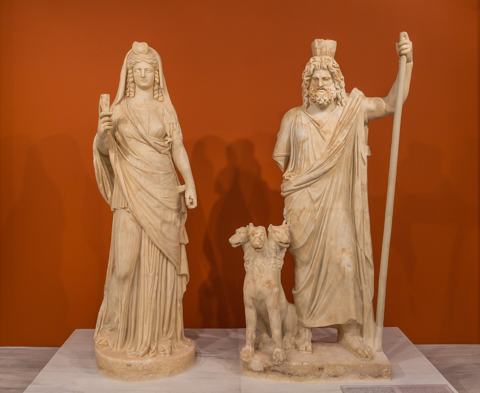
Lord of the underworld — the Roman god of the dead whose older name, Dis Pater, means "the rich father": wealth is what lies buried in the ground.
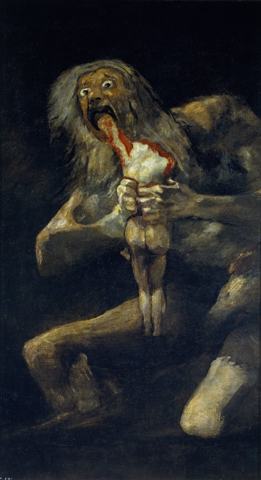
Rome's god of sowing and the lost Golden Age, whose temple held the state treasury and whose December festival turned the social order upside down.
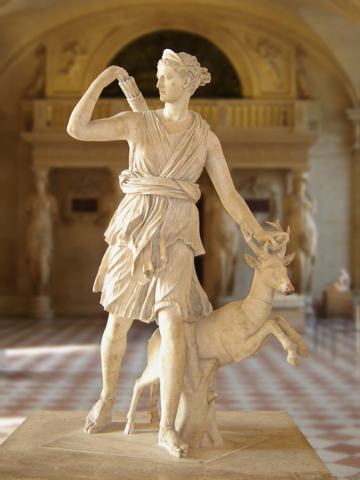
Roman goddess of the hunt, wild places and the moon, whose oldest sanctuary at Lake Nemi was guarded by a priest who held office by killing his predecessor.
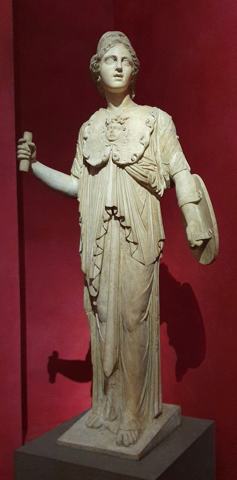
The wooden image of Pallas Athena said to guard Troy, stolen by the Greeks and, by Roman legend, carried to Italy by Aeneas to protect Rome instead.
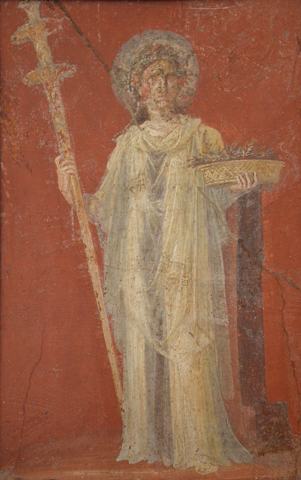
Rome's grain goddess, patron of the plebeian order, whose search for her stolen daughter gave the city its most solemn public festival.
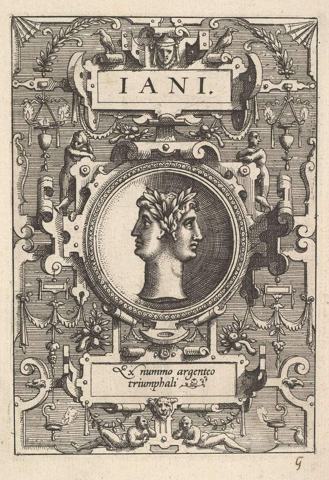
The two-faced Roman god of doors, beginnings and endings, named first in every prayer, whose gates in the Forum stood open only while Rome was at war.
Sources & Further Reading
- 1.Ovid, Metamorphoses — Books I-XV (completed c. AD 8).
- 2.Ovid, Tristia — Book II (c. AD 9-12).
- 3.Ovid. Metamorphoses. Trans. Frank Justus Miller, rev. G.P. Goold. 2 vols. Loeb Classical Library. Harvard University Press.
- 4.Ovid. Metamorphoses. Trans. David Raeburn, introduction by Denis Feeney. Penguin Classics, 2004.
- 5.Otis, Brooks. Ovid as an Epic Poet. 2nd ed. Cambridge University Press, 1970.
- 6.Hardie, Philip, ed. The Cambridge Companion to Ovid. Cambridge University Press, 2002.
- 7.Anderson, William S., ed. Ovid's Metamorphoses, Books 1-5. University of Oklahoma Press, 1997.
Spot an error or have a source to suggest? Write to info@viseterna.com. We cite primary sources and modern scholarship, and we correct fast.