
Lamassu (Assyrian Winged Bull)
The human-headed winged bull that guarded Assyrian palace gates, sculpted with five legs so it reads correctly as both standing and walking.
Human-headed winged bull (lamassu) and a winged genie, from the palace of Sargon II, Khorsabad, 710-705 BCE (British Museum) · CC BY-SA 4.0 · source
What a Lamassu Is
A lamassu is a composite guardian: the bearded head of a man wearing the horned crown of divinity, the body and ears of a bull or a lion, and the spread wings of a great bird, combining a king's wisdom, a bull's strength, and an eagle's reach in a single figure standing at a door 3,4. Akkadian distinguishes a female lamassu from a male shedu, but by the time the great Neo-Assyrian palace colossi were carved the two words, along with aladlammu, were used almost interchangeably for the same figure, and modern usage has settled on "lamassu" for all of them regardless of the gender the texts once implied 4.
Their genealogy runs back through a long Mesopotamian tradition of composite protective beings — the bull-man kusarikku, the hairy hero lahmu, the horned serpent mushussu — carved or moulded and stationed at doorways to keep demons and disease out of a building 2. Wiggermann's study of the ritual texts that accompanied such figures shows they were never merely decorative: each type had a name, a prescribed material, and a place in a written ritual that activated it before it was buried or installed 2.
The Five-Legged Illusion
The colossal gate lamassu solved a problem no single flat relief or free-standing statue could: how to make a guardian that reads correctly from two different angles at once 3. Seen head-on, blocking the doorway, the figure stands planted on two visible front legs, monumental and immovable. Seen from the side, walking the length of the passage past it, it strides forward on four legs in motion 3,4.
Assyrian sculptors solved this by giving the animal five legs rather than four, carving an extra limb into the relief so the count works out differently depending on where a visitor stood — an optical solution to a problem of architecture and ritual movement, not a mistake or a taste for the uncanny 3,4. Reade's survey of the sculpture notes the technique is consistent across the major Assyrian palace sites, evidence of standard workshop practice rather than an experiment tried once 3.
Guardians of the Threshold
Pairs of lamassu flanked the gates of cities, the outer gates of royal palaces, and the doorways into throne rooms, always in twos, always facing outward or toward the passage a visitor had to walk 3,4. At Sargon II's new capital of Dur-Sharrukin — modern Khorsabad — a long cuneiform inscription is carved directly between the colossi's legs, reciting the king's titles and the building of the palace, so that the guardian and the royal record occupy the same block of stone 1,4.
The same protective logic operated on a domestic scale far from any palace. Ordinary households buried small clay or bronze figures of protective spirits, lamassu among them, under thresholds and in the corners of rooms, following instructions recorded in the ritual texts Wiggermann edited — proof that the idea guarding a king's gate at colossal scale was also doing quiet work in private houses that left no inscriptions at all 2,4.
From Nimrud to Nineveh
The type is at its grandest under the Neo-Assyrian kings: Ashurnasirpal II raised lamassu at Nimrud in the ninth century BCE, Sargon II at Khorsabad in the eighth, and Sennacherib and Ashurbanipal at Nineveh after him, each figure weighing tens of tons and cut from a single block hauled from the quarry by the forced labour the palaces' own reliefs depict 3,4. Unlike the household amulets of Pazuzu, which protect by being more alarming than the danger they repel, or the monstrous Humbaba, whose terror keeps people away from a forest, the lamassu protects by dignity and permanence — a threshold guardian that does not threaten the visitor it is watching 4.
Excavated and Dispersed
When European excavation reached these sites in the 1840s, Paul-Emile Botta at Khorsabad and Austen Henry Layard at Nimrud and Nineveh found lamassu still standing at ruined gates, and both had them sawn into transportable sections and shipped to Paris and London — an operation that damaged some figures badly and left others, too large to move at all, still half-buried on site 5. Russell's study of the resulting collections traces how the Louvre, the British Museum, and later the Metropolitan Museum in New York each acquired figures through this process, so that a pair originally carved for one Assyrian doorway can now stand in different cities, or on different continents 5.
Destroyed and Remembered
In February and March 2015 the group calling itself Islamic State filmed the deliberate destruction of monuments still standing in Iraq: militants used power drills and sledgehammers on a lamassu at the Nergal Gate of Nineveh, then bulldozed the palace of Ashurnasirpal II at Nimrud outright, smashing roughly ten winged bulls at the palace gates and at the nearby temples of Ishtar and Nabu before demolishing the site with explosives 6. Harmansah's analysis of the episode reads the destruction as a deliberate media event as much as an act of iconoclasm, staged for circulation as video — a use of the lamassu's old power to unsettle an audience, aimed for the first time in three thousand years not at the figures' own worshippers but at the world watching a screen 6.
Continue Exploring
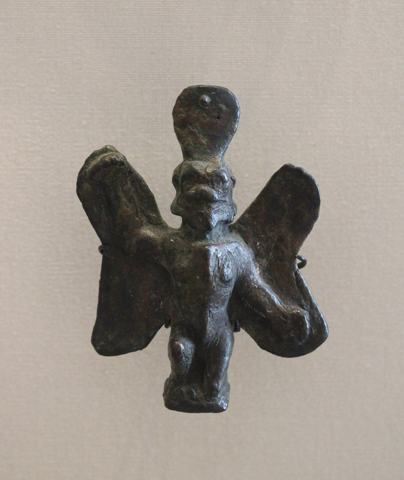
King of the lilu wind demons, invoked as a monstrous protector against the worse demon Lamashtu -- and, since 1973, the face of The Exorcist.
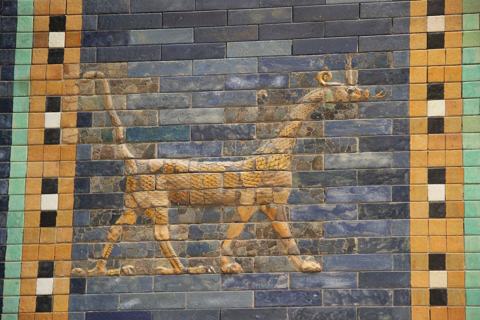
The scaled, horned dragon that once fought for Tiamat, was defeated by Marduk, and ended up as his tame guardian on the glazed brick of Babylon's Ishtar Gate.
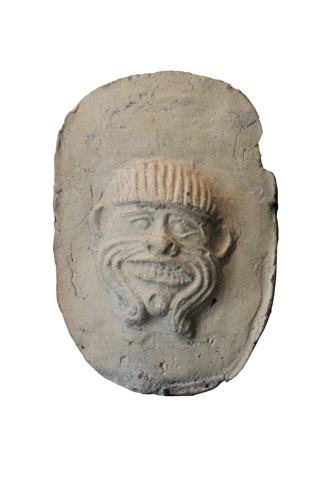
Guardian of the Cedar Forest, killed by Gilgamesh and Enkidu -- and, since a 2015 tablet turned up, a monster who kept court to a chorus of monkeys.
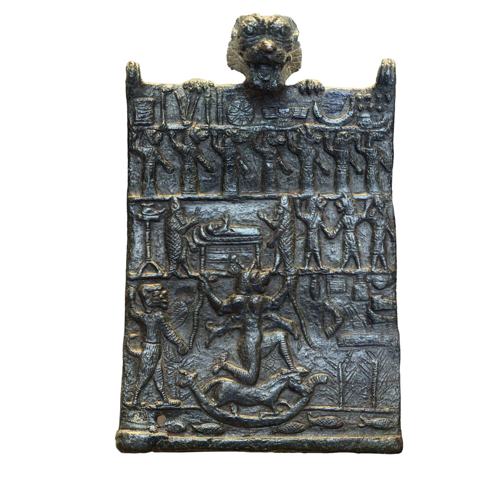
Daughter of Anu who preyed on pregnant women and infants, driven off by incantations, amulets, and the monstrous protection of Pazuzu.
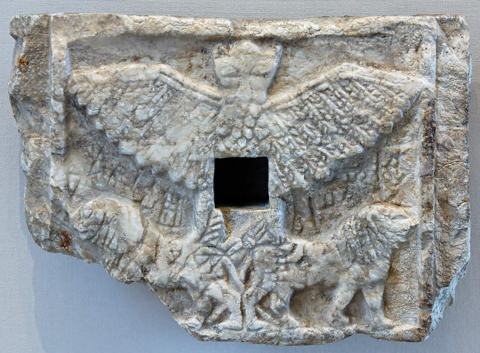
The monstrous lion-headed eagle who stole the Tablet of Destinies from Enlil's sanctuary and was hunted down by the god Ninurta.
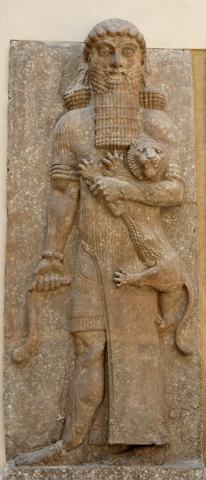
King of Uruk, two-thirds god and one-third man — the hero of the world's oldest surviving epic, who went to the ends of the earth to escape death.
Sources & Further Reading
- 1.The Khorsabad inscriptions of Sargon II, recording the building of Dur-Sharrukin (8th century BCE).
- 2.Wiggermann, F.A.M. Mesopotamian Protective Spirits: The Ritual Texts. Cuneiform Monographs 1. Styx & PP, 1992.
- 3.Reade, Julian. Assyrian Sculpture. British Museum Press, rev. ed. 1998.
- 4.Black, Jeremy & Anthony Green. Gods, Demons and Symbols of Ancient Mesopotamia: An Illustrated Dictionary. British Museum Press, 1992.
- 5.Russell, John Malcolm. From Nineveh to New York: The Strange Story of the Assyrian Reliefs in the Metropolitan Museum. Yale University Press, 1997.
- 6.Harmansah, Omur. 'ISIS, Heritage, and the Spectacles of Destruction in the Global Media.' Near Eastern Archaeology 78.3 (2015), 170-177.
Spot an error or have a source to suggest? Write to info@viseterna.com. We cite primary sources and modern scholarship, and we correct fast.