
Shennong (the Divine Farmer)
The horned sage who tasted a hundred herbs to found Chinese medicine, invented the plow, and reigns as second of the Three Sovereigns before the Yellow Emperor.
Shennong (Shen Nung), Hasegawa Nobukata, c. late 16th - early 17th century · Public domain · source
Second of the Three Sovereigns
Shennong (神農), "the Divine Farmer," is counted among the Three Sovereigns who precede China's Five Emperors and its historical dynasties — the group most often filled out with Fuxi and Nuwa — credited with pulling humanity out of a diet of raw foraging and into settled agriculture 6,7. Sima Qian's Shiji, compiled around 91 BCE, actually opens its narrative history with the Yellow Emperor and originally contained no chapter on Fuxi, Nuwa, or Shennong at all; it was the Tang-dynasty commentator Sima Zhen who, centuries later, wrote a supplementary Sanhuang benji, "Basic Annals of the Three Sovereigns," to carry the official record back further 2,6. That a figure this central to Chinese antiquity had to be written into the official history so late is itself evidence of how the Three Sovereigns scheme took shape gradually, out of older and looser material, rather than arriving as a finished set 2,6.
Inventing Agriculture
The core of Shennong's myth is technological rather than martial. He is credited with inventing the plow and the hoe, teaching people to till the soil and sow the five grains, and, in some accounts, introducing the marketplace so that surplus goods could be exchanged 4,7. The Lüshi Chunqiu, a compendium assembled under the patronage of the Qin minister Lü Buwei around 239 BCE, already treats agricultural diligence as Shennong's defining trait, holding him up as the standard against which a ruler's attentiveness to farming could be measured 4. Yang and An note that this economic portfolio, rather than a cosmological one, is what separates Shennong from Fuxi and marks him as the point where Chinese myth begins to imagine political legitimacy through a ruler's usefulness to ordinary subsistence 7.
Tasting the Hundred Herbs
Shennong's most durable story is medical. According to the Huainanzi, compiled at the Han court by 139 BCE, in the age before agriculture and medicine people ate whatever they found and suffered constant illness and poisoning as a result, so Shennong tasted the hundred herbs himself, testing each for its properties, and is said to have encountered as many as seventy toxic substances in a single day 1. Later retellings sharpen the story into something closer to martyrdom, holding that repeated poisoning eventually killed him — a detail absent from the Han-era text but standard in popular versions collected since 7. The episode casts him as the founder of Chinese pharmacology by the most literal method available: not observation from a safe distance, but self-experimentation 1,5.
The Bencao Tradition
That reputation attached itself to a real body of literature. The Shennong bencao jing, "The Divine Farmer's Classic of Materia Medica," is the earliest surviving systematic Chinese pharmacopoeia, cataloguing several hundred substances by their properties and toxicity; despite its title, the text was compiled by anonymous editors during the Han dynasty, centuries after the earliest strands of the Shennong legend, and its attribution to him is honorific rather than historical 3,5. Unschuld situates the bencao genre it founded within a broader Han-dynasty shift toward systematic medical classification, and the Shennong bencao jing remained the base text that later, larger materia medica compilations continued to cite and expand for roughly the next two thousand years 5.
Shennong and the Yan Emperor
Shennong is regularly identified with, or placed as an ancestor of, the Yan Emperor (Yandi), the ruler whose defeat by the Yellow Emperor at the Battle of Banquan is remembered as a founding contest of Chinese antiquity 6,7. The two figures are not consistently distinguished in the sources: some texts treat Shennong and Yandi as the same person under different names, others as a father and the line he founded, and modern Chinese usage more often invokes the pairing "descendants of Yan and Huang" than either figure alone 6,7. Birrell warns against expecting the early corpus to resolve the question; the genealogy, like much of the Three Sovereigns material, was still being assembled and rationalized centuries after the figures themselves were already fixed in popular memory 6.
Living Cult
Shennong temples remain active across China, most prominently the Yandi Mausoleum in Hunan and shrines in Hubei's Suizhou, where he is worshipped alongside the Yan Emperor as a founding ancestor rather than treated purely as a mythological curiosity 7. Tea's origin is also popularly credited to him — legend holds that leaves blew into water he was boiling to purify it and produced the first cup — a story absent from the early bencao tradition but now inseparable from his popular image, one more later addition folded onto an older agricultural myth 7.
Continue Exploring
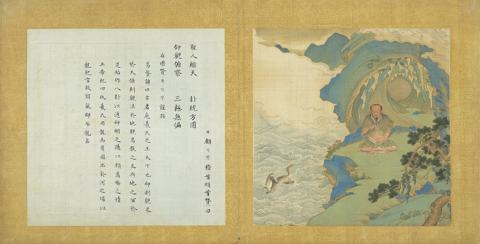
The serpent-tailed sage who read the eight trigrams from a dragon-horse's markings and taught fishing, fire, and marriage — first of China's Three Sovereigns.
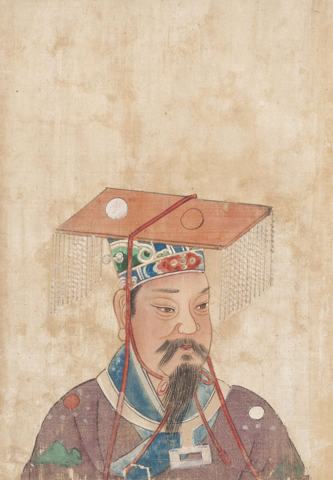
Legendary founder of Chinese civilization who defeated the horned rebel Chiyou at Zhuolu and gave his name to the medical canon that shaped Chinese medicine.
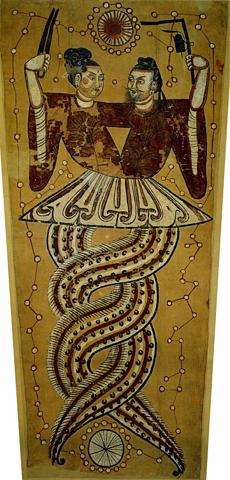
The serpent-bodied creator goddess who shaped the first humans out of yellow earth and patched the broken sky with five-coloured stone.
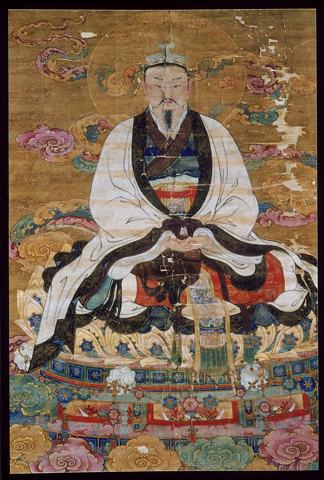
Sovereign of Heaven and head of the celestial bureaucracy — the emperor of the gods, who governs the cosmos the way a dynasty governs a realm.
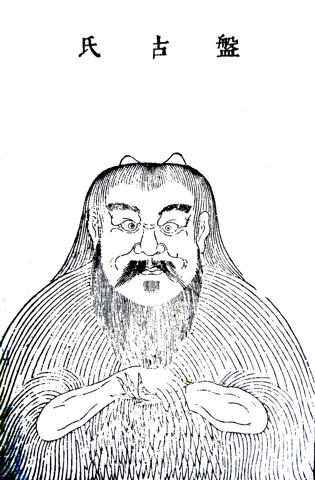
The primordial giant who split chaos into heaven and earth, and whose body at death became the mountains, rivers, winds, and stars of the world.
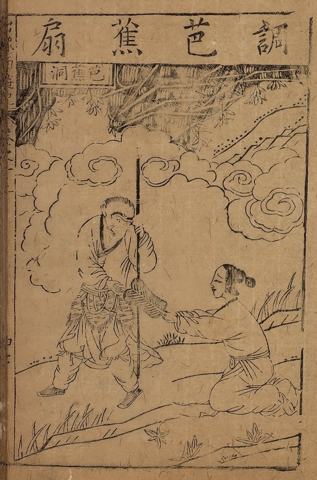
The Monkey King — a stone-born immortal with seventy-two transformations who fought heaven to a standstill, then walked to India as a monk's disciple.
Sources & Further Reading
- 1.Huainanzi (139 BCE), 'Xiuwu' chapter; trans. John S. Major, Sarah A. Queen, Andrew Seth Meyer and Harold D. Roth. The Huainanzi. Columbia University Press, 2010.
- 2.Sima Zhen (attrib.), Sanhuang benji — Basic Annals of the Three Sovereigns, supplement to Sima Qian's Shiji (Tang dynasty, 8th century).
- 3.Shennong bencao jing — The Divine Farmer's Classic of Materia Medica (compiled Han dynasty, 1st-2nd century CE).
- 4.Lüshi Chunqiu — The Annals of Lü Buwei (compiled c. 239 BCE).
- 5.Unschuld, Paul U. Medicine in China: A History of Ideas. University of California Press, 1985.
- 6.Birrell, Anne. Chinese Mythology: An Introduction. Johns Hopkins University Press, 1993.
- 7.Yang, Lihui and Deming An. Handbook of Chinese Mythology. ABC-CLIO, 2005.
Spot an error or have a source to suggest? Write to info@viseterna.com. We cite primary sources and modern scholarship, and we correct fast.