
Fuxi
The serpent-tailed sage who read the eight trigrams from a dragon-horse's markings and taught fishing, fire, and marriage — first of China's Three Sovereigns.
Fuxi and the Origin of the Trigrams, attributed to Qiu Ying, Ming dynasty · Public domain · source
First of the Three Sovereigns
Fuxi (伏羲), also called Paoxi or Tai Hao, heads the traditional roster of the Three Sovereigns (San Huang), the sage-rulers Chinese historiography places before the Five Emperors and the recorded dynasties 4,5. Where later culture heroes solve one specific crisis — a flood, a fire, an invasion — Fuxi is credited with something broader: the basic equipment of civilized life, from divination to cooked food to marriage itself 4,5. The third-century compiler Huangfu Mi, whose Diwang shiji is the main source that strings the fragmentary Warring States and Han material on the sage-kings into a connected genealogy, places Fuxi first in the sequence, ruling from Chen, near modern Huaiyang in Henan 4,5.
Reading the Trigrams
Fuxi's best-attested achievement is the origin of the eight trigrams that underlie the Yijing, the Book of Changes. The Xici zhuan, the philosophical commentary appended to the Yijing, describes how, when Fuxi — there called by his older name Baoxi — ruled the world, he looked upward and observed the patterns of the heavens, looked downward and observed the patterns of the earth, and studied the markings of birds and beasts and what suited the land; from this observation, rather than invention, he is said to have drawn the eight trigrams and used them to classify the qualities of the ten thousand things 1. Wang Aihe reads the passage as one of the founding texts of Chinese correlative cosmology: the trigrams are presented as a diagram of a structure already present in the world, discovered rather than designed 7.
The Dragon-Horse and the River Chart
Later tradition supplies the moment with a specific prop. A dragon-horse is said to have risen from the Yellow River bearing markings on its back — the Hetu, or "River Chart" — which Fuxi used directly to derive the trigrams 4,5. The story functions as an origin myth for a real and durable strand of Chinese numerology, the "River Chart and Luo Writing" (Hetu Luoshu) tradition that Song-dynasty scholars later built into elaborate cosmological diagrams; Yang and An caution that the tidy diagrammatic version familiar today is a much later systemization layered onto a vaguer and older legend 5.
Naming by Dragons
A separate and much older-looking reference to Fuxi survives in the Zuozhuan, the commentary on the Spring and Autumn Annals, in material traditionally dated to 525 BCE. There, in a passage explaining how the earliest rulers named their officials after the auspicious sign that had attended their rise, Tai Hao — identified with Fuxi — is said to have used the dragon: his officers were recorded and titled after dragons, just as the Yellow Emperor is credited elsewhere in the same passage with naming his after clouds 2,4. It is among the oldest surviving references to Fuxi by name, well predating the fully developed Three Sovereigns scheme in which he later appears 4.
Serpent Body, Culture-Bringer
Fuxi is regularly described and depicted with a human head and torso ending in a serpent's or dragon's coiling tail, an iconography he shares with his sister and counterpart Nuwa 5. Beyond the trigrams, tradition credits him with teaching people to twist cords into nets for fishing and hunting, to cook meat over fire rather than eat it raw, to keep livestock, and to observe the customs of marriage that separate humans from animals 4,5. Some versions also give him the invention of the se, an ancient zither, an attribution that overlaps with instruments credited to Shennong in adjacent traditions 5.
Fuxi and Nuwa
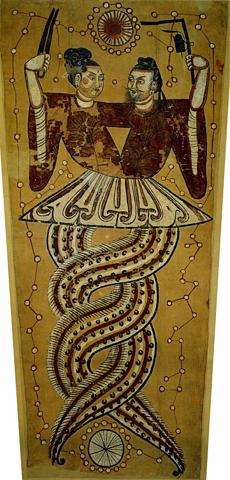
By the Han dynasty, Fuxi is standardly paired with Nuwa in stone reliefs and painted tomb banners, shown from the waist up as a man and a woman and below as two serpent tails wound together, he typically holding a carpenter's square and she a pair of compasses 5. The Huainanzi holds up their joint rule as a Daoist political ideal in its own right, praising Fuxi and Nüwa for governing without formally instituted laws and regulations and still leaving their profound virtue to later generations, precisely because their conduct already matched the underlying pattern of Heaven and needed no additional code to enforce it 3. The sources disagree on whether the two are siblings, spouses, or both, and a later and much more widely told version — not part of the ancient corpus — casts them as a brother and sister who repopulate the world after a great flood and win heaven's permission to marry 5. See Nuwa for that story in full.
Legacy
Fuxi remains a living reference point rather than a purely textual one: temples associated with him stand in Gansu and Henan, and the Hetu Luoshu tradition he is credited with starting still circulates in feng shui and popular divination 4,5. Imperial historiography periodically depicted the Three Sovereigns and Five Emperors as a connected set, and Fuxi's place at the head of the list made him, for that tradition, the notional beginning of Chinese civilization itself — a role the Yellow Emperor would later share, and partly eclipse him in, as head of the Five Emperors that follow 4,6.
Continue Exploring
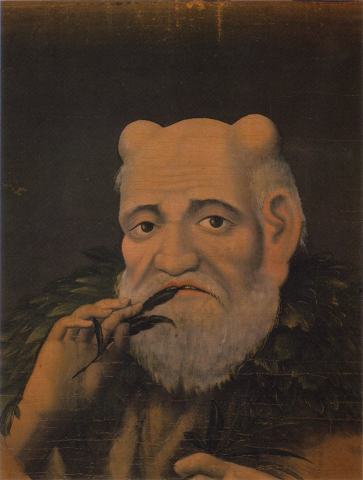
The horned sage who tasted a hundred herbs to found Chinese medicine, invented the plow, and reigns as second of the Three Sovereigns before the Yellow Emperor.
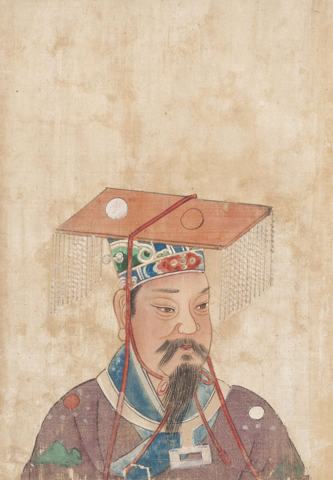
Legendary founder of Chinese civilization who defeated the horned rebel Chiyou at Zhuolu and gave his name to the medical canon that shaped Chinese medicine.
The serpent-bodied creator goddess who shaped the first humans out of yellow earth and patched the broken sky with five-coloured stone.
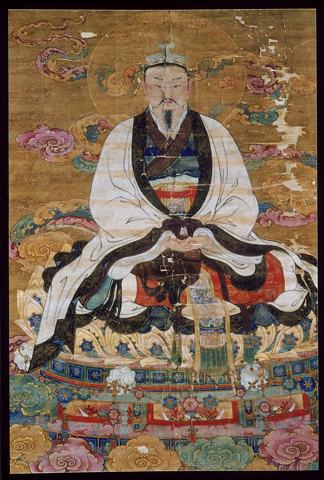
Sovereign of Heaven and head of the celestial bureaucracy — the emperor of the gods, who governs the cosmos the way a dynasty governs a realm.
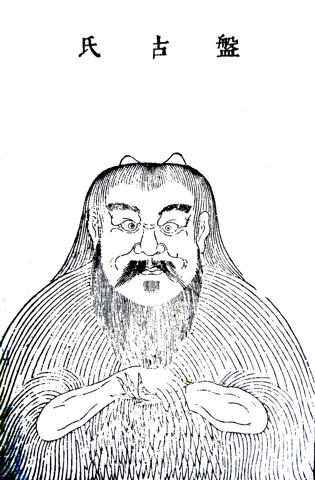
The primordial giant who split chaos into heaven and earth, and whose body at death became the mountains, rivers, winds, and stars of the world.
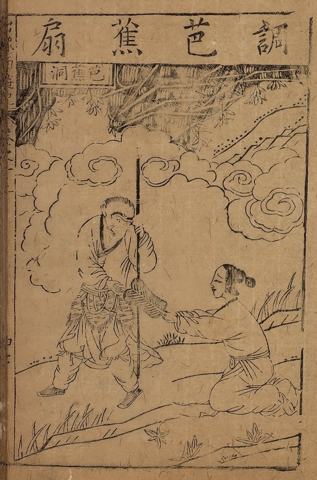
The Monkey King — a stone-born immortal with seventy-two transformations who fought heaven to a standstill, then walked to India as a monk's disciple.
Sources & Further Reading
- 1.Yijing — Book of Changes, 'Xici zhuan' (Great Commentary), attributed compilation (Warring States period).
- 2.Zuozhuan — Zuo Commentary on the Spring and Autumn Annals, Duke Zhao, Year 17 (compiled Warring States period).
- 3.Huainanzi (139 BCE); trans. John S. Major, Sarah A. Queen, Andrew Seth Meyer and Harold D. Roth. The Huainanzi. Columbia University Press, 2010.
- 4.Huangfu Mi, Diwang shiji — Chronicles of Emperors and Kings (3rd century CE).
- 5.Birrell, Anne. Chinese Mythology: An Introduction. Johns Hopkins University Press, 1993.
- 6.Yang, Lihui and Deming An. Handbook of Chinese Mythology. ABC-CLIO, 2005.
- 7.Wang, Aihe. Cosmology and Political Culture in Early China. Cambridge University Press, 2000.
Spot an error or have a source to suggest? Write to info@viseterna.com. We cite primary sources and modern scholarship, and we correct fast.