
Epona (Celtic Horse Goddess)
The Gaulish horse goddess whose cult rode with Rome's cavalry — the only Celtic deity ever given a day on the Roman religious calendar.
Epona, Gallo-Roman votive relief (Musee d'Archeologie Nationale, Saint-Germain-en-Laye) · CC BY-SA 4.0 · source
A Gaulish Goddess Who Conquered Rome
Epona is the horse-goddess of the Gauls, and she is, by a wide margin, the best epigraphically attested Celtic deity anywhere in the ancient world: several hundred inscriptions and images naming her survive, scattered from Britain and Spain to the Danube frontier 3,6. That distribution is the single most important fact about her. Most Celtic gods are known from a handful of local dedications close to where they were worshipped before Rome arrived; Epona's cult travelled with the Roman army's Gaulish, German, and Pannonian cavalry auxiliaries, and by the second century CE she was worshipped as far from Gaul as she was inside it — the same continental, archaeologically documented end of Celtic religion as Cernunnos and Taranis 4,6.
What the Stones Say
Almost nothing about Epona survives in narrative form — no saga, no myth of her birth or her deeds, nothing resembling the Irish material this Codex draws on for Danu or Brigid. What exists instead is a large, repetitive body of stone and bronze votive reliefs, most carrying only her name and a short formula of thanks 3. The name itself is transparent: Gaulish epos, "horse," with a divine-name suffix, giving something close to "Great Mare" or "Divine Horse" — a title rather than evidence of any personal biography 6,7.
Fernand Benoit's classification of the surviving images, still the standard typology, sorts them into recurring poses: Epona riding side-saddle on a single horse; standing or seated beside one; positioned symmetrically between two horses or ponies; and, in a smaller group, seated with a basket or bowl of fruit or bread while foals nurse or feed at her side 3,5. That last group is the one iconographers connect most directly to fertility and abundance rather than to horsemanship specifically, and Green reads the cornucopia-and-foals type as evidence that her protection extended to the herd and its young rather than to riders alone 5.
The Only Celtic God with a Day on the Roman Calendar
Epona's Roman reception went further than any other Gaulish deity's. She is addressed in some inscriptions as Epona Augusta or Epona Regina, brought inside the vocabulary of the imperial cult, and a surviving rural Roman calendar from Guidizzolo in northern Italy lists 18 December as her feast day — the only day anywhere in the Roman festival calendar assigned to a deity of unambiguously Celtic origin 4,6. Cavalry regiments recruited from Gaul and the Rhineland appear to have carried her worship wherever they were posted, which explains why her densest concentrations of inscriptions cluster along exactly the frontier provinces those units garrisoned 3,4.
In the Stables
Two Roman writers mention her directly, and both place her exactly where the archaeology does: the stable. Juvenal's eighth satire, mocking a young nobleman who behaves like the lowest of his own grooms, has him swearing oaths "only by Epona, and the pictures painted on the reeking stable walls" — a jab that only works if a stablehand invoking Epona was an entirely unremarkable thing to see in Rome itself 1. Apuleius's Metamorphoses, the first-person account of a man transformed into a donkey, describes a stable shrine with Epona's image set into a niche in a supporting pillar, freshly wreathed in roses — an ordinary devotional detail, offered without explanation, that only makes sense if Epona in a working stable needed no introduction for a Roman readership 2.
What Is Missing
What is conspicuously absent is anything Irish or Welsh to compare her to directly. Insular Celtic literature has no goddess who maps onto Epona one-to-one, though her name-root — Gaulish epos, cognate with Old Irish ech and Welsh ebol, "horse" — sits behind horse-associated figures in later Welsh legend, a connection scholars have long proposed on linguistic grounds without any surviving text actually stating it 6,7. That absence is a useful check on how this Codex is organised by pantheon: Epona belongs to the continental, Gaulish end of Celtic religion, attested by archaeology and by Roman literature rather than by native saga, and her cult is a genuinely different kind of evidence from the Irish manuscripts that carry most of the rest of this pantheon 5,6,7.
Continue Exploring
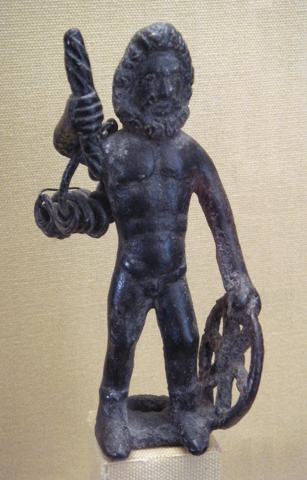
The Gaulish thunder god named by a Roman poet, sacrificed to by burning according to later scholiasts, and pictured with Jupiter's wheel.
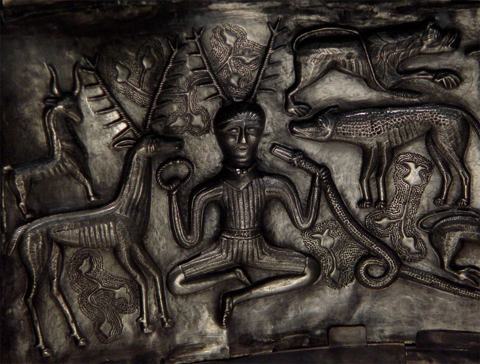
The horned one — an antlered Gaulish god known from images alone, whose name survives on exactly one damaged stone and who has no surviving myth at all.
The mother goddess of the Tuatha De Danann — and the most famous Irish deity who may never have existed under that name.
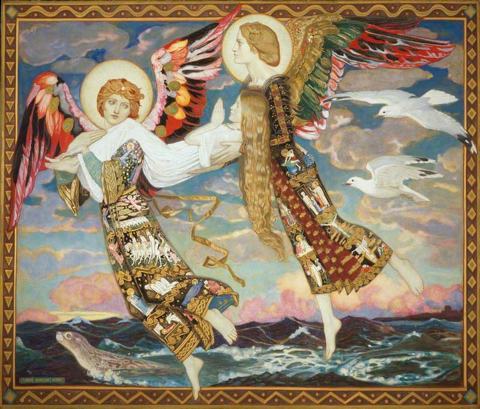
Goddess of poetry, smithcraft and healing — a triple Brigit in the glossaries, a saint at Kildare, and the figure Imbolc still belongs to.
Ireland's race of gods — arriving with four treasures from four lost cities, winning Ireland twice, then losing it once and withdrawing into the mounds.
Master of every skill — the young god admitted to Tara because he alone could do all the crafts at once, and who killed his own grandfather Balor.
Sources & Further Reading
- 1.Juvenal. Satires, Book III, Satire VIII (early 2nd century CE).
- 2.Apuleius. Metamorphoses (The Golden Ass), Book III (2nd century CE).
- 3.Magnen, Rene and Emile Thevenot. Epona, deesse gauloise des chevaux, protectrice des cavaliers. Bordeaux, 1953.
- 4.Linduff, Katheryn M. 'Epona: A Celt among the Romans.' Latomus 38.4 (1979): 817-837.
- 5.Green, Miranda J. The Gods of the Celts. Alan Sutton, 1986.
- 6.MacKillop, James. Dictionary of Celtic Mythology. Oxford University Press, 1998.
- 7.Koch, John T. (ed.). Celtic Culture: A Historical Encyclopedia. ABC-CLIO, 2006.
Spot an error or have a source to suggest? Write to info@viseterna.com. We cite primary sources and modern scholarship, and we correct fast.