
Sekhmet
The lion-headed Eye of Ra — Sekhmet is slaughter, fever and desert heat, and the same power that heals when the gods can persuade her to stop.
Statue of the goddess Sekhmet, granodiorite, reign of Amenhotep III, c. 1390-1352 BCE (Museo Egizio, Turin, C 248) · CC0 · source
The Powerful One
Her name is a feminine formation on sekhem, "power" or "might", and it can be translated flatly as "the Powerful Female One" — an Egyptian deity whose name is a job description 4. She is shown as a woman with the head of a lioness, crowned with the solar disk and the rearing cobra of the uraeus, usually holding the ankh and a papyrus sceptre, and almost always standing or sitting perfectly still. The stillness is deliberate. Egyptian art renders her as contained force, and the texts are unanimous that when she moves, things die.
Sekhmet is a daughter of Ra and one of the goddesses identified with his Eye — the detachable, feminine, aggressive aspect of the sun that goes out to punish on his behalf 4,5. At Memphis she formed a triad with Ptah, the craftsman-creator, as his consort, and with the lotus god Nefertem as their son, a pairing that set the ferocity of the lioness beside the ordering intelligence of the artisan 4.
The Destruction of Mankind
Her defining myth survives in the Book of the Heavenly Cow, inscribed in New Kingdom royal tombs including that of Tutankhamun. Ra has grown old, and humanity plots against him. On the advice of the assembled gods he sends out his Eye in the form of Hathor, who becomes Sekhmet in the doing, and she goes through the land killing until the fields run with blood and she is wading in it 1,5.
Then Ra changes his mind — and finds he cannot call her off. The solution is a trick. Overnight, servants grind red ochre into seven thousand jars of beer and flood the fields with it. Sekhmet arrives at dawn, sees what she takes for a lake of blood, drinks until she is too drunk to continue, and wakes pacified, restored to Hathor 1,5. The story explains three things at once: why the world is not destroyed, why the goddess has a gentle form and a savage one, and why Egyptian festivals of the returning goddess involved deliberate, ritual drunkenness — a practice attested archaeologically at the Mut temple precinct at Karnak, where a porch of drunkenness was built for exactly this purpose 5.
Plague, Arrows and the Physician's Art
Sekhmet's ordinary jurisdiction is epidemic disease. Her "messengers" or "slaughterers" — a troop of demons under her command — carry sickness through the land, and the dangerous transition at the end of the Egyptian year, the five epagomenal days, was thought of as the season when they were loose. Spells and amulets from those days name her explicitly, asking her to pass by 4,5. To speak of a "year of Sekhmet" was to speak of a plague year.
The logic of Egyptian religion being what it is, the deity who sends a thing can also withhold it, and Sekhmet was consequently the patron of healers. A recognised class of practitioner, the wab priest of Sekhmet, appears alongside the ordinary physician in the medical papyri, and her name is invoked in remedies and diagnostic texts — the same power that inflicts fever is the power addressed to end it 3,4. Hornung's point about Egyptian gods holding contradictory functions without resolving them applies here with unusual force: Sekhmet is not a goddess of disease and a goddess of medicine as two departments, but one dangerous force approached from two directions 6.
She had a martial face as well. Royal inscriptions describe the king going into battle with Sekhmet's rage upon him, and her breath is called the desert wind — the hot, killing air off the sand 4,5.
A Litany in Stone
The most extraordinary evidence for her cult is a sculptural programme. Amenhotep III, in the fourteenth century BCE, commissioned an immense series of granodiorite Sekhmet statues, standing and seated, for his mortuary temple at Kom el-Hettan on the Theban west bank; hundreds survive, scattered across the world's museums, and many were later shifted to the temple of Mut at Karnak, apparently by the high priest Pinedjem I in the Twenty-First Dynasty 4,7.
Jean Yoyotte's study of the inscriptions argued that the statues carry a systematic set of epithets keyed to the days of the Egyptian year, so that the whole assembly functions as a permanent, monumental litany appeasing the dangerous goddess on every day of the calendar 7. The figure most often quoted is 730 statues — two for each of the 365 days — which is a reasonable inference from the pattern rather than a number preserved in any ancient text, and the total actually produced is disputed 4,7. Either way, the intent is clear enough: a king with a strong personal devotion to Sekhmet, or a strong fear of her, built the largest insurance policy in Egyptian history.
Fusions and Later Life
Sekhmet does not stay separate from her neighbours. She merges with Hathor in the myth above, with Mut at Thebes, with Bast in the Delta, and with the lioness goddesses Wadjet, Pakhet and Tefnut in various local systems, so that the sources sometimes name her and sometimes name a near-identical goddess doing the same work 4,5. Her relationship to Bastet is the clearest case: by the first millennium BCE Egyptian thought treats the pair as the enraged and the pacified faces of a single leonine goddess.
Her images kept their charge long after the temples closed. Medieval and modern visitors to Karnak recorded local reverence and unease around the surviving Sekhmet statues in the Mut precinct, and the goddess remains one of the most immediately legible figures in Egyptian art — a seated woman, entirely calm, with the head of a lion.
Continue Exploring
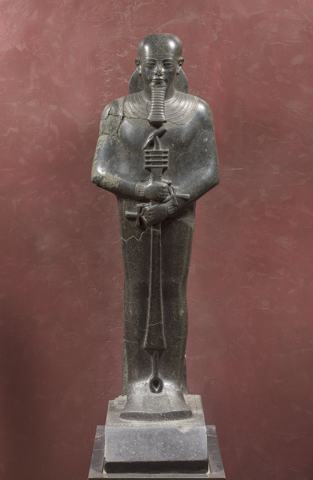
The creator who made the world by thinking it and speaking it — Ptah of Memphis, patron of sculptors and architects, and lord of the Apis bull.
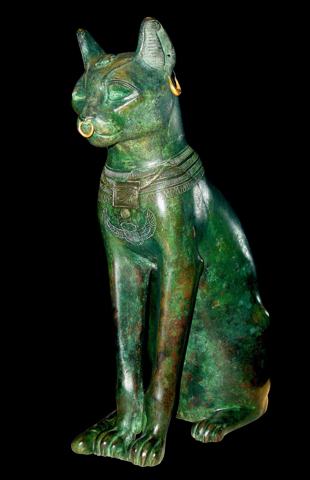
Egypt's cat goddess — a lioness of the Eye of Ra who softened into the guardian of the home, honoured at Bubastis with the loudest festival in Egypt.
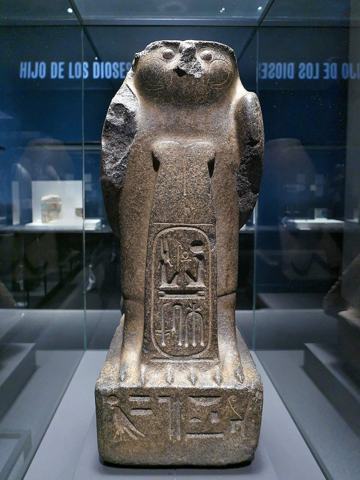
The sun itself as a god — Ra sails the sky by day, fights the serpent of chaos by night, and is reborn on the horizon every dawn.
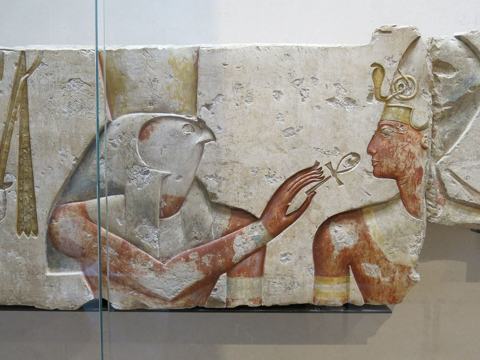
The looped cross Egyptian gods hand to kings on every temple wall, the hieroglyph for life itself, worn as an amulet for three thousand years.
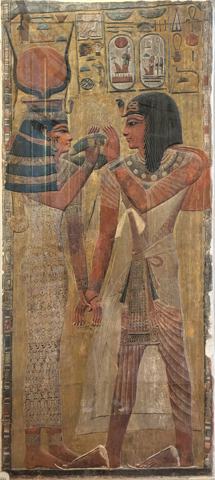
Cow-horned goddess of love, music and joy — Hathor is the sky that carries the sun, the mother of kings, and the one who meets the dead in the west.
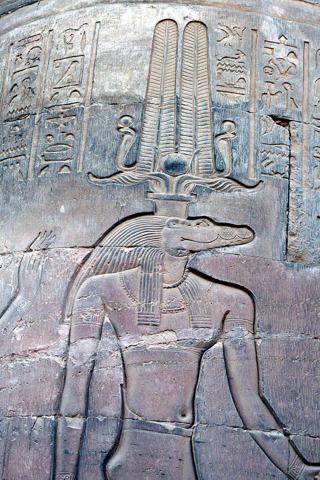
Crocodile god of the Nile, the marshes and raw pharaonic power — Sobek is the danger in the water turned into a protector, worshipped with living crocodiles.
Sources & Further Reading
- 1.The Book of the Heavenly Cow (New Kingdom royal texts; the Destruction of Mankind).
- 2.Pyramid Texts (Old Kingdom, c. 2400–2300 BCE).
- 3.The Ebers Papyrus and the Edwin Smith Surgical Papyrus (New Kingdom medical texts).
- 4.Wilkinson, Richard H. The Complete Gods and Goddesses of Ancient Egypt. Thames & Hudson, 2003.
- 5.Pinch, Geraldine. Egyptian Mythology: A Guide to the Gods, Goddesses, and Traditions of Ancient Egypt. Oxford University Press, 2002.
- 6.Hornung, Erik. Conceptions of God in Ancient Egypt: The One and the Many. Trans. John Baines. Cornell University Press, 1982.
- 7.Yoyotte, Jean. "Une monumentale litanie de granit: les Sekhmet d'Aménophis III et la conjuration permanente de la déesse dangereuse." Bulletin de la Société Française d'Égyptologie 87–88 (1980).
Spot an error or have a source to suggest? Write to info@viseterna.com. We cite primary sources and modern scholarship, and we correct fast.