
Nian (the New Year Beast)
The horned beast said to terrorize villages once a year until scared off by firecrackers, fire, and red — a legend newer than the New Year customs it explains.
Chinese New Year Lion Dance, Bob Jagendorf, photograph. A New Year lion dance, one of the noise-and-colour customs the Nian legend is told to explain; it does not show the beast · CC BY 2.0 · source
The Story as It Is Told Today
Nian (年) is the beast at the center of China's best-known New Year legend: a horned creature, part lion and part ox in most retellings, that lived in the mountains or the sea and came down once a year, on the night before the new year, to eat livestock, crops, and — if it could get them — village children. The villagers fled to the hills each time, until an old beggar, sometimes described as an immortal in disguise, stayed behind and showed one household the trick: paper cut in red, candles and lanterns left burning, and bamboo cracked loudly in the fire. Nian arrived, was terrified by the noise, the flame, and the color, and fled. The village survived, and every year since, people have hung red decorations, lit firecrackers, and stayed up past midnight to keep the beast away 4,5.
The story supplies a folk etymology for the everyday Chinese phrase for celebrating the new year, guo nian (過年), literally "passing the nian" or "surviving the nian." It is a satisfying story, in that it explains, in one move, why the New Year is red, loud, and lit — and that neatness is part of why scholars treat it with some caution 4.
What the Old Texts Actually Describe
The customs the story explains are genuinely old. Zong Lin's sixth-century record of seasonal life in the Jing-Chu region describes households setting off cracked bamboo, baozhu, at the turn of the year specifically to drive away a mountain-dwelling spirit that caused sickness — a being he names, but not as "Nian" 1. Bodde's study of Han-dynasty New Year observance likewise documents an established repertoire of exorcistic practice at the year's turn — noise, fire, ritualized expulsion of harmful influence — centuries before any surviving text names a monster called Nian as their cause 3. Eberhard's survey of Chinese festival custom treats the noise-and-fire complex as one of the oldest and most widespread apotropaic practices in the calendar, independent of any single explanatory legend attached to it later 2.
The character nian itself is old and unrelated to monstrosity: in early bronze and oracle-bone use it denotes the grain harvest, and by extension the year that harvest measures — which is also, in fact, why "passing the nian" makes sense as a season-ending idiom without needing a beast in it at all 4.
A Legend Without a Paper Trail
What folklorists have not been able to do is trace the specific narrative told above — the horned beast, the frightened flight to the hills, the beggar who teaches the village the trick of red and noise and fire — back into the premodern textual record under the name Nian. Handbooks of Chinese mythology that catalogue the story present it as a widely circulated modern folk tale rather than as an attested classical myth, and note that it belongs to a broad and very old family of household- and village-protection customs whose etiological stories vary by region and period 4,5. That does not make the story false in any meaningful sense — folk legends routinely arise to explain practices whose original rationale has been forgotten — but it does mean the beast itself, as a named character with a fixed plot, is best treated as a comparatively recent popularization layered onto a much older ritual calendar, not as ancient myth in the way chinese-dragon or zhong-kui are.
Nian in the Ritual Calendar
Whatever its textual age, the story now sits at the very start of China's festival year, functioning as the opening beat of a cycle that runs on through summer's dragon-boat-festival and the autumn's mid-autumn-festival. Red paper cuttings and couplets go up on doors, firecrackers and fireworks are set off at midnight and through the following days, and lion and dragon dances — performed with exactly the noise, color, and fire the Nian story explains — open Lunar New Year celebrations in Chinese communities worldwide 2,4.
Red envelopes of money, hongbao, given to children and unmarried relatives, are sometimes folded into the same explanatory frame — money as protection passed down against the beast, or against a closely related demon-child figure, sui, in regional variants of the tale 5. The multiplicity of these variants is itself instructive: rather than one canonical Nian story handed down unbroken, the folklore record shows a cluster of related, locally adjusted legends serving the same purpose, all converging on the same three weapons — noise, fire, and red — that the exorcistic calendar had been using for the New Year long before any of them were written down 3,4.
Continue Exploring

China's fifth-month river festival of racing dragon boats and rice dumplings — tied to the poet Qu Yuan's drowning, though the boats likely predate him.
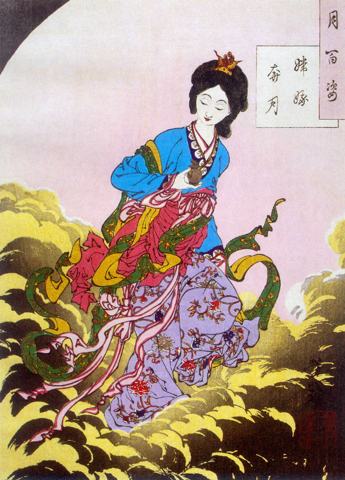
China's harvest-moon festival of family reunion, mooncakes, and lantern-lit nights under the fullest moon — inseparable from the goddess Chang'e.
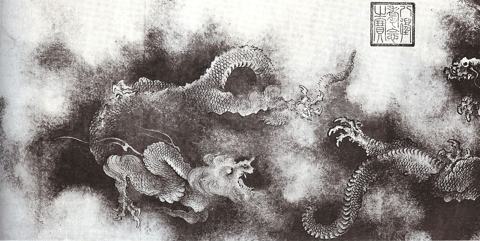
China's dragon — a benevolent, scaled power of rain, river, and sea, emblem of imperial authority and the only mythical beast in the zodiac.
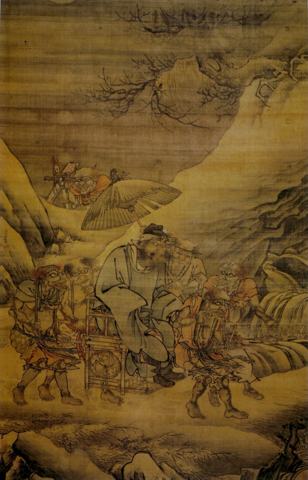
The ugly failed scholar who killed himself on the palace steps and came back as heaven's demon-catcher — hung on doors at New Year to eat what haunts the house.
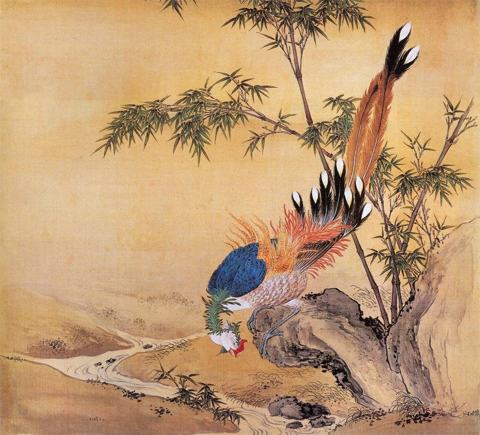
The radiant bird of Chinese myth — ruler of all birds, marked with the five virtues, whose rare appearance announces a just reign and an age of peace.
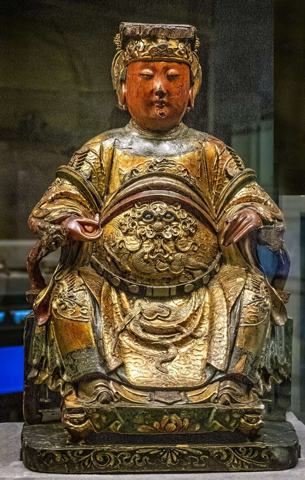
A Fujian fisherman's daughter who died young around 987 and rose, title by imperial title, to become Empress of Heaven and the sea goddess of the Chinese coast.
Sources & Further Reading
- 1.Zong Lin, Jingchu Suishiji — Record of the Seasonal Customs of Jing-Chu (6th c. CE).
- 2.Eberhard, Wolfram. Chinese Festivals. Henry Schuman, 1952.
- 3.Bodde, Derk. Festivals in Classical China: New Year and Other Annual Observances During the Han Dynasty, 206 B.C.-A.D. 220. Princeton University Press, 1975.
- 4.Yang, Lihui & Deming An. Handbook of Chinese Mythology. ABC-CLIO, 2005.
- 5.Birrell, Anne. Chinese Mythology: An Introduction. Johns Hopkins University Press, 1993.
Spot an error or have a source to suggest? Write to info@viseterna.com. We cite primary sources and modern scholarship, and we correct fast.