
Rokurokubi
A cursed woman whose neck stretches, or whose head detaches outright while she sleeps: two distinct yokai that Western readers have long treated as one.
Rokurokubi, Toriyama Sekien, Gazu Hyakki Yagyo, 1776 · Public domain · source
Two Creatures Sharing One Name
"Rokurokubi" is used, confusingly, for two related but distinct yokai. The name itself, "pulley-neck" or "windlass-neck," describes the first and more literal type: a person whose neck stretches to an unnatural length while their body remains asleep, the neck's motion compared to the up-and-down travel of a well-windlass or a potter's wheel 1. The second type, properly called nukekubi, "removable neck," is more drastic still: the head detaches from the body entirely and flies off on its own at night, leaving an inert, headless torso behind until it returns before dawn 3,5. Japanese yokai researchers generally treat the two as separate traditions that print culture and, later, translation gradually merged into a single blurred figure 5.
The Neck That Stretches
In the stretching-neck version, the affliction is usually involuntary and the sleeper is unaware of it. By day the woman — the type is overwhelmingly female in the surviving tales — behaves normally; by night, once asleep, her neck extends across a room toward a lamp, a meal, or whatever has drawn her curiosity, and travels back before morning as if nothing had happened 1. The condition is presented less as a monstrous nature than as a hidden affliction, discovered by a housemate or lodger rather than confessed, which gives most rokurokubi stories the shape of a discovery narrative rather than a monster hunt 1,5.
The Head That Detaches
Nukekubi is the older and, by most tellings, the more dangerous of the two. Early Edo-period tale collections describe the phenomenon in surprisingly restrained terms — the Shokoku Hyakumonogatari of 1677 treats a floating, detached head less as an attack by a species of monster than as a wandering soul briefly separated from a deeply sleeping body, a folk explanation closer to a theory of sleep than to a bestiary entry 4. The painter Sawaki Suushi gave the type its own plate in his 1737 Hyakkai Zukan, evidence that by the mid-eighteenth century the detached head was recognized as a distinct figure worth illustrating in its own right, separately from the stretching-neck rokurokubi proper 3.
Toriyama Sekien's String
Toriyama Sekien's 1776 illustration, reproduced above, draws the rokurokubi's neck as something closer to a thin cord than a stretched column of flesh, connecting a floating head to a body slumped some distance away 1. That choice sits oddly between the two traditions — not quite the elastic, visibly living neck of the stretching type, and not quite the fully severed head of the nukekubi — and later popular art largely followed Sekien's version rather than resolving the ambiguity, which is one reason the two figures never fully separated back out in the print record that followed him 1,5.
Hearn's Traveling Monks
Lafcadio Hearn's "Rokuro-Kubi," in his 1904 collection Kwaidan, is itself part of the confusion it helped export. The story concerns a warrior-monk, Kwairyo, who lodges overnight with a family of woodcutters in the mountains and discovers, once they are asleep, that their heads have detached and gone wandering — a nukekubi story in every particular, since the bodies are left inert and the heads travel independently, told under the rokurokubi title that Western readers would come to associate with the entire category 2. Kwairyo survives by moving one sleeper's body so its head cannot find its way back to reattach; the head dies still trying 2.
A Curse, Not a Species
Origin stories for both types generally describe the condition as a curse rather than an inherited nature — punishment, in various tellings, for a past sin, a broken vow, or a parent's transgression visited on a daughter, which the sufferer herself may not remember or understand 1,5. Foster notes that the setting recurs suspiciously often in inns, lodging houses, and brothels, places where itinerant working women were already objects of both curiosity and suspicion in Edo-period fiction — the rokurokubi's horror lands less on the neck itself than on the idea of a woman who is, secretly and without her own knowledge, not what her household believes her to be 5. That theme sets her usefully beside yurei, where transformation follows death rather than sleep, and beside jorogumo and yuki-onna, two more of Japanese folklore's uncanny women whose true nature is discovered rather than declared.
Continue Exploring
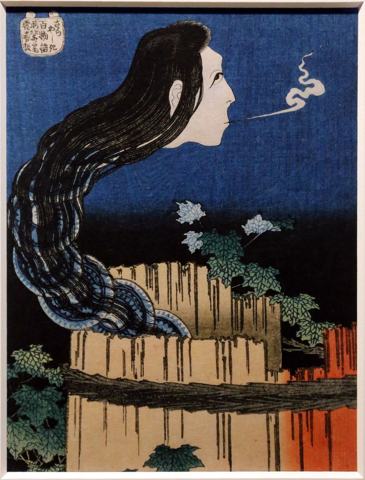
Japan's ghosts of specific dead people, bound by grievance to one place until it is resolved — white-robed, black-haired, and famous through Oiwa and Okiku.
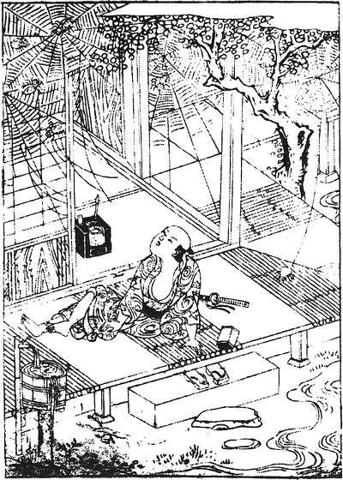
A giant spider of Japanese folklore that takes the shape of a beautiful woman to lure victims into her web, haunting Edo ghost stories and mountain waterfalls.
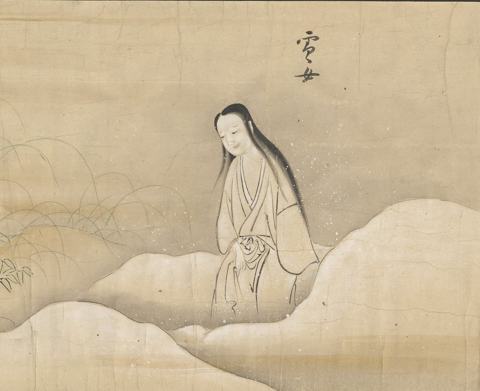
Japan's snow spirit, who freezes travelers on winter nights — known worldwide through Hearn's Kwaidan, though the folklore is far older and less romantic.
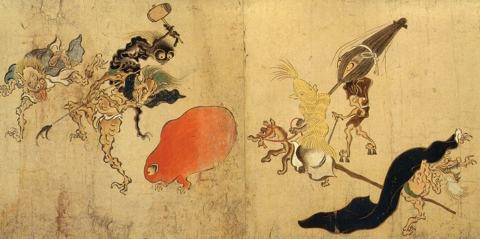
Tools that, discarded near their hundredth year, rise up as spirits in a Muromachi handscroll built to teach a Buddhist lesson about ordinary things.
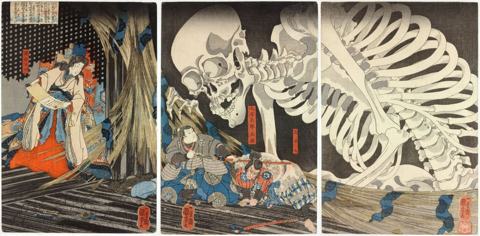
A building-sized skeleton yokai widely presented as ancient folklore, though the figure itself was invented in illustrated books of the 1960s and 70s.
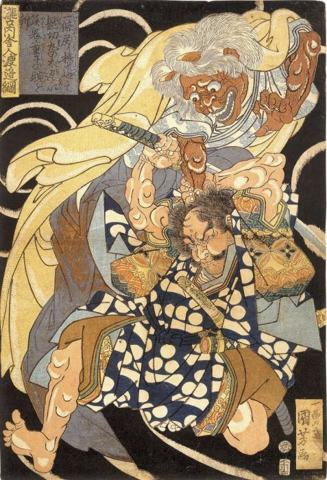
Horned, fanged ogres of Japanese folklore: hell's wardens, mountain bandits and village guardians, driven out with beans every February.
Sources & Further Reading
- 1.Toriyama Sekien. Gazu Hyakki Yagyo (1776), in Sekien Toriyama's Japandemonium Illustrated — The Yokai Encyclopedias of Toriyama Sekien. Translated by Hiroko Yoda and Matt Alt. Dover Publications.
- 2.Hearn, Lafcadio. "Rokuro-Kubi," in Kwaidan — Stories and Studies of Strange Things. Houghton, Mifflin and Company, 1904.
- 3.Sawaki Suushi. Hyakkai Zukan (1737).
- 4.Shokoku Hyakumonogatari (Hundred Tales from the Provinces, 1677).
- 5.Foster, Michael Dylan. The Book of Yokai — Mysterious Creatures of Japanese Folklore. University of California Press, 2015.
Spot an error or have a source to suggest? Write to info@viseterna.com. We cite primary sources and modern scholarship, and we correct fast.