
The Yellow Emperor (Huangdi)
Legendary founder of Chinese civilization who defeated the horned rebel Chiyou at Zhuolu and gave his name to the medical canon that shaped Chinese medicine.
Portraits of Famous Men - Yellow Emperor (Huangdi), unknown Chinese artist, 19th - early 20th century · Public domain · source
Head of the Five Emperors
The Yellow Emperor, Huangdi (黃帝), opens Sima Qian's Shiji — the "Annals of the Five Emperors" is the very first chapter of China's first great dynastic history, compiled around 91 BCE — and with it opens the connected, genealogically continuous account of Chinese antiquity that structured how the empire understood its own past for two thousand years 1,6. Sima Qian was cautious even as he wrote it: he notes that material on the earliest rulers was fragmentary and hard to verify, and that he had selected only what seemed most credible from a much larger and more contradictory body of tradition 1. Modern scholarship largely reads the figure the other way around from the traditional account — not a historical king later mythologized, but very probably a god or culture hero of earlier legend who was gradually written down into the form of a historical founder as the idea of a single continuous Chinese lineage took shape across the Warring States and Han periods 5,6.
The Battle of Zhuolu
The Yellow Emperor's founding act is a war. Chiyou, a rebel leader described as bronze-headed, iron-browed, and commanding a horde of monstrous or ox-horned warriors, rises against him; in the ensuing Battle of Zhuolu, Chiyou raises a thick fog to blind the Yellow Emperor's forces, who counter with the south-pointing chariot, a device that kept its indicator fixed on south regardless of how the chariot turned, and cut their way out 2,6. The Shanhaijing adds that the Yellow Emperor called on Ba, a drought demon, and on the winged dragon Yinglong — the same dragon later said to help the flood-tamer Yu drain the waters — to finish the battle, after which Chiyou is captured and killed 2. The victory is remembered as the founding contest between the Yellow Emperor's confederation and a rival power, and Chiyou himself survives in later folk religion as a war god in his own right, worshipped in some traditions independently of his defeat 2,6.
Inventions and Ministers
As with Fuxi and Shennong, the Yellow Emperor's reign is remembered less for personal adventure than for a long list of institutions founded through his ministers: the cyclical calendar, silk cultivation credited to his consort Leizu, the compass-cart, boats, and the standardization of weights and measures are all variously assigned to his court 6,7. Wang Aihe reads this accumulation of firsts as a deliberate structural feature of the mythology rather than a random pile of folklore: the Yellow Emperor is placed at the center of the compass — the fifth direction, paired with the earth phase and the color yellow in Han five-phases cosmology — and the inventions attributed to his reign are the ones needed to organize a world around that center 7.
Ancestor of "Yan and Huang"
Chinese identity still invokes the Yellow Emperor directly: the phrase "descendants of Yan and Huang" (Yan-Huang zisun), pairing him with the Yan Emperor associated with Shennong, remains a common way of naming a shared Chinese ancestry, regardless of how differently individual ethnic and regional traditions actually trace their descent 6. Sima Qian's genealogy traces the founding lines of the Xia, Shang, and Zhou dynasties back to the Yellow Emperor's descendants, which is precisely the structural work the chapter was written to do — turning a collection of regional legends into one continuous royal family tree 1,5.
The Medical Canon
The Yellow Emperor's name was also attached, probably during the Han dynasty and certainly long after any historical Huangdi could have lived, to the Huangdi neijing, the Yellow Emperor's Inner Canon, the foundational text of Chinese medical theory 3. The work is structured as a dialogue in which the Yellow Emperor questions his physician Qibo about the body, illness, and the balance of yin and yang and the five phases, and scholars are confident the attribution is honorific rather than authorial — a way of giving a compiled, evolving body of medical theory the authority of antiquity's most authoritative name 3,6. The neijing's influence on Chinese medicine has been continuous rather than antiquarian: physicians were still writing commentaries on it, and citing it as a live authority, well into the twentieth century 3.
A Seeker in Daoist Legend
Not every tradition remembers Huangdi as a warrior-founder. The Zhuangzi recasts him as a seeker rather than a conqueror, most famously in the story of his journey to Mount Kongtong to ask the reclusive sage Guangchengzi how to govern both a state and his own body so as to attain long life; the sage rebuffs him at first for asking a ruler's question, and only later, once the Yellow Emperor has set aside affairs of state to withdraw and ask again in humility, does Guangchengzi actually answer 4. Later Daoist and alchemical tradition took the story and ran with it, building an entire body of self-cultivation lore around a Huangdi who ends his earthly reign not in a tomb but by ascending to immortality on the back of a dragon — a very different exit from the sober death-and-burial notice in Sima Qian's history 4,6.
From God to History and Back
Modern archaeology and textual criticism have not settled who, if anyone, the Yellow Emperor was, and mainstream scholarship no longer treats the question as answerable in those terms 5,6. What is better documented is the figure's second life: a state cult centered on the Yellow Emperor's tomb in Shaanxi has been sponsored by governments from imperial China through the present, precisely because "ancestor of the Chinese people" is a claim useful to any regime that wants one, and Huangdi has functioned as a unifying national symbol for longer, and more consistently, than almost any other figure in the tradition 6,7.
Continue Exploring
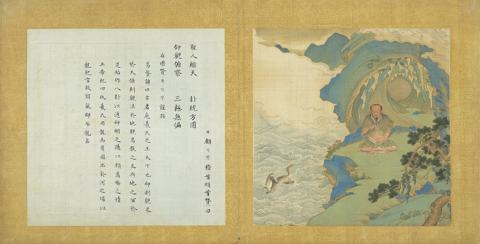
The serpent-tailed sage who read the eight trigrams from a dragon-horse's markings and taught fishing, fire, and marriage — first of China's Three Sovereigns.
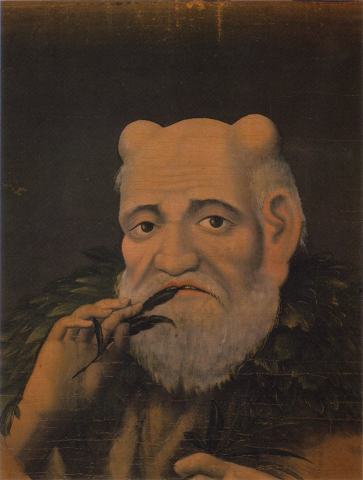
The horned sage who tasted a hundred herbs to found Chinese medicine, invented the plow, and reigns as second of the Three Sovereigns before the Yellow Emperor.
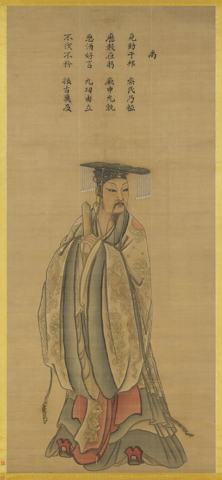
The hero who ended China's great flood by dredging channels instead of damming them, walked the Nine Provinces, and founded the Xia — if he existed at all.
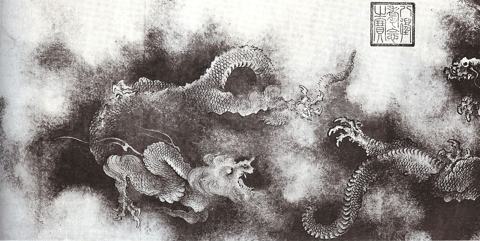
China's dragon — a benevolent, scaled power of rain, river, and sea, emblem of imperial authority and the only mythical beast in the zodiac.
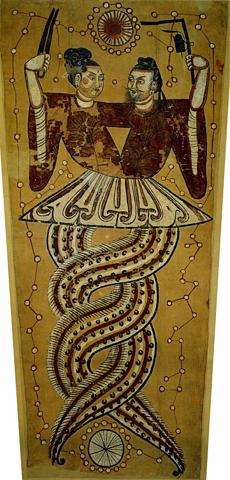
The serpent-bodied creator goddess who shaped the first humans out of yellow earth and patched the broken sky with five-coloured stone.
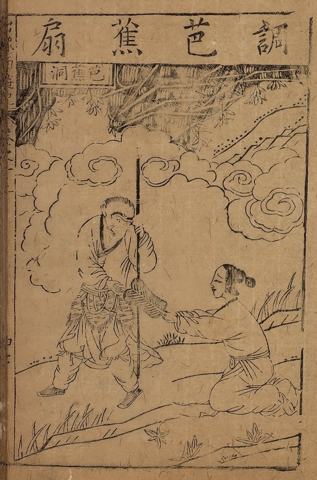
The Monkey King — a stone-born immortal with seventy-two transformations who fought heaven to a standstill, then walked to India as a monk's disciple.
Sources & Further Reading
- 1.Sima Qian, Shiji — Records of the Grand Historian, 'Wudi benji' (Annals of the Five Emperors), c. 91 BCE; trans. William H. Nienhauser Jr. (ed.), The Grand Scribe's Records, Volume I. Indiana University Press, 1994.
- 2.Shanhaijing — The Classic of Mountains and Seas; trans. Anne Birrell. Penguin Classics, 1999.
- 3.Huangdi neijing — The Yellow Emperor's Inner Canon (compiled Han dynasty); trans. Ilza Veith, The Yellow Emperor's Classic of Internal Medicine. University of California Press, 1949 (rev. 2002).
- 4.Zhuangzi (compiled c. 3rd century BCE) — the Yellow Emperor as a seeker of the Way.
- 5.Lewis, Mark Edward. The Flood Myths of Early China. State University of New York Press, 2006.
- 6.Birrell, Anne. Chinese Mythology: An Introduction. Johns Hopkins University Press, 1993.
- 7.Wang, Aihe. Cosmology and Political Culture in Early China. Cambridge University Press, 2000.
Spot an error or have a source to suggest? Write to info@viseterna.com. We cite primary sources and modern scholarship, and we correct fast.