
Sadko (Novgorod's Bylina Hero)
The poor gusli-player of Novgorod who wagered with the Sea Tsar, grew rich, and nearly stayed in the Tsar's underwater hall forever.
Sadko, Ilya Repin, 1876 (State Russian Museum) · Public domain · source
A Gusli-Player by Lake Ilmen
Sadko belongs to the smaller and more geographically specific of the two great groupings scholars use to sort the Russian byliny: not the "Kyivan cycle" of Prince Vladimir's court, where Ilya Muromets and Dobrynya Nikitich serve, but the "Novgorod cycle," tied to the independent merchant city-republic on the Volkhov 3,4. Like the rest of the byliny, the Sadko songs survive only because folklorists such as P. N. Rybnikov began taking them down from peasant singers around Lake Onega in the 1860s; no medieval manuscript preserves the story in anything close to its epic form 5,2. The songs open with Sadko poor: a gusli-player with no property, who earns his bread going from feast to feast in Novgorod to play, until no one troubles to invite him any longer and he takes his instrument down to the shore of Lake Ilmen to play alone 1,2. There, for three days, his music draws the attention of the ruler of the waters below - called in most recorded texts Tsar Morskoy, "the Sea Tsar," though the being is fished up, so to speak, out of an inland lake rather than the sea proper, a geographic looseness typical of oral epic that scholars have long noted without fully resolving, and not to be confused with the more domestic, mill-pond-dwelling vodyanoy of village folklore, who belongs to a humbler register of water-spirit entirely 2,3,6.
The Wager and the Golden-Finned Fish
Pleased by the playing, the Sea Tsar rewards Sadko with instructions rather than gold outright: go to the merchants of Novgorod, wager his own head against their combined shops, and cast a net into Lake Ilmen for a fish with golden fins. Sadko does exactly this, the net comes up with the promised fish, and he wins both the bet and, more durably, the Sea Tsar's favor - which he converts, over the songs that follow, into the largest trading fortune in the city 1,2,6. He buys goods, fits out ships, and becomes "Sadko the rich guest," gost' being the specific Novgorod term for a merchant trading beyond the city rather than a general word for wealth 1,4.
The Boast That Failed
One version of the cycle gives him a very Novgorodian kind of hubris. Flush with success, Sadko boasts in the merchants' hall that he can buy up every good for sale in Novgorod, emptying the market entirely. He tries for three days running, spending his fortune on everything offered him - and loses the bet anyway, because more goods keep arriving from Moscow and the other towns of Rus' faster than he can clear the stalls 1,2. Chadwick reads the episode less as a moral about pride than as civic boasting turned inside out: the song's real subject is that Novgorod's trade is bigger than any one merchant, however favored by the Sea Tsar, could ever corner 3.
Tribute Owed at Sea
The debt comes due once Sadko takes to the water himself. Sailing home with his fleet loaded with goods, his ships stop dead in open sea and will not move, however hard the wind blows - a sign, the crew concludes, that the Sea Tsar has gone unpaid for years of tribute and now wants a living offering 1,2,6. Lots are cast three times, on shavings of wood or on candles depending on the telling, and every time the lot falls on Sadko himself, however the crew tries to weight it otherwise 1,2. He takes his gusli, says his goodbyes, and either steps overboard onto a waiting plank or is simply let down into the water; the ships sail on the moment he is gone 1,2.
In the Sea Tsar's Hall
He wakes at the bottom of the sea in the Tsar's palace, is welcomed as an honored guest, and is asked to play. He plays, the Sea Tsar begins to dance, and the dance grows so violent that it churns the sea into a storm wrecking ships far above - until, in most versions, the figure of St. Nicholas the Wonderworker, Mikola Mozhaisky, appears to Sadko and orders him to break his strings, since no earthly craftsman can mend them and the dancing must stop 1,2,6. Nicholas also instructs him in what follows: the Tsar will offer him a bride from a procession of maidens passing before him, and Sadko is told to let the finest pass and choose the plainest of them all, a maiden usually named Chernava, and, crucially, not to touch her on the wedding night 1,2. Sadko obeys on both counts.
Chernava and the Way Home
He wakes on the bank of the river Volkhov, back in Novgorod, his fleet arriving safely behind him with the fortune it carried before the storm intact 1,2,7. Grateful, he builds a stone church to St. Nicholas with part of the wealth and gives up the sea. A separate strand of scholarship has long connected the legend to a real name in the historical record: the Novgorod First Chronicle credits a merchant called Sotko Sytinich with founding a stone church of Boris and Gleb in the city's citadel in 1167, and some historians treat this as the possible seed the legendary Sadko grew from - though the chronicle gives no hint that its Sotko ever met a Sea Tsar, and the identification remains a proposal rather than a settled fact 4,6. The bylina outlived its own genre by a wide margin: Nikolai Rimsky-Korsakov built his 1898 opera Sadko directly on the songs, and Ilya Repin's 1876 painting of the hero surrounded by underwater princesses remains one of the most reproduced images of Russian epic in Western museums 6,7. Unlike the warrior-bogatyrs of Kyiv, Sadko wins nothing with a sword; the whole cycle is, unusually for its genre, a story about music, trade, and debt 3,7.
Continue Exploring
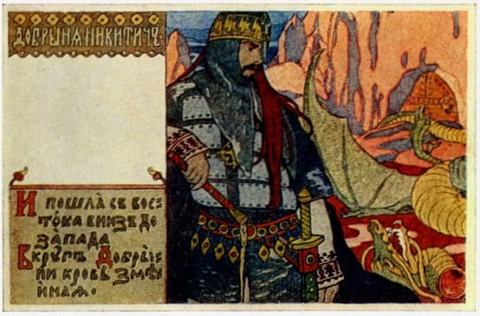
The courtly bogatyr of Kyivan byliny who slew the dragon Zmey Gorynych, outwitted a sorceress, and returned home from a false report of his death.
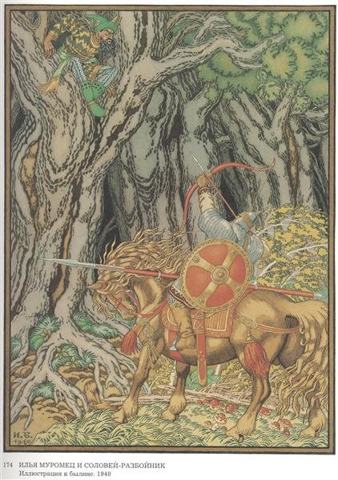
The paralysed peasant's son of Murom who rose from the stove to become Russia's greatest epic hero, and shot down the monstrous Nightingale the Robber.
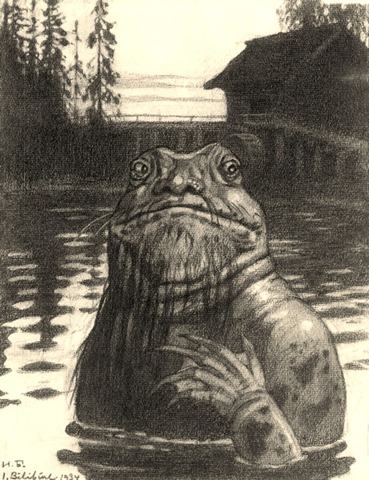
The bearded, shapeshifting master of Slavic rivers and millponds, placated by millers and fishermen and blamed for every drowning in his water.
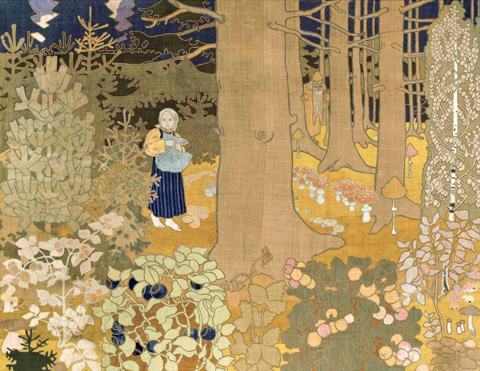
The Slavic forest lord who leads travellers in circles, owns the wolves and the game, and can stand taller than the pines or shorter than the grass.
Slavic water spirit of the restless dead: a drowned or unbaptised girl who leaves the river for one week each summer to walk the fields and the woods.
The glowing bird of Russian wonder tale whose single stolen feather starts a fatal quest — first collected by Afanasyev, later Stravinsky's ballet subject.
Sources & Further Reading
- 1."Sadko," bylina, in Bailey, James & Tatyana Ivanova, trans. An Anthology of Russian Folk Epics. M.E. Sharpe, 1998.
- 2.Hapgood, Isabel Florence. The Epic Songs of Russia. Charles Scribner's Sons, 1886.
- 3.Chadwick, N. Kershaw, trans. and ed. Russian Heroic Poetry. Cambridge University Press, 1932.
- 4.Cross, Samuel Hazzard & Olgerd P. Sherbowitz-Wetzor, trans. The Russian Primary Chronicle: Laurentian Text. Medieval Academy of America, 1953.
- 5.Rybnikov, P. N., ed. Pesni, sobrannye P. N. Rybnikovym (Songs Collected by P. N. Rybnikov). 4 vols. Moscow/Petrozavodsk, 1861-1867.
- 6.Dixon-Kennedy, Mike. Encyclopedia of Russian and Slavic Myth and Legend. ABC-CLIO, 1998.
- 7.Warner, Elizabeth. Russian Myths. British Museum Press, 2002.
Spot an error or have a source to suggest? Write to info@viseterna.com. We cite primary sources and modern scholarship, and we correct fast.